
Great Bittern
Botaurus stellaris
Order: Pelecaniformes / Family: Ardeidae
Wikimedia Commons
About the Great Bittern
The Great Bittern, Botaurus stellaris, is a large, cryptically colored wading bird in the heron family, Ardeidae. This elusive bird is primarily found in dense reed beds across Europe and Asia, making it a quintessential species of wetland ecosystems. It plays a vital role in maintaining the health of these habitats, preying on a variety of aquatic organisms that helps balance the food web. Great Bitterns are notoriously difficult to spot due to their streaky brown plumage, which offers exceptional camouflage among the reeds. However, their characteristic booming call, often described as a far-carrying foghorn-like sound, serves as a reliable auditory marker of their presence during the breeding season.
Great Bitterns are significant bioindicators of wetland health. Their presence or absence can provide insights into the ecological conditions of these habitats. In the UK, the species once faced severe declines due to habitat loss. However, concerted conservation efforts have led to a significant recovery, demonstrating the species' resilience and the importance of targeted habitat restoration. In continental Europe, the bird is widely distributed, with key populations in countries like France, Poland, and the Netherlands. In Asia, it is found in a more fragmented distribution, favoring similar wetland habitats.
Seasonal behaviors of the Great Bittern include migratory movements in northern populations. These birds travel to milder climates in southern Europe and parts of Africa during the winter months. Conversely, southern populations tend to be more sedentary, remaining within their breeding territories year-round. The Great Bittern's ecological role extends beyond its immediate habitat, as it serves as prey for larger birds of prey and mammals, thus contributing to the broader ecological community.
The Great Bittern belongs to the family Ardeidae, within the order Pelecaniformes. These birds typically live average 10-15 years.
How to Identify a Great Bittern
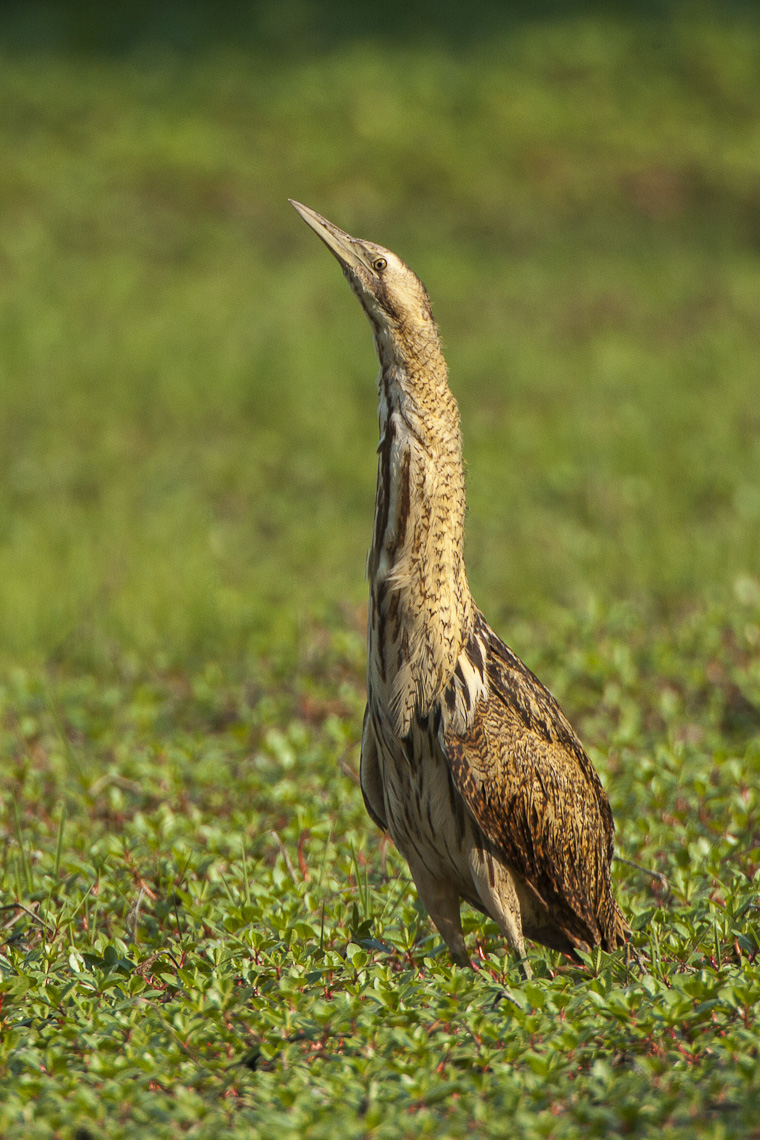
Identifying the Great Bittern can be challenging due to its cryptic plumage, which is a blend of streaky browns, tans, and blacks that mimic the appearance of dried reeds. Adults typically measure 69-81 cm in length with a wingspan of 100-130 cm, making them large wading birds. One of the bird's distinctive features is its thick neck, which it often extends in a characteristic posture resembling a spear. This posture aids in its camouflage when it feels threatened.
There is little sexual dimorphism in the Great Bittern, meaning males and females look quite similar, though males are generally slightly larger. Juvenile Bitterns resemble adults but tend to have more uniformly colored plumage with less distinct streaking. In flight, the Great Bittern exhibits broad wings with rounded tips and a steady, deliberate wingbeat that can be recognized by experienced birders.
Similar species that may cause confusion include the American Bittern and the Eurasian Bittern, though the Great Bittern is larger and has a more pronounced black streaking pattern on its upperparts. Observers often rely on the bird's unique vocalizations, particularly during the breeding season, to differentiate it from other waders.
Having trouble telling birds apart? Upload a photo to our bird identification tool for an instant species match.
Great Bittern Habitat and Range
Preferred Habitat
The Great Bittern primarily inhabits extensive reed beds (Phragmites australis) and other marshy areas rich in dense vegetation. These habitats provide the cover and food resources necessary for their survival. The bird prefers lowland wetlands at elevations up to 500 meters but can occasionally be found at higher altitudes. Seasonal habitat shifts occur as northern populations move to more temperate wetlands during winter.
In rural settings, Great Bitterns thrive in large, undisturbed marshes. Urban encroachment poses a threat, though well-managed reserves offer sanctuary. The bird's preference for large reed beds means it is less common in urban areas, except where suitable habitat patches exist. Habitat management efforts focus on maintaining water levels and reed health to support this species.
Geographic Range
The Great Bittern's range spans across Europe and Asia, with breeding populations in countries such as the UK, France, Germany, and Poland. In Asia, they breed in parts of Russia, China, and Mongolia. During winter, northern populations migrate southward to regions including southern Europe, northern Africa, and parts of the Middle East.
Migration corridors are vital for the Great Bittern, with key stopover sites providing necessary resources during their journeys. Population density hotspots include the expansive reed beds of the Netherlands and the Danube Delta, where conservation organizations focus efforts due to the high concentration of breeding pairs.
In the UK, the East Anglian Fens represent a significant stronghold for the species, thanks to successful habitat restoration projects. In contrast, the bird's presence is more scattered in southern Europe, with smaller, localized populations benefiting from protected wetland reserves.
Want to know which birds visit your area? Browse our backyard birds by location guides for region-specific species lists.
What Does the Great Bittern Eat?
The Great Bittern's diet primarily consists of fish, amphibians, and invertebrates, reflecting its role as a top predator in wetland ecosystems. Fish, such as eels and small carp, form the bulk of their diet, supplemented by frogs, insects, and crustaceans. Seasonal diet changes occur as prey availability fluctuates, with more amphibians consumed in spring and fish dominating in winter.
Foraging techniques are specialized. The Great Bittern employs a stealthy approach, using slow, deliberate movements to stalk prey. It often stands motionless or moves with a slow, creeping gait, striking with lightning speed when prey is within reach. Prey size varies, but the bird typically targets organisms small enough to swallow whole.
Feeding occurs primarily during dawn and dusk, aligning with peak activity periods of many prey species. This crepuscular feeding schedule minimizes competition with diurnal predators and reduces exposure to potential threats.
Great Bittern Behavior and Social Structure
Great Bitterns exhibit solitary behaviors, especially outside the breeding season. Males become territorial during spring, establishing and defending their breeding grounds with their powerful booming calls. These vocal displays serve both to attract mates and deter rival males, resonating across the reed beds.
Courtship involves elaborate displays, with males often engaging in neck-stretching postures and wing-flapping to impress females. Once paired, the birds remain together only for the duration of the breeding season. Outside this period, Great Bitterns are generally solitary, though they may be seen in loose aggregations in areas of high prey abundance.
Their response to predators includes remaining motionless, using their cryptic plumage for camouflage. When threatened, they adopt a 'bitterning' posture, stretching their necks upward to blend in with surrounding reeds. Daily activity peaks during dawn and dusk, with the birds often resting or remaining hidden during the day to avoid detection.
Great Bittern Nesting and Reproduction
The Great Bittern's nesting process is closely tied to its habitat preferences. Nests are typically constructed in dense reed beds, surrounded by water to protect against predators. The nest itself is a platform made of reeds and other aquatic vegetation, providing a stable base for the eggs.
Clutch size ranges from four to six eggs, with incubation lasting about 25-26 days. Females primarily handle incubation duties, while males focus on territory defense and occasionally providing food. The fledging timeline extends to approximately 50-55 days, during which the female continues to feed and care for the young.
The Great Bittern typically raises one brood per year, though in optimal conditions, a second brood may occur. Parental roles are clearly defined, with the female tending to the young while the male's booming calls continue to assert territorial dominance.
Great Bittern Sounds and Vocalizations
The Great Bittern's primary song is its iconic booming call, a resonant, low-frequency sound that carries over considerable distances. This call, produced mainly by males during the breeding season, consists of a series of three to four deep, foghorn-like notes. The rhythm is slow, with each note separated by a few seconds, creating an eerie, haunting atmosphere in the marshes.
In addition to the booming call, Great Bitterns produce various croaks and grunts as part of their communication repertoire. Alarm calls are harsh and guttural, alerting others to potential threats. The dawn chorus of a reed bed featuring booming Bitterns is an unforgettable auditory experience for any birder.
Interesting Facts About the Great Bittern
- 1The Great Bittern's booming call can be heard up to 5 kilometers away, aiding in territory establishment.
- 2Great Bitterns can consume prey up to 30% of their body weight, demonstrating their adaptability as predators.
- 3Their camouflage is so effective that even when alarmed, Bitterns freeze in place, becoming nearly invisible.
- 4During courtship, males can inflate their esophagus, producing the characteristic booming sound unique to the species.
- 5The Great Bittern was once considered extinct in the UK, but conservation efforts have led to a remarkable comeback.
- 6A group of Bitterns is known as a 'Sedge', reflecting their preferred habitat among reeds.
- 7Great Bitterns can remain motionless for extended periods, a tactic that aids them in ambushing prey efficiently.
Great Bittern Conservation Status
The IUCN currently lists the Great Bittern as 'Least Concern', though it has faced significant conservation challenges in the past. Population trends vary regionally, with increases in areas where wetland restoration has been successful. Primary threats include habitat loss due to drainage and degradation of wetlands, pollution, and disturbance from human activities. Conservation efforts have focused on habitat protection and restoration, particularly in Europe where the bird has shown notable recovery. Wetland reserves and management practices, such as controlled water levels and reed bed maintenance, have proven effective in supporting population growth. Historical declines have been addressed through international cooperation, showcasing a positive model for species recovery.
Other Ardeidae Species


Birds Similar to the Great Bittern
These species are often confused with the Great Bittern due to similar appearance or overlapping range.
