
Great Bustard
Otis tarda
Order: Otidiformes / Family: Otididae
Wikimedia Commons
About the Great Bustard
The Great Bustard (Otis tarda) stands as one of the heaviest flying birds, with males reaching weights of up to 16 kg (35 lbs). These birds are remarkable not just for their size, but also for their display behaviors and striking sexual dimorphism. Native primarily to Europe and Asia, the Great Bustard inhabits open, rolling landscapes such as grasslands, steppes, and agricultural fields. They are particularly prevalent in central Spain, Hungary, and parts of Russia. These birds play a significant role in the ecosystems they inhabit by influencing vegetation structure and serving as prey for large predators.
Great Bustards are known for their elaborate mating displays, which are critical for their reproductive success. Males perform striking displays during the breeding season, puffing up their chest feathers, fanning their tails, and producing deep booming calls to attract females. This ritual can be observed from late March to early May, coinciding with the spring breeding season.
Ecologically, Great Bustards contribute to seed dispersal, particularly of grasses and herbs. They also help control insect populations, as invertebrates form a significant part of their diet. As the seasons change, so does their behavior. In winter, they may form larger flocks, sometimes comprising hundreds of individuals, to forage cooperatively and gain protection against predators.
The Great Bustard belongs to the family Otididae, within the order Otidiformes. These birds typically live average 10-15 years, with some individuals living over 20 years..
How to Identify a Great Bustard
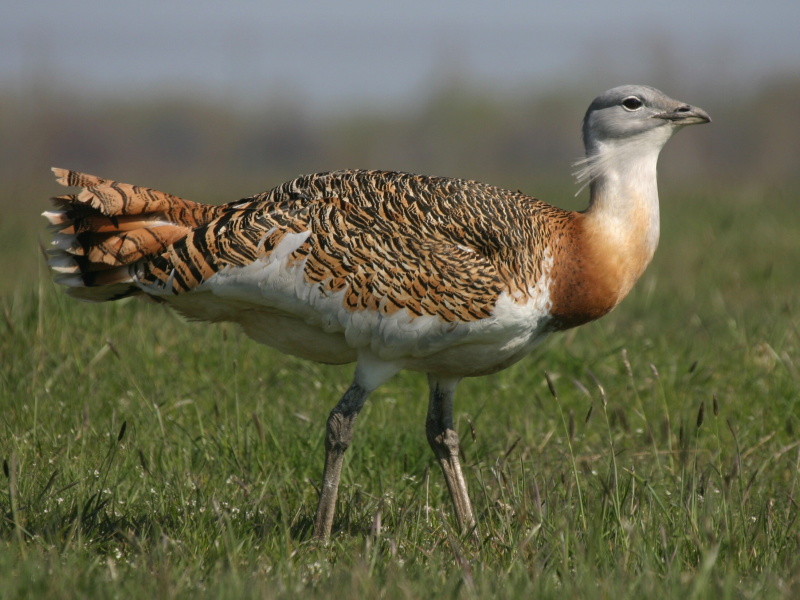
The Great Bustard is easily recognizable by its substantial size and distinctive plumage. Adult males have a predominantly grayish-brown body with a white belly and a strikingly thick neck, adorned with a distinctive ruff of white feathers during the breeding season. Their wings, when extended, reveal a stark white pattern with black flight feathers. In contrast, females are smaller and less conspicuous, with more subdued coloration lacking the ruff.
Juveniles resemble females but with more speckled patterns across the back and wings, making them slightly harder to identify at a distance. In flight, Great Bustards have a heavy, powerful appearance with broad wings and a relatively slow, deliberate wingbeat. Their necks are extended forward, and feet trail behind, contributing to a distinctive silhouette.
Though similar in size to some cranes, the Great Bustard's bulkier body and broader wings help distinguish it from other large birds. Unlike cranes, bustards do not feature a straight neck posture during flight, instead maintaining a more horizontal alignment.
Having trouble telling birds apart? Upload a photo to our bird identification tool for an instant species match.
Great Bustard Habitat and Range
Preferred Habitat
Great Bustards favor open habitats, primarily inhabiting grasslands, steppes, and agricultural fields. They thrive in areas where low vegetation offers both ample foraging opportunities and visibility to detect predators. Their preference for flat or gently undulating terrain makes regions like the Spanish steppes and the Hungarian plains ideal.
In terms of elevation, Great Bustards are generally found from sea level up to about 1,000 meters, depending on the availability of suitable open landscapes. Seasonal shifts in habitat use occur mainly as a response to agricultural practices and climatic conditions. During the breeding season, they often select areas with less disturbance, moving to more open fields during winter to take advantage of stubble and fallow lands.
While primarily rural in their habitat choice, Great Bustards occasionally venture near urban fringes, especially where agricultural fields border city limits. However, they generally avoid densely populated or heavily wooded areas.
Geographic Range
The range of the Great Bustard spans across Europe and Asia, with key populations in Spain, Portugal, Hungary, and Russia. In Spain, they are more concentrated in the central and western regions, notably in Castilla-La Mancha and Extremadura. In Hungary, the Hortobágy National Park is a significant stronghold for these birds.
During the breeding season, most Great Bustards are found in these areas, where vast open spaces support their nesting and display activities. As autumn approaches, some populations undertake short migrations to find more favorable foraging grounds. This seasonal movement is more pronounced in northern ranges, such as Russia, where harsh winters necessitate migration to milder regions.
In winter, some populations remain resident, while others move to southern Europe. As a result, countries like Turkey and southern Russia become important wintering grounds. Their presence in various countries is often tied to specific agricultural practices that influence habitat availability and quality.
Want to know which birds visit your area? Browse our backyard birds by location guides for region-specific species lists.
What Does the Great Bustard Eat?
The Great Bustard's diet is omnivorous, consisting of a mix of plant and animal matter. In spring and summer, their diet focuses heavily on plant material, including seeds, leaves, and flowers of various grasses and herbs. They also consume significant quantities of insects, especially beetles and grasshoppers, which provide essential protein during the breeding season.
As autumn arrives, Great Bustards shift their diet to include more cultivated grains, such as wheat and barley, taking advantage of post-harvest remains in agricultural fields. This adaptability in their diet helps them survive in diverse habitats and conditions.
Their foraging technique involves slow, deliberate walks through the fields, occasionally pausing to peck at vegetation or capture insects. While they forage primarily during daylight hours, early morning and late afternoon are peak times for feeding activity.
Great Bustard Behavior and Social Structure
Great Bustards exhibit fascinating behavioral patterns, especially evident in their complex social structures and mating rituals. Males are generally solitary outside the breeding season but come together in spring to display in leks. These leks are arenas where males perform their elaborate courtship displays, puffing up their plumage and emitting deep vocalizations to attract females.
Females, on the other hand, form small groups, particularly during non-breeding seasons, and often forage together. This social structure offers increased protection against predators, as group vigilance helps in early predator detection. During breeding, however, females become more secretive, nesting alone to avoid drawing attention to their eggs and chicks.
The response of Great Bustards to predators includes a combination of vigilance and flight. They prefer open landscapes where they can see threats from afar, taking to the air if necessary. Daily activities are typically diurnal, with peak activity occurring during the cooler parts of the day.
Great Bustard Nesting and Reproduction
Great Bustards nest on the ground, selecting sites with low vegetation to conceal their nests from potential predators. The nesting process begins in late April to early May, with females choosing well-hidden spots within open grasslands or fallow fields.
The nest itself is a simple scrape in the ground, occasionally lined with grass and feathers to provide some insulation. Clutch size typically ranges from two to three eggs, with incubation carried out solely by the female. The incubation period lasts approximately 21 to 28 days.
Once hatched, chicks remain with the mother, who takes on full responsibility for their care and protection. The fledging period is about 30 to 35 days, during which the female must balance feeding her young and defending them from predators. Generally, Great Bustards have one brood per year, although favorable conditions may lead to occasional attempts at a second.
Great Bustard Sounds and Vocalizations
The primary sound associated with the Great Bustard is the male's booming call, which is a deep, resonant sound used during display to attract females. This call can carry over long distances, especially in open landscapes.
Aside from the booming displays, Great Bustards are relatively quiet birds. They use soft grunts and whistles for communication within flocks or between a mother and her chicks. Alarm calls are more abrupt and serve as warnings of imminent danger, prompting immediate flight.
Unlike songbirds, Great Bustards do not participate in a dawn chorus. Their vocalizations are mostly limited to the breeding season, with little need for sound communication during the rest of the year.
Interesting Facts About the Great Bustard
- 1The Great Bustard is one of the heaviest flying birds, with males weighing up to 16 kg (35 lbs).
- 2During courtship, a male Great Bustard can display for up to several hours a day to attract females.
- 3Great Bustards have impressive wingspans, reaching up to 2.4 meters (7.9 feet) in length.
- 4Despite their size, Great Bustards are capable of reaching flight speeds of up to 60 km/h (37 mph).
- 5Great Bustards have been recorded traveling over 3,000 kilometers during seasonal migrations.
- 6The species' elaborate mating rituals are believed to have inspired cultural dances and traditions.
- 7Some Great Bustard populations are non-migratory, adapting to local conditions year-round.
Great Bustard Conservation Status
The Great Bustard is currently listed as Vulnerable on the IUCN Red List, with populations experiencing a general decline. Habitat loss and fragmentation, largely due to agricultural intensification and land conversion, are the primary threats. Conservation efforts focus on habitat protection and restoration, including the establishment of protected areas and the promotion of traditional farming practices that benefit these birds. In several countries, reintroduction programs and captive breeding efforts aim to bolster populations. Historically, the Great Bustard's range and numbers have significantly declined, particularly in Western Europe. However, there have been some successes, with stable or increasing populations in protected regions of Spain and Hungary, highlighting the importance of targeted conservation strategies.


