Green Shrike-Babbler
Pteruthius xanthochlorus
Order: Passeriformes / Family: Vireonidae

Wikimedia Commons
About the Green Shrike-Babbler
The Green Shrike-Babbler, scientifically known as Pteruthius xanthochlorus, is a small, vibrant bird belonging to the family Vireonidae. Renowned for its striking green plumage and distinctive song, this bird inhabits the forested regions of the Himalayas, extending through countries such as Nepal, Bhutan, northern India, and into parts of Southeast Asia. As a member of the passerine order, it plays a significant role in the ecosystem, primarily as an insectivore, helping to control insect populations in its habitat.
This bird thrives in mixed montane forests and subtropical or tropical moist lowland forests, where it often occupies the mid-canopy layer. The Green Shrike-Babbler's presence is indicative of healthy, undisturbed forest environments. Its role extends beyond mere insect control; it also participates in seed dispersal, though to a lesser extent than frugivorous species, by occasionally consuming small fruits. This ecological niche underscores its importance in maintaining the balance of these biodiverse areas.
During the breeding season, which coincides with the onset of the monsoon in its native range, the Green Shrike-Babbler becomes more vocal and territorial. The males engage in displaying behaviors to attract mates, often perched conspicuously on branches while delivering their melodious songs. Outside the breeding season, these birds are known to join mixed-species foraging flocks, a strategy that enhances feeding efficiency and predator vigilance. The Green Shrike-Babbler's seasonal behaviors reflect its adaptation to the cyclical nature of its environment, responding dynamically to changes in weather, food availability, and habitat conditions.
The Green Shrike-Babbler belongs to the family Vireonidae, within the order Passeriformes. These birds typically live average 5-8 years with a maximum recorded of 10 years..
How to Identify a Green Shrike-Babbler
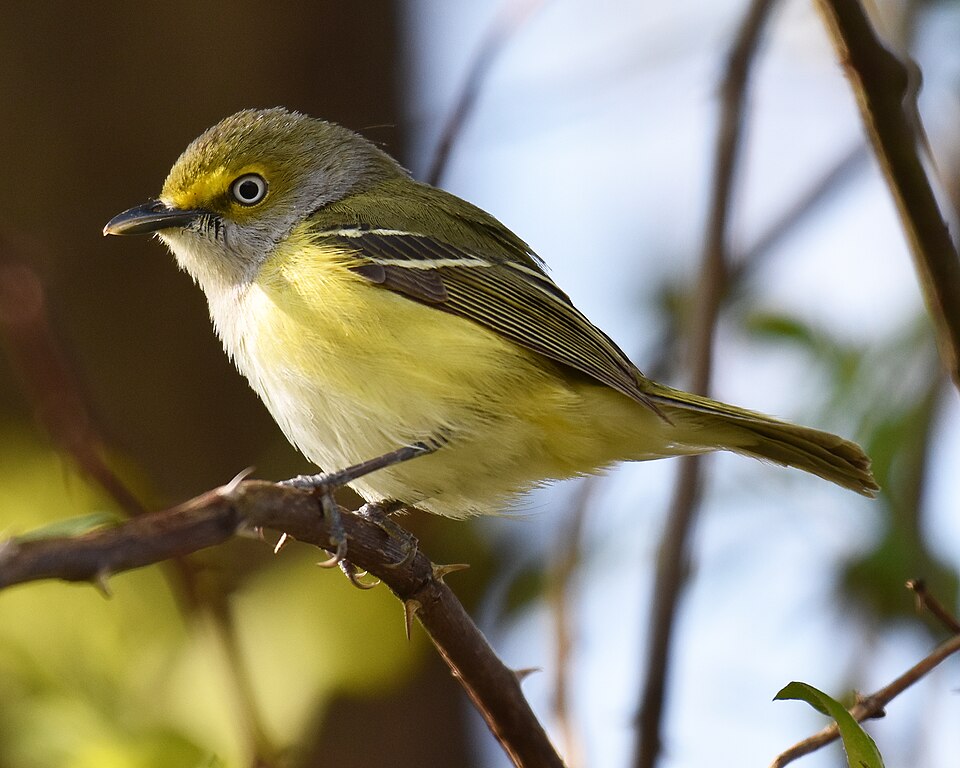
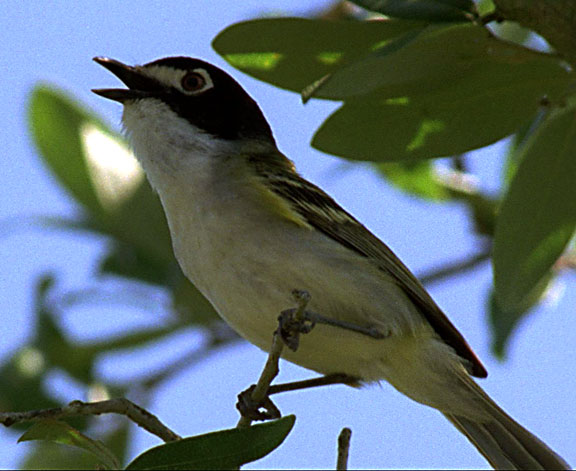
The Green Shrike-Babbler is easily identified by its vibrant green upperparts, contrasting sharply with its white underparts. The bird measures about 13 to 15 cm in length, making it a small member of its family. Males and females exhibit slight sexual dimorphism; males typically display a more vivid green plumage and a subtle yellow wash on the throat and sides, whereas females may appear slightly duller. Juveniles resemble females but with more muted colors, lacking the brighter hues of adults.
The bird's thick, hooked bill is adapted for its insectivorous diet, allowing it to deftly handle a variety of prey. Its eye-catching white eye-ring and wing-bars provide additional identification points, especially when observed at a distance. In flight, the Green Shrike-Babbler shows a distinctive silhouette, with broad, rounded wings and a slightly fanned tail, characteristics that help differentiate it from similar species.
When perched, the bird holds a slightly upright posture, often tilting its head inquisitively. This posture, combined with its vivid coloration, makes it a conspicuous presence in its forest habitat. While it may be confused with other greenish forest birds, the combination of its unique markings and vocalizations aids in accurate identification.
Having trouble telling birds apart? Upload a photo to our bird identification tool for an instant species match.
Green Shrike-Babbler Habitat and Range
Preferred Habitat
The Green Shrike-Babbler predominantly inhabits the montane forests of the Himalayan region. It prefers elevations ranging from 1,500 to 3,000 meters, where the forest is dense and diverse. These habitats include subtropical or tropical moist lowland forests and montane forests, often characterized by a rich understory and a canopy of mixed broadleaf and coniferous trees.
In regions like Nepal and Bhutan, the bird is frequently found in rhododendron and oak forests, which provide ample food and nesting opportunities. The Green Shrike-Babbler tends to avoid urban areas, maintaining a presence in more pristine, undisturbed environments. However, it can adapt to secondary forests if the conditions are suitable.
Seasonally, there may be slight altitudinal movements, particularly in response to severe weather conditions or changes in food availability. These shifts are typically minimal, as the bird relies heavily on the stable environment provided by its montane forest habitat year-round.
Geographic Range
The Green Shrike-Babbler occupies a range that encompasses several countries across the Himalayan region and parts of Southeast Asia. It breeds and resides primarily in northern India, Nepal, and Bhutan, extending into southern China, including Yunnan and Sichuan provinces. Its range also touches northern Myanmar and parts of northern Thailand.
The bird's presence is most concentrated in the mid to high-elevation montane forests, where populations are generally stable and relatively widespread. Unlike many passerines, the Green Shrike-Babbler does not undertake long migratory journeys, opting instead for more localized altitudinal movements as necessary.
Within its range, the bird's population density is highest in undisturbed forest areas, where it can find abundant food and suitable nesting sites. These regions include well-preserved national parks and wildlife sanctuaries, which offer critical refuges from habitat degradation elsewhere.
Want to know which birds visit your area? Browse our backyard birds by location guides for region-specific species lists.
What Does the Green Shrike-Babbler Eat?
The diet of the Green Shrike-Babbler primarily consists of insects and other small invertebrates. It actively forages in the mid-canopy layer, using its strong, hooked bill to glean insects from foliage and bark. This bird shows a preference for caterpillars, beetles, and a variety of larvae, which constitute the bulk of its diet during the breeding season when protein demands are high.
In addition to insects, the Green Shrike-Babbler occasionally supplements its diet with small fruits and seeds, particularly outside the breeding season when insect availability decreases. This opportunistic feeding strategy allows it to exploit a range of food sources throughout the year.
Its foraging behavior is active and methodical, often involving short flights between branches as it searches for prey. The bird typically feeds in the early morning and late afternoon, coinciding with peak insect activity. Its role as an insectivore not only supports its nutritional needs but also aids in controlling pest populations within its habitat.
Green Shrike-Babbler Behavior and Social Structure
The Green Shrike-Babbler exhibits a range of fascinating behaviors, particularly during the breeding season. Males become highly vocal and territorial, using their melodious songs to both attract mates and ward off rivals. Courtship displays often involve males perching prominently and singing, sometimes engaging in aerial displays to demonstrate their fitness.
Socially, these birds are generally found in pairs during the breeding season, but they become more gregarious outside of it. They frequently join mixed-species foraging flocks, a behavior that enhances their ability to locate food resources while reducing the risk of predation. Within these flocks, the Green Shrike-Babbler often takes on a leadership role, guiding the movement through the forest.
In response to predators, this bird relies on its cryptic coloration and the dense foliage of its habitat for cover. When threatened, it may emit alarm calls to alert other birds in the vicinity. Daily activity patterns show peaks during the cooler morning and late afternoon hours, with periods of rest during the hottest part of the day.
Green Shrike-Babbler Nesting and Reproduction
The nesting habits of the Green Shrike-Babbler are closely tied to the monsoon season, which provides the necessary resources for raising young. Nests are typically constructed in dense shrubbery or small trees, often at heights ranging from 1 to 4 meters off the ground. The nest is cup-shaped, meticulously woven from grass, leaves, and spider silk, providing both camouflage and structural integrity.
A typical clutch consists of 2 to 4 eggs, with both parents sharing the responsibilities of incubation, which lasts approximately 14 to 16 days. After hatching, the young are altricial and require constant feeding and care from both parents. Fledging occurs about 12 to 15 days post-hatching, but the fledglings remain dependent on their parents for several weeks thereafter.
The Green Shrike-Babbler usually raises one brood per year, although in optimal conditions, a second brood may be attempted. This reproductive strategy reflects the bird's adaptation to the seasonal abundance of food and the need to maximize reproductive success during favorable conditions.
Green Shrike-Babbler Sounds and Vocalizations
The primary song of the Green Shrike-Babbler is a clear, melodious series of whistled notes, often described as a 'tsee-tsee-tsee-tsoo' pattern. The rhythm is steady, with each note delivered in quick succession. This song serves multiple functions, including mate attraction and territory defense.
In addition to its song, the bird produces a variety of call notes, including sharp 'chip' sounds used for communication between mates or within mixed-species flocks. Alarm calls are harsher and more urgent, intended to alert others to the presence of predators.
During the dawn chorus, the Green Shrike-Babbler's song stands out with its clarity and musicality, often one of the first heard in its habitat. Its vocalizations play a crucial role in its social interactions and survival strategies, enabling it to maintain territory and coordinate activities with others.
Interesting Facts About the Green Shrike-Babbler
- 1The Green Shrike-Babbler has a unique foraging style, often seen hanging upside-down like a nuthatch to reach insects.
- 2Despite its vibrant plumage, the Green Shrike-Babbler can be surprisingly elusive, blending seamlessly with the forest canopy.
- 3This bird is a member of the family Vireonidae, which includes over 60 species known for their complex vocalizations.
- 4The Green Shrike-Babbler is a vital part of mixed-species flocks, contributing to the overall success of these cooperative groups.
- 5During courtship, the male Green Shrike-Babbler performs aerial displays, showcasing his agility and strength to potential mates.
- 6The species is non-migratory, but it may move to lower elevations during particularly harsh winters.
- 7Its cup-shaped nest is a marvel of avian architecture, often using spider silk for additional strength and flexibility.
Green Shrike-Babbler Conservation Status
The Green Shrike-Babbler currently holds a status of Least Concern according to the IUCN, with populations considered stable across its range. However, habitat loss due to deforestation poses a potential threat, particularly in regions where forest clearance for agriculture and human settlement is prevalent. Conservation efforts focus on preserving the bird's montane forest habitats through the establishment of protected areas and sustainable land-use practices. Historical population data suggest that while some local declines have occurred, the overall population remains robust. Continued monitoring and habitat protection are essential to ensure the long-term survival of the Green Shrike-Babbler, especially as human activities continue to encroach upon its natural environment.