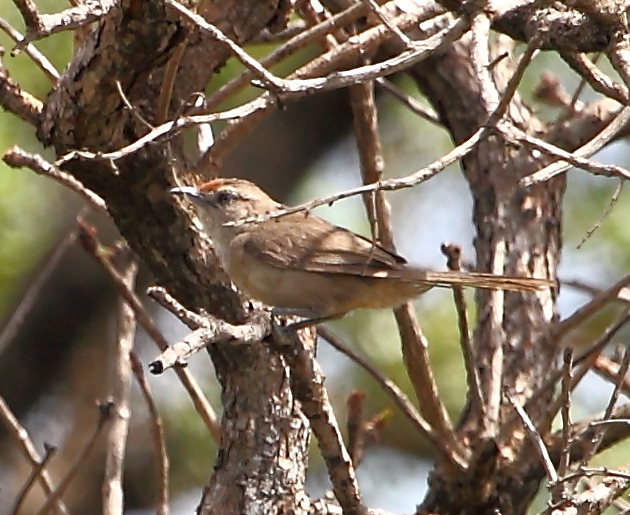
Itatiaia Spinetail
Oreophylax moreirae
Order: Passeriformes / Family: Furnariidae

Wikimedia Commons
About the Itatiaia Spinetail
The Itatiaia Spinetail (Oreophylax moreirae), a small bird of the Furnariidae family, is endemic to the montane forests of southeastern Brazil, particularly within the Itatiaia National Park. These birds play a vital ecological role as both insectivores and seed dispersers, contributing significantly to the health of their forest habitats. Typically found at elevations ranging from 1,500 to 2,000 meters, they prefer regions dense with shrubs and bamboo, where they can forage efficiently. Their presence in the Atlantic Forest biome highlights their significance in this biodiversity hotspot, known for its high level of endemism and the challenges it faces from deforestation.
The Itatiaia Spinetail's seasonal behaviors reflect its adaptation to its unique environment. During the breeding season, which aligns with the austral spring and summer months, these birds engage in more conspicuous displays of territoriality and vocalization. These activities are crucial for mating success and territory establishment. Outside the breeding season, the Itatiaia Spinetail tends to exhibit more subdued behavior, focusing on foraging and maintaining its territory. Their adaptability to the montane climates of southeastern Brazil underscores their resilience, although they remain sensitive to large-scale habitat alterations.
Ecologically, the Itatiaia Spinetail serves as an indicator species for the health of its montane forest habitat. Their reliance on specific plant species for nesting and foraging makes them particularly susceptible to changes in forest composition due to logging or climate change. Conservation efforts aimed at preserving their habitat not only benefit the Itatiaia Spinetail but also ensure the survival of countless other species sharing the ecosystem. Thus, understanding and protecting this bird is integral to broader conservation strategies within the region. As a species thriving in a delicate balance with its environment, the Itatiaia Spinetail reflects the intricate connections between avian life and forest ecosystems.
The Itatiaia Spinetail belongs to the family Furnariidae, within the order Passeriformes. These birds typically live 5 years with a maximum recorded of 8 years..
How to Identify a Itatiaia Spinetail
The Itatiaia Spinetail is easily identifiable by its reddish-brown upperparts and contrasting paler underparts. The bird's plumage provides excellent camouflage among the dense forest foliage. Its tail feathers are long and pointed, a characteristic feature of spinetails. Adults have a subtle grayish wash on the throat, which distinguishes them from juveniles.
Juveniles typically display duller coloration, lacking the distinct gray throat of adults. Male and female Itatiaia Spinetails show little sexual dimorphism, making visual sex differentiation challenging. Observers rely more on behavioral cues during the breeding season to distinguish between the sexes.
Their flight silhouette features a slightly rounded wing and a prominently long tail. While perched, they maintain an upright posture, often flicking their tails as they move through foliage. The Itatiaia Spinetail could be confused with other members of the Furnariidae family, but its specific coloration and habitat preference aid in proper identification.
Having trouble telling birds apart? Upload a photo to our bird identification tool for an instant species match.
Itatiaia Spinetail Habitat and Range
Preferred Habitat
The Itatiaia Spinetail inhabits high-altitude montane forests in southeastern Brazil, particularly within the Atlantic Forest biome. These regions provide dense vegetation, including shrubs and bamboo, which are essential for their foraging and nesting needs. Elevation ranges from 1,500 to 2,000 meters, with the bird exhibiting a preference for undisturbed forest areas.
While predominantly found in rural and protected areas like Itatiaia National Park, they occasionally venture into nearby semi-urban regions if suitable vegetation is present. Seasonal habitat shifts are minimal, as the bird remains largely sedentary year-round, relying on consistent food availability within its established territory.
Geographic Range
The Itatiaia Spinetail's range is restricted to southeastern Brazil, with populations concentrated in regions such as the Itatiaia National Park and surrounding montane forests. This localized distribution underscores their status as a geographically restricted species.
They do not undertake long-distance migrations but may exhibit minor altitudinal movements in response to climatic conditions or food availability. Population density hotspots align with areas of intact montane forest, where they benefit from limited human disturbance.
Conservation of these specific areas is crucial for maintaining the Itatiaia Spinetail's population, as habitat fragmentation poses a significant threat. Their presence in these biodiverse regions highlights the importance of targeted conservation efforts to protect this and other endemic species.
Want to know which birds visit your area? Browse our backyard birds by location guides for region-specific species lists.
What Does the Itatiaia Spinetail Eat?
The Itatiaia Spinetail primarily feeds on insects and other small invertebrates found within the dense foliage of its montane forest habitat. The bird employs a gleaning foraging technique, meticulously picking prey from leaves and branches.
During different seasons, their diet may include seeds and small fruits, particularly when insect availability fluctuates with climatic changes. This dietary flexibility aids in their survival but also ties them closely to the health of their ecosystem.
Prey size typically ranges from small ants and beetles to larger caterpillars, with feeding occurring throughout the day. The Itatiaia Spinetail forages alone or in pairs, rarely forming large feeding flocks, which aligns with their territorial nature.
Itatiaia Spinetail Behavior and Social Structure
The Itatiaia Spinetail exhibits solitary or paired social structures, particularly during the breeding season when territorial behaviors intensify. Males engage in elaborate vocal displays to advertise their presence and attract mates, asserting dominance over their chosen territory.
Courtship involves mutual preening and synchronized movements, strengthening pair bonds. Nesting pairs remain close throughout the breeding season, defending their nests vigorously against intruders. The bird's daily activity pattern involves active foraging during cooler morning and late afternoon hours, with mid-day periods spent in resting or inconspicuous perching.
In response to predators, the Itatiaia Spinetail relies on its cryptic coloration and rapid, darting flight to evade detection. Alarm calls, short and sharp, serve to alert mates or nearby conspecifics of potential threats. These behavioral adaptations ensure their survival in the complex montane ecosystems they inhabit.
Itatiaia Spinetail Nesting and Reproduction
The Itatiaia Spinetail constructs a cup-shaped nest made from twigs, leaves, and moss, typically situated in dense vegetation or bamboo thickets. Nest placement is strategic, often hidden within the underbrush to protect against predators.
Clutch sizes range from two to three eggs, with an incubation period lasting approximately 16 days. Both male and female participate in incubation and subsequent chick-rearing, ensuring high parental investment in offspring survival.
Fledging occurs about 18 days post-hatching, with juveniles remaining under parental care for several weeks thereafter. The Itatiaia Spinetail generally raises one brood per year, with breeding concentrated during the austral spring and early summer months.
Itatiaia Spinetail Sounds and Vocalizations
The Itatiaia Spinetail's primary song consists of a series of rapid, high-pitched notes, often delivered in a rhythmic sequence. This song serves as both a territorial marker and a mating call during the breeding season.
Call notes are typically sharp and brief, used for communication between mates or to signal alarm. In the presence of threats, their alarm calls become more insistent, serving as a warning to nearby birds.
During dawn chorus, the Itatiaia Spinetail contributes its distinct song to the symphony of the forest, with its clear, piercing notes standing out among other avian voices.
Interesting Facts About the Itatiaia Spinetail
- 1The Itatiaia Spinetail is named after the Itatiaia National Park, highlighting its endemic status to this specific region.
- 2This bird's preferred habitat, the Atlantic Forest, is one of the most threatened ecosystems worldwide, with only 15% of its original cover remaining.
- 3Despite its small size, the Itatiaia Spinetail's song can be heard up to 100 meters away, making it a prominent feature of the forest soundscape.
- 4The bird's nesting strategy includes using thorny branches to deter predators, showcasing its adaptive nesting behavior.
- 5The Itatiaia Spinetail's diet varies with seasons, incorporating more fruits during periods of insect scarcity, demonstrating dietary flexibility.
- 6Itatiaia Spinetails rarely form large flocks, emphasizing their territorial and solitary nature, especially during breeding season.
- 7Their long tail feathers not only aid in balance and maneuverability but also play a role in communication during courtship displays.
Itatiaia Spinetail Conservation Status
The Itatiaia Spinetail currently holds a Near Threatened status on the IUCN Red List, with population trends showing a gradual decline. Habitat loss, primarily due to deforestation and land conversion for agriculture, poses the most significant threat. Conservation efforts focus on protecting remaining forest habitats within its range, with national parks like Itatiaia playing a crucial role. Historical population changes reflect the broader impacts of environmental degradation in the region. While ongoing conservation initiatives aim to stabilize populations, continued habitat protection and restoration are vital to ensure the long-term survival of the Itatiaia Spinetail.
Other Furnariidae Species


Birds Similar to the Itatiaia Spinetail
These species are often confused with the Itatiaia Spinetail due to similar appearance or overlapping range.