
Kakapo
Strigops habroptila
Order: Psittaciformes / Family: Psittacidae
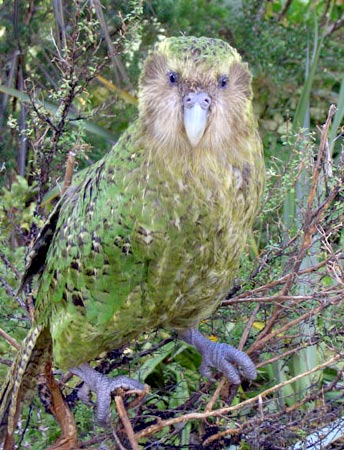
Wikimedia Commons
About the Kakapo
The Kakapo, scientifically named Strigops habroptila, holds a special place in the avian world as one of the few flightless parrots. Endemic to New Zealand, this unique bird is a symbol of both the country's natural heritage and the global conservation movement. Historically, the Kakapo inhabited a range of environments from coastal lowlands to mountainous regions across New Zealand's North and South Islands. Today, due to habitat destruction and introduced predators, it survives only on predator-free offshore islands such as Codfish Island (Whenua Hou) and Anchor Island. A marvel of evolution, the Kakapo is well-adapted to its nocturnal lifestyle with its cryptically colored feathers that blend seamlessly with the forest floor. This mossy green plumage, speckled with yellow and black, provides camouflage from predators, while its stocky build and short wings reflect its ground-dwelling habits. During the breeding season, male Kakapos perform a spectacular courtship display known as booming. They create a series of deep, resonant calls that can travel up to five kilometers in the still night air, attracting females from afar. Unlike most parrots, Kakapos are solitary and nocturnal, spending their days hidden in dense vegetation and feeding at night. They play a vital ecological role as seed dispersers, particularly of native New Zealand flora such as rimu and kahikatea. The Kakapo's seasonal behaviors are closely linked to the availability of these key food sources. Their breeding cycles are irregular and often coincide with the masting of certain plant species, especially the rimu tree, highlighting their intricate relationship with their environment. As a critically endangered species, the Kakapo's conservation has become a global priority. Efforts include intensive management programs involving habitat protection, breeding interventions, and predator control. The Kakapo Recovery Program has been instrumental in preventing their extinction, with the population now slowly increasing. Despite these efforts, the Kakapo remains one of the world's rarest birds, embodying the challenges and triumphs of wildlife conservation.
The Kakapo belongs to the family Psittacidae, within the order Psittaciformes. These birds typically live average 40-60 years with a maximum recorded of 90 years..
How to Identify a Kakapo
Adult Kakapos are easily identified by their robust build, round face, and owl-like facial disk that gives them a distinctive appearance. Their plumage is predominantly a mossy green with black and yellow barring, providing excellent camouflage against the forest floor. Males and females are similar in appearance, though males tend to be larger and heavier, weighing up to 3.5 kilograms, while females are slightly smaller. Juvenile Kakapos resemble adults but with a slightly duller plumage. Unlike many birds, the Kakapo lacks the strong flight muscles and keeled sternum necessary for flight. Instead, it has evolved to be a strong climber, using its wings for balance and control rather than lift. When perched, the Kakapo's posture is upright, often with its tail feathers spread for additional stability. While the Kakapo is unique in its flightlessness, it might sometimes be confused with other New Zealand parrots such as the Kaka or Kea. However, these species are adept fliers and have more vibrant coloration, making the Kakapo's muted hues and terrestrial habits reliable differentiators.
Having trouble telling birds apart? Upload a photo to our bird identification tool for an instant species match.
Kakapo Habitat and Range
Preferred Habitat
The Kakapo is primarily found in dense forests and shrublands, favoring areas with abundant cover and food sources. Historically, they occupied a variety of habitats across New Zealand, from coastal areas to alpine regions. Currently, they are restricted to predator-free offshore islands like Codfish Island and Anchor Island, where they inhabit temperate rainforest environments. These areas provide the necessary resources, such as native fruits and foliage, while offering protection from introduced predators. The Kakapo does not engage in seasonal migrations but may shift its territory slightly in response to food availability, particularly during breeding events tied to specific plant masting cycles.
Geographic Range
The Kakapo's historical range included the entirety of New Zealand's North and South Islands, where they thrived in diverse habitats from lowland forests to alpine environments. Today, their range is drastically limited to specific conservation areas on predator-free islands like Codfish Island, Anchor Island, and Little Barrier Island. These islands provide a safe haven where intensive conservation efforts can be focused. With a population of just over 200 individuals, the distribution is highly concentrated, making each inhabited location a critical stronghold for the species. There are no migration corridors as the Kakapo is flightless and non-migratory, relying entirely on these islands for their survival.
Want to know which birds visit your area? Browse our backyard birds by location guides for region-specific species lists.
What Does the Kakapo Eat?
The Kakapo's diet consists primarily of native plant material, with a particular emphasis on fruits, seeds, leaves, and bark. A significant portion of their diet includes the fruit of the rimu tree, which is crucial during breeding seasons. They also consume kahikatea, totara, and various other native species, demonstrating their adaptability within their habitat. Kakapos use their strong beaks to strip leaves and bark, and they are known for their methodical foraging behavior, often leaving behind evidence in the form of chewed vegetation. Unlike many other parrots, Kakapos feed primarily at night, aligning with their nocturnal nature. The size of the prey is limited to smaller insects and invertebrates, which they consume opportunistically.
Kakapo Behavior and Social Structure
Kakapos exhibit a range of intriguing behaviors due to their unique evolutionary history. Primarily nocturnal, they are solitary in nature, with individuals maintaining separate territories. During the breeding season, males gather at traditional display areas called leks, where they engage in elaborate courtship rituals. The males create bowl-shaped depressions in the ground and emit booming calls, which can be heard up to five kilometers away, to attract females. This lekking behavior is rare among parrots and highlights the Kakapo's unique reproductive strategy. The species shows limited social interaction outside of breeding, with individuals leading largely solitary lives. When faced with predators, Kakapos rely on their camouflage and remain motionless to avoid detection. Despite being flightless, they are agile climbers, using trees as vantage points to survey their surroundings. Their daily activity patterns are largely governed by their nocturnal habits, foraging and moving primarily under the cover of darkness.
Kakapo Nesting and Reproduction
Kakapos have a unique approach to nesting compared to many other parrots. Females select secluded sites on the ground, often under the cover of dense vegetation or in natural cavities, to build their nests. They use available materials such as leaves, moss, and twigs to create a comfortable nesting area. The typical clutch size ranges from one to four eggs, with the female solely responsible for incubation, which lasts about 30 days. After hatching, the chicks remain in the nest for up to 12 weeks before fledging. During this time, the female must balance foraging with caring for her young, as males do not participate in rearing the chicks. Kakapos have infrequent breeding cycles, often dictated by the masting of key plant species, and may breed only every two to four years.
Kakapo Sounds and Vocalizations
The Kakapo's vocalizations are diverse, with their most famous being the male's booming call during the breeding season. This sound has a low-frequency, resonant quality, often likened to a distant foghorn, and serves to draw females to the lekking area. In addition to booming, males produce chinging calls, which are higher-pitched and serve as an additional attractant for females. Outside of the breeding season, Kakapos use a variety of soft grunts and squawks for communication, often during foraging. Alarm calls are less common, as the Kakapo relies more on its camouflage and stealth to evade predators.
Interesting Facts About the Kakapo
- 1The Kakapo is the world's heaviest parrot, with males weighing up to 3.5 kilograms.
- 2Kakapos can live for over 90 years, making them one of the longest-living bird species.
- 3Each male Kakapo creates its own lek, a bowl-shaped depression, for its booming displays.
- 4Kakapos are known for their pleasant, musky odor, which is unique among parrots.
- 5The Kakapo's booming call can be heard up to five kilometers away on a quiet night.
- 6Their breeding cycle is closely tied to the masting of rimu trees, occurring every two to four years.
- 7Kakapos were once widespread throughout New Zealand, but are now restricted to predator-free islands.
Kakapo Conservation Status
The Kakapo is listed as Critically Endangered on the IUCN Red List, with a population of just over 200 individuals. The primary threats to their survival have historically been introduced predators such as rats, stoats, and cats, which have decimated populations on the mainland. Massive conservation efforts have been made since the 1990s, focusing on predator control, habitat protection, and intensive management of breeding programs. The Kakapo Recovery Program has been pivotal, employing techniques such as supplementary feeding and artificial incubation to increase chick survival rates. While the population trend is cautiously increasing, the species remains vulnerable, with ongoing efforts required to ensure its long-term survival.
Other Psittacidae Species


Birds Similar to the Kakapo
These species are often confused with the Kakapo due to similar appearance or overlapping range.
