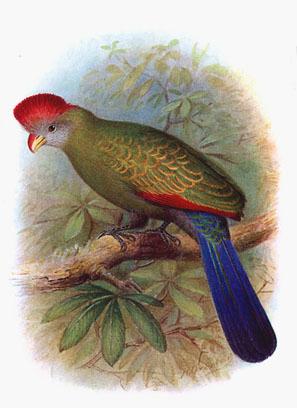
Knysna Turaco
Tauraco corythaix
Order: Musophagiformes / Family: Musophagidae

Wikimedia Commons
About the Knysna Turaco
The Knysna Turaco (Tauraco corythaix) stands as a vibrant emblem of the dense, moist forests along Africa's eastern coastline, particularly flourishing in the subtropical regions of South Africa. Known for its striking appearance, the Knysna Turaco is more than just a visual delight; it plays a crucial ecological role within its habitat. This bird is one of the most visually captivating members of the Musophagidae family, which includes other turacos and plantain-eaters. Its presence is most pronounced in the coastal forest ecosystems, where its vivid plumage contributes to a unique blend of avian biodiversity that supports a rich tapestry of life. The Knysna Turaco's vibrant green plumage provides excellent camouflage among the leafy canopies of the forests, while its crimson flight feathers are revealed in a breathtaking display during flight. The bird is a vital seed disperser, facilitating the propagation of numerous plant species that constitute the backbone of its habitat. Its diet primarily consists of fruits, which it gleans from the mid and upper canopy levels, playing a pivotal role in seed dispersal and forest regeneration. In terms of seasonal behaviors, the Knysna Turaco remains largely sedentary, with no significant migratory patterns. However, it may undertake local movements in response to food availability or to avoid adverse weather conditions. The bird's breeding season is typically aligned with the region's rainy season, when food is abundant, ensuring the survival of its offspring. The ecological significance of the Knysna Turaco extends beyond its role as a seed disperser. It is part of a delicate balance of predator-prey dynamics that sustain the forest ecosystem. By preying on insects and small invertebrates, it helps regulate these populations, preventing any one species from dominating the ecosystem. In turn, the turaco itself serves as a prey species for larger birds of prey, mammals, and snakes, highlighting its integral role in the food web. The Knysna Turaco's presence is most commonly associated with the dense afromontane forests found along the Garden Route in South Africa, particularly in protected areas like the Knysna-Amatole montane forests. These forests, characterized by their high canopy cover and rich biodiversity, serve as an ideal habitat for this and many other endemic species. The turaco's preference for these environments underscores the importance of forest conservation efforts in the region, as habitat loss poses a significant threat to its survival.
The Knysna Turaco belongs to the family Musophagidae, within the order Musophagiformes. These birds typically live around 12 years in the wild..
How to Identify a Knysna Turaco
The Knysna Turaco is unmistakable with its vivid emerald green plumage, which serves as excellent camouflage among the leaves. Adult plumage showcases a striking combination of green across the body and head, with a distinctive white-tipped crest on the crown. The bird's crimson primary flight feathers are often hidden when perched but become a brilliant display in flight. Eye-catching in appearance, the Knysna Turaco has bright red eye-rings that contrast sharply with its green face. Juveniles resemble adults but may have duller plumage and lack the full development of the crest. Males and females look alike, making sex differentiation in the field challenging. A possible source of confusion could arise with the Purple-crested Turaco, but the Knysna Turaco's green body and white facial markings are distinguishing features. In flight, the Knysna Turaco presents a medium-sized silhouette with a short, rounded tail and broad wings. Its perching posture is often upright, with a tendency to remain still within the canopy, making it difficult to spot despite its vivid coloration. The bird's size, generally around 40-42 centimeters in length, places it in the medium-size class, and its robust body and strong legs are adapted for a life among the trees.
Having trouble telling birds apart? Upload a photo to our bird identification tool for an instant species match.
Knysna Turaco Habitat and Range
Preferred Habitat
The Knysna Turaco inhabits dense, moist afromontane forests and coastal woodlands, often found at elevations ranging from sea level up to 1800 meters. It thrives in areas where the canopy is closed, and undergrowth is sparse, allowing for easy movement between trees. These birds are closely associated with the forests along South Africa's Garden Route and the Eastern Cape, where their presence is a marker of rich biodiversity. While primarily forest dwellers, Knysna Turacos can also adapt to well-wooded suburban gardens and plantations, provided there are sufficient food resources. During the dry season, they may shift to areas with more abundant fruiting trees, demonstrating a degree of flexibility in habitat use. However, they remain predominantly linked to forested environments, avoiding open grasslands and deserts. The bird's dependence on forest habitats underscores the importance of conserving these environments to ensure its continued presence. The Knysna Turaco is not typically found in urban centers, preferring the tranquility and resources of less disturbed areas.
Geographic Range
The Knysna Turaco is endemic to the southeastern regions of Africa, with its range predominantly confined to South Africa. It is commonly found along the coastal forests stretching from the Eastern Cape to KwaZulu-Natal. The bird's range is tightly linked to the availability of suitable forest habitats, particularly the afromontane forests, which provide the resources necessary for its survival. Within these areas, population densities can vary, with the highest concentrations typically found in well-protected forest reserves such as the Knysna-Amatole montane forests. The turaco does not undertake long migrations, but it may engage in local movements to exploit seasonal fruiting patterns and avoid unfavorable climatic conditions. Despite its relatively restricted range, the Knysna Turaco is a common sight within its preferred habitats, benefiting from the conservation efforts aimed at preserving South Africa's unique forest ecosystems. Its presence is often used as an indicator of forest health, reflecting the overall biodiversity of the region.
Want to know which birds visit your area? Browse our backyard birds by location guides for region-specific species lists.
What Does the Knysna Turaco Eat?
The Knysna Turaco's diet is primarily frugivorous, focusing on a wide array of fruits, berries, and figs which it plucks deftly from trees. Key fruit sources include species from the Ficus and Cussonia genera. Despite its preference for fruits, it supplements its diet with leaves, flowers, and occasionally small invertebrates, ensuring a balanced nutritional intake. During the breeding season, when energy demands increase, the bird may consume more protein-rich food sources such as insects and small reptiles. Foraging usually occurs in the morning and late afternoon, when the bird is most active. The Knysna Turaco employs a methodical foraging technique, hopping between branches and using its strong beak to manipulate and consume food items. It typically forages alone or in pairs, although small family groups may form around abundant food sources. The bird's role as a seed disperser is crucial, as it contributes to the propagation of trees that form the backbone of its habitat, thereby sustaining the forest ecosystem.
Knysna Turaco Behavior and Social Structure
The Knysna Turaco exhibits a social structure that is generally monogamous, with pairs forming strong bonds that often last for several breeding seasons. Territorial behavior is pronounced, with pairs actively defending their chosen area from intruders through a combination of vocalizations and aggressive displays. Courtship involves elaborate displays where the male showcases his agility and the vivid crimson of his flight feathers. Flocking behavior is limited, but small family groups may remain together during the non-breeding season, indicating some degree of social cohesion. In response to predators, the Knysna Turaco relies on its acute vision and swift flight to evade danger, often retreating into dense foliage. Its daily activity patterns are marked by periods of foraging, interspersed with rest and preening sessions. Early morning and late afternoon are peak activity periods, aligning with the availability of food and favorable light conditions. The bird's strong territorial instincts ensure that it remains a dominant presence within its chosen habitat, with vocalizations serving as a primary means of communication and territory demarcation.
Knysna Turaco Nesting and Reproduction
Knysna Turacos build their nests high in the canopy, often choosing a well-concealed fork in a tree to support their loosely constructed platform-like nests. The nests are made from twigs and lined with leaves, providing a secure site for their eggs. A typical clutch consists of two to three eggs, which both parents incubate over a period of approximately 21 to 24 days. Parental roles are shared, with both male and female taking turns in incubating the eggs and feeding the chicks once they hatch. The chicks fledge about three to four weeks after hatching, during which time they are fed a diet rich in fruits and supplemented with protein sources. The number of broods per year is often limited to one, although favorable conditions may allow for a second brood. The nesting period is aligned with the rainy season, ensuring that food is plentiful for raising young. This strategic timing is crucial for the survival of the offspring, as it maximizes resource availability during the demanding period of chick rearing.
Knysna Turaco Sounds and Vocalizations
The Knysna Turaco's primary vocalization is a series of deep, guttural calls that echo through the forest, often described as a repetitive 'kok-kok-kok' sound. These calls serve as both territorial signals and a means of communication between mates. The rhythm is consistent, and the pitch is medium to low, carrying well through dense foliage. Besides its primary call, the Knysna Turaco emits sharp alarm calls when threatened, alerting nearby birds to the presence of predators. During the dawn chorus, the turaco's calls can be heard prominently, adding to the symphony of forest sounds. The sound of the Knysna Turaco is distinctive and can be likened to the rhythmic drumming of a woodpecker, though more resonant and melodic. These vocalizations play a crucial role in maintaining social bonds and ensuring the bird's presence is known within its territory.
Interesting Facts About the Knysna Turaco
- 1The Knysna Turaco's bright green color comes from a unique pigment called turacoverdin, found only in turacos.
- 2Unlike many birds, the Knysna Turaco's crimson wing color is due to copper-based pigments, not structural coloration.
- 3The Knysna Turaco can often be heard before it is seen, thanks to its loud, distinctive calls resonating through the forest.
- 4During courtship, the Knysna Turaco performs acrobatic flights to display its striking crimson wings to potential mates.
- 5The turaco's strong legs and feet are adapted for hopping along branches, allowing it to forage effectively in dense foliage.
- 6Despite its vivid colors, the Knysna Turaco blends seamlessly into its leafy environment, making it a challenging bird to spot.
- 7The Knysna Turaco plays a key role in seed dispersal, helping maintain the health of the forests it inhabits.
Knysna Turaco Conservation Status
Currently, the Knysna Turaco is listed as Least Concern by the IUCN, with a stable population trend across its range. However, the primary threats to its survival include habitat loss due to deforestation and urbanization in South Africa's coastal regions. Conservation efforts focus on preserving the afromontane forests that are crucial for the bird's habitat. Protected areas like the Garden Route National Park and various forest reserves provide sanctuaries for the turaco and other forest-dependent species. Historical population changes have been minimal, but ongoing habitat protection is essential to prevent future declines. Conservation actions are aimed at sustainable forest management and community involvement in preserving critical habitats. These efforts ensure the continued survival of the Knysna Turaco and the biodiversity it supports.
Other Musophagidae Species


Birds Similar to the Knysna Turaco
These species are often confused with the Knysna Turaco due to similar appearance or overlapping range.