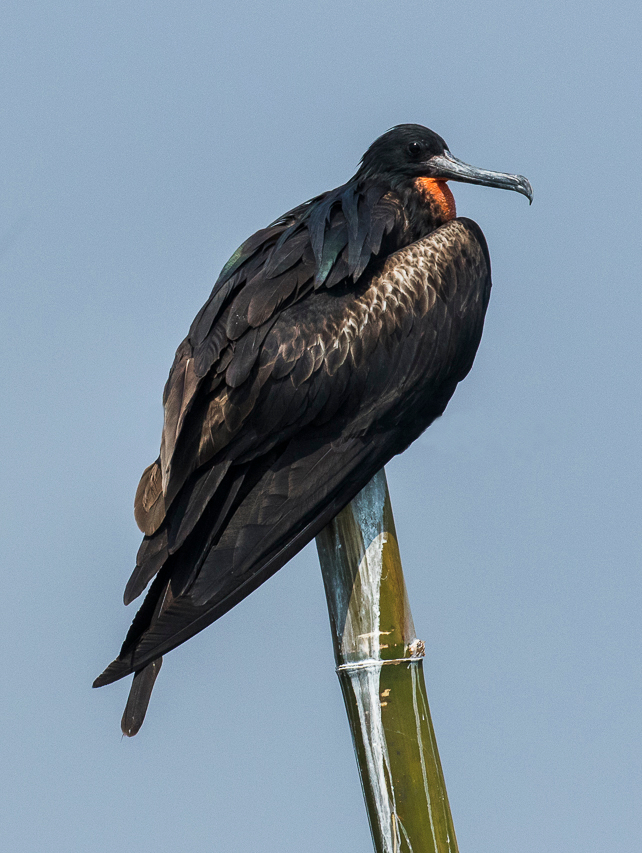
Hasegawa's Frigatebird
Limnofregata hasegawai
Order: Suliformes / Family: Fregatidae

Wikimedia Commons
About the Hasegawa's Frigatebird
Hasegawa's Frigatebird, scientifically known as Limnofregata hasegawai, is a fascinating member of the Fregatidae family, primarily recognized through fossil records. Unlike its modern relatives, this prehistoric bird inhabited freshwater environments, a unique trait among frigatebirds. The fossils of Hasegawa's Frigatebird were discovered in the sedimentary deposits of the Green River Formation in Wyoming, which dates back to the Eocene epoch, approximately 50 million years ago. This period was crucial for avian diversification, providing insights into the evolution of seabirds and their adaptive strategies. The freshwater habitat of Limnofregata hasegawai suggests a significant ecological role in its ecosystem. The bird likely occupied a niche similar to that of modern-day cormorants or pelicans, preying on fish and other aquatic organisms. The presence of Hasegawa's Frigatebird in a freshwater environment challenges our understanding of frigatebird evolution, traditionally associated with marine habitats. Seasonal behaviors of this species are difficult to ascertain due to the lack of direct observation, but fossil evidence indicates that it inhabited a subtropical to tropical climate, with warm temperatures and abundant aquatic resources. The significance of Hasegawa's Frigatebird extends beyond its unique habitat preferences. It provides a window into the past when large inland lakes offered diverse ecological opportunities. The bird's adaptation to freshwater systems highlights the dynamic nature of avian evolution, illustrating how environmental changes can drive the divergence of species within a family. This ancient frigatebird serves as a crucial piece in the puzzle of avian history, offering clues about the ancient ecosystems of North America and the evolutionary pressures that shaped modern bird lineages.
The Hasegawa's Frigatebird belongs to the family Fregatidae, within the order Suliformes. These birds typically live N/A.
How to Identify a Hasegawa's Frigatebird
Although we lack live specimens of Hasegawa's Frigatebird, fossil analysis reveals several distinctive field marks. The bird's long, slender wings and deeply forked tail are reminiscent of modern frigatebirds, suggesting excellent soaring capabilities. Its skeletal structure indicates a medium-sized bird, likely comparable to the size of a modern-day Magnificent Frigatebird, which has a wingspan of up to 2.3 meters. The fossilized remains suggest sexual dimorphism, although definitive evidence distinguishing males from females remains inconclusive. The plumage of Limnofregata hasegawai is speculative, but based on the typical coloration of the Fregatidae family, it might have exhibited dark feathers with a sheen, facilitating thermal regulation and camouflage in its freshwater environment. Juvenile differences are also speculative, but as with modern frigatebirds, juveniles might have sported lighter plumage to provide camouflage during their vulnerable early life stages. Similar species confusion could arise from its skeletal similarity to other seabirds, such as pelicans or cormorants. However, the unique structure of its forked tail and wing shape set it apart. In flight, Hasegawa's Frigatebird likely displayed a silhouette characterized by long wings and a distinctive tail, while its perching posture might have involved hanging in tree branches or cliffs near water bodies, resembling the behavior of its modern relatives.
Having trouble telling birds apart? Upload a photo to our bird identification tool for an instant species match.
Hasegawa's Frigatebird Habitat and Range
Preferred Habitat
Hasegawa's Frigatebird inhabited freshwater environments, a rare trait among frigatebirds. Fossil evidence places it in the Green River Formation, a region that once hosted expansive subtropical lakes and rivers in what is now Wyoming. These habitats provided abundant aquatic life, supporting the bird's dietary needs and offering suitable sites for nesting and roosting. The elevation of these prehistoric lakes was relatively low, likely under 1500 meters, allowing for a warm climate and diverse flora and fauna. Seasonal habitat shifts are unknown, but the consistent climate of the Eocene epoch suggests year-round residency in this region. Urban development was nonexistent during the time of Limnofregata hasegawai, so human impact was absent. Instead, the bird thrived in rural and untouched landscapes, with its presence indicating a healthy, biodiverse ecosystem.
Geographic Range
Hasegawa's Frigatebird existed during the Eocene epoch, with its range primarily confined to the prehistoric Green River Formation in Wyoming. This area, rich in fossilized remains, marks the primary breeding and living region of Limnofregata hasegawai. The bird's range did not include migration corridors as modern birds experience, primarily due to the stable climatic conditions and the abundant resources available year-round in its habitat. Specific regions within the Green River Formation, such as the ancient Fossil Lake, served as population density hotspots, providing ideal conditions for feeding, breeding, and nesting. Without the need for long-distance migration, Hasegawa's Frigatebird likely maintained a localized range, adapting to seasonal fluctuations in resource availability. The absence of modern geographical markers makes it challenging to compare its range directly with that of contemporary species, but its historical presence in North America offers valuable insights into ancient avian distribution patterns.
Want to know which birds visit your area? Browse our backyard birds by location guides for region-specific species lists.
What Does the Hasegawa's Frigatebird Eat?
The diet of Hasegawa's Frigatebird likely mirrored that of its modern relatives, focusing on aquatic prey. Primary food sources included fish and possibly small amphibians or aquatic invertebrates. Seasonal diet changes are speculative, but shifts in available prey due to climatic conditions might have influenced feeding habits. The bird's foraging techniques remain unknown, although it likely employed aerial hunting strategies, diving or skimming over water surfaces to capture prey, much like modern-day frigatebirds. Prey size likely varied, with a preference for small to medium-sized fish, optimizing energy expenditure during foraging. Feeding schedules could have been influenced by prey activity, with potential peaks in feeding during dawn and dusk when fish are more active near the water's surface. The ecological role of Limnofregata hasegawai as a predator highlights its contribution to controlling aquatic populations and maintaining the balance within its freshwater ecosystem.
Hasegawa's Frigatebird Behavior and Social Structure
Hasegawa's Frigatebird likely exhibited social behaviors similar to those of extant frigatebirds, potentially forming loose colonies near water bodies. Territorial behavior could have been influenced by competition for nesting sites or food resources. Courtship displays remain speculative, but modern frigatebirds exhibit elaborate aerial displays and vocalizations, suggesting similar behaviors in Limnofregata hasegawai. Flocking patterns might have included small groups, enhancing foraging efficiency and predator avoidance. The bird's response to predators is unknown, but group living and vigilance might have reduced predation risks. Daily activity patterns are inferred from modern frigatebird behavior, potentially involving periods of soaring, foraging, and resting. The bird's adaptation to a freshwater environment indicates behavioral flexibility, allowing it to exploit unique ecological niches within its prehistoric habitat.
Hasegawa's Frigatebird Nesting and Reproduction
The nesting habits of Hasegawa's Frigatebird are largely speculative. Nest type likely involved simple structures, possibly constructed with twigs and vegetation, placed in trees or on cliffs near freshwater. Location preferences would have included areas offering protection from predators and proximity to food sources. Clutch size remains unknown, but considering modern relatives, it might have ranged from one to three eggs. The incubation period is also uncertain, but the close evolutionary relationship to other frigatebirds suggests a period of several weeks. Fledging timelines are speculative, influenced by factors such as food availability and predation pressure. Parental roles in Limnofregata hasegawai likely involved shared responsibilities between mates, similar to modern frigatebirds, ensuring high survival rates for offspring. The number of broods per year is unknown, but stable environmental conditions might have allowed for multiple breeding attempts annually.
Hasegawa's Frigatebird Sounds and Vocalizations
The vocalizations of Hasegawa's Frigatebird remain a mystery due to its extinction. However, comparisons with modern frigatebirds suggest it might have produced a range of sounds, including calls for communication and courtship. Primary song descriptions are speculative, possibly resembling the rhythmic croaks and whistles of extant species. Call notes could have varied in pitch and quality, serving functions in social interactions and mate attraction. Alarm calls might have been harsher, alerting conspecifics to potential threats. Dawn chorus behaviors are unlikely to be documented, but vocal activity might have peaked during breeding seasons, facilitating mate selection and territory establishment.
Interesting Facts About the Hasegawa's Frigatebird
- 1Hasegawa's Frigatebird lived during the Eocene epoch, over 50 million years ago, providing a glimpse into prehistoric avian life.
- 2This bird is one of the few frigatebirds known to have inhabited freshwater environments, a unique ecological adaptation.
- 3Fossils of Limnofregata hasegawai were discovered in the Green River Formation, a site rich with Eocene-era avian fossils.
- 4The bird's long wings and forked tail suggest excellent soaring abilities, similar to modern frigatebirds.
- 5Hasegawa's Frigatebird likely shared its habitat with diverse Eocene fauna, including early mammals and reptiles.
- 6The species' extinction provides valuable insights into ancient ecological shifts and the evolution of modern seabirds.
- 7Despite its extinction, Hasegawa's Frigatebird continues to intrigue scientists, offering clues about avian evolutionary patterns.
Hasegawa's Frigatebird Conservation Status
Hasegawa's Frigatebird is extinct and not subject to conservation status by the IUCN. Its extinction predates human influence, resulting from natural climatic and environmental shifts during the Eocene epoch. The primary threats to its historical population might have included changes in habitat conditions, competition, and predation. Conservation efforts focus on studying fossil records, providing insights into prehistoric avian life and informing conservation strategies for modern birds. Historical population changes highlight the dynamic nature of ecosystems, emphasizing the importance of preserving diverse habitats to support avian biodiversity.