
Little Owl
Athene noctua
Order: Strigiformes / Family: Strigidae
Wikimedia Commons
About the Little Owl
The Little Owl, scientifically known as Athene noctua, is a captivating bird native to a wide range of habitats across Europe, Asia, and parts of North Africa. This diminutive owl holds a significant place in various cultures, often symbolizing wisdom and vigilance, a legacy from its association with the Greek goddess Athena. Interestingly, it exhibits a preference for open countryside and farmlands, where it can often be seen perched on stone walls or fence posts. This bird thrives in a variety of landscapes, from the Mediterranean's olive groves and vineyards to the grassy steppes of Central Asia. The Little Owl plays a crucial ecological role as a predator of insects and small mammals, helping to control these populations. It exhibits fascinating behavioral adaptations, such as its ability to hunt both day and night, though it shows more activity during dusk and dawn. In winter, it may shift its hunting strategy slightly, taking advantage of available prey based on seasonal abundance.
The Little Owl belongs to the family Strigidae, within the order Strigiformes. These birds typically live typically around 3-5 years, with a maximum recorded of 16 years..
How to Identify a Little Owl
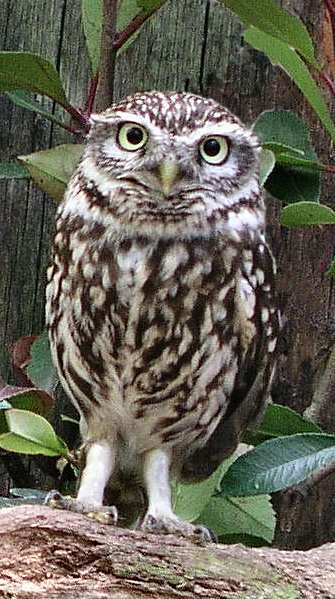
The Little Owl is easily recognized by its small stature, rounded body, and characteristic head bobbing. Adults possess a mottled brown and white plumage, with a distinctive white 'eyebrow' above their bright yellow eyes, giving them an expression of perpetual curiosity. Juveniles resemble adults but have more uniform and paler plumage, with less defined markings. While males and females look similar, females tend to be slightly larger. In flight, the Little Owl's broad wings and short tail give it a stubby appearance, which, along with its flight pattern of rapid wingbeats interspersed with glides, helps distinguish it from other species. When perched, this owl often adopts a hunched posture, maintaining a low profile against its chosen backdrop.
Having trouble telling birds apart? Upload a photo to our bird identification tool for an instant species match.
Little Owl Habitat and Range
Preferred Habitat
The Little Owl favors lowland habitats, typically at elevations up to 1500 meters. It thrives in semi-open environments such as farmland, orchards, and open woodland, where it can find suitable hunting perches. Urban edges also provide adequate habitat, as this owl adapts well to human-altered landscapes like parks and gardens. Seasonal habitat shifts are minimal, as the Little Owl is largely non-migratory. However, some populations may move slightly in response to severe weather or prey availability.
Geographic Range
The Little Owl's range covers a broad expanse from the Iberian Peninsula across Europe, through the Middle East, and into Central Asia. It is a resident species in much of its range, from southern England and central Europe to the steppes of Kazakhstan. In regions like France and Italy, their presence is relatively dense, while in northern Europe, populations are more fragmented. Some isolated populations exist in North Africa, particularly in Morocco and Algeria. Notably, the Little Owl does not undertake extensive migrations, though some altitudinal movement may occur in mountainous regions.
Want to know which birds visit your area? Browse our backyard birds by location guides for region-specific species lists.
What Does the Little Owl Eat?
The Little Owl primarily feeds on a diet of insects, small mammals, and occasionally small birds, utilizing a sit-and-wait hunting strategy. Insects, particularly beetles and grasshoppers, form a significant portion of its diet during the warmer months. As seasons change, and insects become scarce, it shifts to hunting voles and other small mammals. The owl's ability to adapt its diet ensures its survival across varied environments. Typically, it hunts from a perch, swooping down to capture prey on the ground. Prey size usually ranges from small insects to small mammals weighing up to 50 grams. Feeding activity peaks at dawn and dusk, although it can hunt at any time of the day or night.
Little Owl Behavior and Social Structure
The Little Owl is generally solitary, although it may be seen in pairs during the breeding season. It exhibits strong territorial behavior, with males often engaging in vocal displays to assert dominance over their territory. Courtship involves a series of calls and aerial displays, culminating in the formation of monogamous pairs that often remain together for life. While not known for flocking, Little Owls may tolerate the presence of conspecifics in overlapping territories. When confronted with predators, they rely on their cryptic plumage and stillness to evade detection, only taking flight if necessary. This owl remains active throughout the day but shows peak activity at dawn and dusk, adapting its behavior to the availability of prey.
Little Owl Nesting and Reproduction
Little Owls prefer to nest in cavities such as tree hollows, rock crevices, or even abandoned buildings. They do not construct elaborate nests, instead relying on existing structures. The typical clutch size ranges from three to five eggs, which the female incubates for about 28-30 days. During this time, the male provides food. Once hatched, the young remain in the nest for approximately 30-35 days before fledging. Both parents participate in feeding and caring for the chicks. The species generally raises one brood per year, though in optimal conditions, a second brood may occur.
Little Owl Sounds and Vocalizations
The Little Owl's primary song is a series of high-pitched, clear hoots that rise in pitch and intensity, often described as 'koo-wik, koo-wik.' These vocalizations serve to establish territory and attract mates, most commonly heard at dusk. Apart from the song, the owl emits a variety of calls, including alarm calls that sound like a short, sharp 'kiew,' used to alert other owls of potential danger. During the breeding season, males and females may engage in duet calling, enhancing their bond.
Interesting Facts About the Little Owl
- 1Little Owls have been introduced to Britain from the Netherlands in the late 19th century, establishing a stable population.
- 2Despite their name, Little Owls are fierce predators, capable of taking down prey nearly their own size.
- 3These owls have a peculiar hunting technique: they bob up and down before swooping down on their prey.
- 4Ancient Greeks revered the Little Owl, associating it with Athena, the goddess of wisdom, making it a symbol of knowledge.
- 5Little Owls can be surprisingly vocal for their size, often engaging in complex calls to communicate with mates and rivals.
- 6The species displays remarkable adaptability, able to live in diverse environments from rural farmlands to city parks.
- 7During courtship, male Little Owls perform aerial displays that include fluttering flights and exaggerated wing beats.
Little Owl Conservation Status
The Little Owl is classified as Least Concern by the IUCN, with population trends varying regionally. In parts of Europe, populations have declined due to habitat loss and changes in agricultural practices. Conservation efforts focus on habitat preservation and creating nesting opportunities, such as installing nest boxes. Historically, the species was more widespread across urban areas, but modernization and increased pesticide use have impacted prey availability.


