
Long-legged Pipit
Anthus pallidiventris
Order: Passeriformes / Family: Motacillidae
Wikimedia Commons
About the Long-legged Pipit
The Long-legged Pipit, scientifically known as Anthus pallidiventris, is a remarkable member of the Motacillidae family, renowned for its long legs which aid in navigating its preferred grassland habitats. This species exhibits adaptability across a diversity of open terrains, from the savannas of South Africa to the volcanic highlands of East Africa. The bird is medium-sized, typically measuring around 16 to 18 centimeters in length, and possesses a streaked brown plumage that provides excellent camouflage against the dry grasses. Its ecological role is significant as it helps control insect populations, serving as a natural pest management agent in its ecosystem.
The Long-legged Pipit thrives in regions where open landscapes dominate, avoiding dense forests but favoring grassy plains, agricultural fields, and even urban parklands. Throughout the year, these pipits demonstrate fascinating seasonal behaviors. During the breeding season, which often coincides with the local rainy season, males perform aerial displays that showcase their agility and stamina. These displays are not only visually captivating but also serve to establish territories and attract mates.
Outside of the breeding season, the Long-legged Pipit displays a shift in behavior, often forming small flocks that forage together. This social structure aids in the effective location of food sources and provides greater protection against potential predators. The species plays a crucial role in the ecosystem by consuming a variety of insects and other small invertebrates, thus maintaining ecological balance. Despite its common presence in suitable habitats, the Long-legged Pipit faces threats from habitat destruction and agricultural expansion, necessitating ongoing conservation attention.
The Long-legged Pipit belongs to the family Motacillidae, within the order Passeriformes. These birds typically live average 3-4 years with a max recorded of 8 years..
How to Identify a Long-legged Pipit
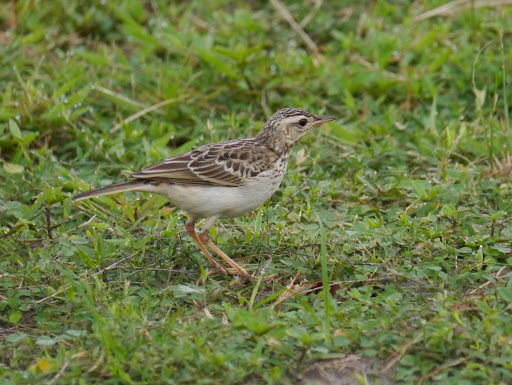
Identifying the Long-legged Pipit involves noting its unique physical characteristics and behaviors. The adult pipit exhibits a primarily brown upper plumage with darker streaks, a pale underpart, and a characteristic white throat. These markings enable it to blend seamlessly into its grassland surroundings. The long legs are a distinctive feature, not only useful for walking swiftly across uneven terrain but also a key identifying trait.
Juvenile Long-legged Pipits resemble adults but generally have a more pronounced streaking pattern and a slightly duller coloration. There is minimal sexual dimorphism, with males and females appearing similar, though males might be slightly larger and more active in display behaviors. When in flight, the Long-legged Pipit presents a straight, swift silhouette, unlike the more undulating flight patterns of some other pipit species.
Confusion with similar species such as the African Pipit (Anthus cinnamomeus) can occur, but the longer legs and slightly larger size of the Long-legged Pipit serve as distinguishing features. Additionally, the Long-legged Pipit's distinctive perching posture, often upright and alert, sets it apart from related species.
Having trouble telling birds apart? Upload a photo to our bird identification tool for an instant species match.
Long-legged Pipit Habitat and Range
Preferred Habitat
The Long-legged Pipit inhabits a variety of open landscapes, predominantly favoring grasslands and savannas. It is most commonly found in Sub-Saharan Africa, thriving in both natural and modified habitats. Areas such as the Serengeti in Tanzania and the Kruger National Park in South Africa provide ideal environments.
This species shows a notable ability to adapt to different elevations, from lowland coastal plains to mountainous regions, as long as open terrain persists. During certain seasons, particularly when not breeding, the Long-legged Pipit may extend its range into agricultural fields and urban edge habitats where short grass and open areas are available. Unlike some more specialized birds, it does not typically inhabit dense forests or wetlands.
Seasonal habitat shifts are observed, with pipits moving to areas that offer abundant food resources and suitable breeding sites during the rainy season. This adaptability in habitat selection is a testament to the species' resilience in the face of environmental changes.
Geographic Range
The Long-legged Pipit has an extensive range covering much of Sub-Saharan Africa. It is a resident breeder in countries such as Kenya, Tanzania, Botswana, South Africa, and Zimbabwe. This species does not engage in long-distance migration but may exhibit local movements in response to rainfall patterns and food availability.
Breeding typically aligns with regional wet seasons, where suitable conditions for raising young are present. The pipit's range includes regions of varying population densities, with higher concentrations observed in areas where open grasslands are prevalent. In countries like Zambia and Namibia, the Long-legged Pipit is a common sight in both natural reserves and agricultural areas.
Despite its widespread distribution, the species is less frequently observed in densely forested regions or areas dominated by intensive agriculture without grassy margins. This range reflects its preference for habitats that balance open spaces with adequate food resources.
Want to know which birds visit your area? Browse our backyard birds by location guides for region-specific species lists.
What Does the Long-legged Pipit Eat?
The Long-legged Pipit's diet primarily consists of insects and small invertebrates, playing a crucial role in controlling pest populations. Its foraging technique involves walking or hopping along the ground, using its keen eyesight to spot prey.
During the rainy season, when insect abundance peaks, the pipit's diet includes a variety of beetles, grasshoppers, and caterpillars, which are easily captured due to the bird's quick movements and precise pecking. Outside of the breeding season, the diet remains consistent, with a slight increase in plant material consumption, likely seeds, during drier periods when insects are less plentiful.
The pipit generally feeds throughout the day, with peak foraging activity occurring during the cooler early morning and late afternoon hours. Its ability to adapt its diet according to seasonal availability of food resources underscores its ecological versatility and resilience.
Long-legged Pipit Behavior and Social Structure
The Long-legged Pipit exhibits a range of behaviors that enhance its survival and reproductive success. It is primarily a solitary bird outside the breeding season but may form small, loose flocks when foraging, which provides safety in numbers against predators such as birds of prey and terrestrial mammals.
Territorial during breeding, males engage in striking aerial displays characterized by spiraling flights and melodious song, both to establish territory and to attract females. These displays occur primarily at dawn and dusk when visibility and acoustic conditions are optimal.
The species is diurnal, with activity peaking during cooler times of the day. In response to threats, the pipit often employs a strategy of crouching low to the ground or taking swift, low-level flight to nearby cover. Social interactions are generally limited to breeding and feeding contexts, with little evidence of long-term pair bonds outside the breeding season.
Long-legged Pipit Nesting and Reproduction
Nesting for the Long-legged Pipit involves constructing a simple cup-shaped nest on the ground, often concealed amidst grass tufts or under small shrubs, providing protection from predators. The female predominantly builds the nest using materials such as grass stems and leaves, occasionally lined with finer plant material for softness.
Clutch size typically ranges from two to four eggs, which the female incubates over a period of approximately 12 to 14 days. During incubation, the male remains in the vicinity, providing occasional food and maintaining territory defense.
After hatching, both parents participate in feeding and caring for the chicks, which fledge roughly 14 to 16 days post-hatching. The number of broods produced annually may vary with environmental conditions, but typically one to two broods are raised each year, aligning with periods of food abundance.
Long-legged Pipit Sounds and Vocalizations
The Long-legged Pipit's song is a series of melodic trills and whistles, often delivered during flight displays. The rhythm is fluid and continuous, with a pleasant, musical quality that distinguishes it from the harsher calls of some related species.
Call notes are generally softer and less conspicuous, serving primarily in communication between mates or alerting to threats. Alarm calls, which are sharper and more abrupt, are employed when a predator is detected, prompting immediate evasive action by nearby pipits.
During the dawn chorus, the pipit's song contributes to the rich tapestry of early morning bird sounds, its melodious trills weaving seamlessly with those of other grassland songbirds.
Interesting Facts About the Long-legged Pipit
- 1The Long-legged Pipit can walk briskly across uneven terrain due to its notably long legs, which are longer than those of many other pipit species.
- 2During the breeding season, the male Long-legged Pipit performs aerial displays that can last up to several minutes, showcasing both stamina and skill.
- 3While primarily insectivorous, the Long-legged Pipit can adapt its diet to include seeds, especially during times when insects are scarce.
- 4The species is particularly adept at using its streaked plumage as camouflage, blending seamlessly into dry grassy landscapes.
- 5The Long-legged Pipit's song contributes significantly to the dawn chorus in African grasslands, adding a melodious element to the morning soundscape.
- 6Juvenile Long-legged Pipits exhibit more prominent streaking than adults, which gradually fades as they mature.
- 7Despite being widespread, the Long-legged Pipit is rarely found in dense forests, indicating a preference for open, airy environments.
Long-legged Pipit Conservation Status
The Long-legged Pipit is currently listed as Least Concern by the IUCN, with a stable population trend across its range. Its adaptability to various open habitats has afforded it resilience against moderate environmental pressures. Primary threats include habitat loss due to agricultural expansion and urban development, which reduce available grassland areas. Conservation efforts focus on habitat preservation and sustainable land management practices that support biodiversity, including the pipit. Historically, the population has remained relatively stable, benefiting from the wide distribution and adaptability of the species. Continued monitoring and habitat protection are essential to ensure the Long-legged Pipit's ongoing viability in the face of environmental changes.
Other Motacillidae Species



Birds Similar to the Long-legged Pipit
These species are often confused with the Long-legged Pipit due to similar appearance or overlapping range.

