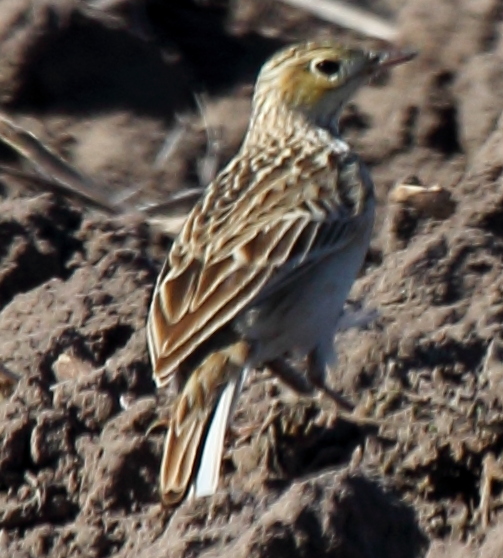
Long-tailed Pipit
Anthus longicaudatus
Order: Passeriformes / Family: Motacillidae

Wikimedia Commons
About the Long-tailed Pipit
The Long-tailed Pipit, scientifically known as Anthus longicaudatus, is a captivating member of the Motacillidae family. Known for its extended tail, this bird is often seen flitting gracefully across open grasslands. Its presence signifies a healthy ecosystem, as it plays a critical role in insect population control. Commonly found in the grasslands of Central Asia, particularly in countries like Kazakhstan and Mongolia, the Long-tailed Pipit thrives in these expansive landscapes. During the breeding season, it migrates to slightly elevated areas, preferring open terrains that provide a panoramic view for predator vigilance.
In the ecological web, the Long-tailed Pipit contributes significantly by regulating insect populations. Its diet consists primarily of insects and small invertebrates, making it a vital controller of pest species. The bird's presence benefits agricultural landscapes by reducing the need for chemical pest control. As a ground-nesting bird, the Long-tailed Pipit influences the composition of the grassland flora. Its foraging habits disturb the soil, aiding in seed dispersal and contributing to plant diversity.
Seasonally, this pipit migrates to milder climates during the harsh Central Asian winters. In autumn, large flocks can be observed traveling southward to regions with more temperate climates, where they continue their ecological role. Their migratory patterns are a spectacle in avian biology, showcasing their endurance and adaptability. These movements also highlight the interconnectedness of different ecosystems across vast geographic areas. The Long-tailed Pipit's adaptability to various climates and ecosystems underscores its resilience, making it a species of interest for conservationists and ornithologists alike.
The Long-tailed Pipit belongs to the family Motacillidae, within the order Passeriformes. These birds typically live average lifespan is 3-5 years, with some living up to 7 years..
How to Identify a Long-tailed Pipit
The Long-tailed Pipit is easily recognizable by its strikingly elongated tail, which sets it apart from other pipits. This tail, often longer than its body, provides an elegant silhouette in flight. Adult plumage is a soft mix of browns and grays, with subtle streaking on the back and wings. This coloration blends seamlessly with their grassland habitats, offering camouflage against predators. Juvenile Long-tailed Pipits exhibit a slightly duller plumage, lacking the defined streaking present in adults.
Males and females appear similar, although males may display slightly more vibrant coloration during the breeding season. This subtle difference assists in mate selection without attracting undue attention from predators. In flight, the Long-tailed Pipit maintains a steady, undulating pattern, with the tail often fanned out for balance and agility. When perched, it exhibits an upright stance, often bobbing its tail in a characteristic motion.
Confusion may arise with similar species such as the Meadow Pipit, but the Long-tailed Pipit's distinctly longer tail is a reliable field mark. Additionally, the call of the Long-tailed Pipit, a series of high-pitched notes, differs from the Meadow Pipit's more melodic song, aiding in proper identification.
Having trouble telling birds apart? Upload a photo to our bird identification tool for an instant species match.
Long-tailed Pipit Habitat and Range
Preferred Habitat
The Long-tailed Pipit typically inhabits open grasslands and steppes, favoring regions with sparse vegetation that allow for unobstructed movement. In Central Asia, it is commonly found in the vast expanses of Kazakhstan and Mongolia. These areas provide the ideal conditions for the pipit's ground-nesting habits and foraging needs.
During breeding season, the Long-tailed Pipit may ascend to higher altitudes, seeking out plateaus and gentle slopes that offer a vantage point to spot potential threats. This altitudinal migration ensures they have access to optimal nesting sites and abundant food supplies.
Outside of breeding season, the Long-tailed Pipit is occasionally spotted in semi-urban areas, particularly in agricultural landscapes where it can forage for insects. However, it largely avoids densely populated urban regions. During winter migrations, it relocates to areas with milder climates, indicating a degree of flexibility in habitat preferences due to seasonal changes.
Geographic Range
The breeding range of the Long-tailed Pipit spans the grasslands of Central Asia, prominently in Kazakhstan and Mongolia. During the breeding season, they are commonly found in these regions' open, grassy landscapes. As winter approaches, the Long-tailed Pipit undertakes a southward migration, with many individuals moving to the warmer climates of southern Asia. This migration typically passes through countries such as Uzbekistan and Turkmenistan, with some populations reaching Afghanistan and northern parts of India.
The migration corridors are vital for the survival of this species, providing necessary resources and resting spots along the way. In these migratory regions, the Long-tailed Pipit can be seen in grasslands and agricultural fields, where it continues its foraging activities. Population density tends to be higher in these wintering grounds, as individuals congregate in areas offering abundant food and suitable shelter.
While the Long-tailed Pipit is not considered a globally threatened species, its distribution is closely tied to specific ecosystems, making it susceptible to habitat alterations. Conservation efforts focus on preserving the grassland habitats that are crucial for both their breeding and wintering stages.
Want to know which birds visit your area? Browse our backyard birds by location guides for region-specific species lists.
What Does the Long-tailed Pipit Eat?
The Long-tailed Pipit primarily subsists on a diet of insects and small invertebrates, making it a proficient predator of grassland pests. During the breeding season, its diet consists largely of arthropods such as beetles, ants, and spiders, which provide the necessary protein for raising young.
In the winter months, as the bird migrates to milder climates, its diet diversifies to include seeds and grains found in agricultural areas. This flexibility in diet allows the Long-tailed Pipit to thrive even when insect availability decreases. Foraging involves a characteristic ground-hopping behavior, where the bird moves swiftly, picking prey from the soil and under vegetation.
The Long-tailed Pipit employs a keen eye and rapid movements to capture prey, often seen darting short distances to snatch insects in flight. Its feeding schedule remains predominantly diurnal, with peak activity during the cooler hours of morning and late afternoon. This pattern minimizes energy expenditure while maximizing prey capture efficiency.
Long-tailed Pipit Behavior and Social Structure
The Long-tailed Pipit exhibits a complex array of behaviors that reflect its adaptability and survival strategies. Socially, it is often seen in small flocks, especially outside the breeding season, where it benefits from the safety in numbers while foraging. During the breeding season, however, the Long-tailed Pipit becomes more territorial, with males establishing and defending breeding territories through song and display flights.
Courtship displays involve aerial performances, where the male ascends with rapid wingbeats before descending in a series of glides, accompanied by vocalizations. This behavior not only attracts females but also reinforces territorial boundaries. The Long-tailed Pipit's response to predators is swift and coordinated, often involving a series of alarm calls that alert others to the presence of threats.
Daily activities of the Long-tailed Pipit are largely diurnal, with periods of high activity during early morning and late afternoon. This schedule allows the bird to avoid the midday heat, optimizing energy use. Flocking patterns in non-breeding seasons demonstrate a loosely organized social structure, with individuals maintaining personal space while benefiting from group vigilance.
Long-tailed Pipit Nesting and Reproduction
Long-tailed Pipits build their nests on the ground, often hidden within dense grass tufts to provide camouflage and protection. The nest is a shallow cup constructed from grass, leaves, and rootlets, lined with finer materials for insulation and comfort. Nest site selection is crucial, with preferences for areas offering both concealment from predators and proximity to food sources.
A typical clutch consists of 3 to 5 eggs, with incubation duties shared between both parents. Incubation lasts approximately 12 to 14 days. After hatching, the chicks remain in the nest for a further 10 to 12 days before fledging. During this period, both parents actively feed the young, ensuring a diet rich in proteins necessary for growth.
Parental roles are well-defined, with males often taking on the role of sentinel, watching for predators while females focus on feeding and brooding. The Long-tailed Pipit typically raises one brood per year, although in favorable conditions, a second brood may be attempted.
Long-tailed Pipit Sounds and Vocalizations
The Long-tailed Pipit's primary song is a series of high-pitched, rapid notes that cascade melodically, often delivered from a perch or during flight. This song serves both as a territorial claim and a courtship display. In addition to its melodic song, the Long-tailed Pipit emits a series of call notes that are sharper and more abrupt, often used to maintain contact within flocks or as alarms.
Alarm calls tend to be more insistent and are delivered when a predator is nearby, prompting others in the vicinity to seek cover. During the dawn chorus, the Long-tailed Pipit's song is most prominent, contributing to the symphony of morning bird calls that signal the start of daily activities. The rhythm and pitch of its song bear resemblance to other pipits, though its unique cadence and tail movements often help distinguish it from similar species.
Interesting Facts About the Long-tailed Pipit
- 1The Long-tailed Pipit can travel over 2,000 kilometers during its migratory journey.
- 2Despite its small size, the Long-tailed Pipit covers vast territories while foraging.
- 3The elongated tail of the Long-tailed Pipit aids in its agile flight maneuvers.
- 4Long-tailed Pipits are known to use deception, feigning injury to distract predators from nests.
- 5Their nests are often so well hidden that they are only discovered by observing parent behavior.
- 6Long-tailed Pipits have been recorded singing over 200 times an hour during peak breeding times.
- 7The species plays a crucial role in controlling pest populations in agricultural regions.
Long-tailed Pipit Conservation Status
Currently, the Long-tailed Pipit is not listed as threatened on the IUCN Red List, with populations regarded as stable. However, the ongoing expansion of agricultural activities and habitat modification pose potential threats. Grassland conversion and pesticide use could impact their insect prey availability, leading to potential declines. Conservation efforts focus on habitat preservation and sustainable agricultural practices. Protecting the open grasslands and maintaining insect-rich environments are key to supporting Long-tailed Pipit populations. Historical data show fluctuations in population sizes, often correlating with regional agricultural trends. Continued monitoring and habitat management are essential to ensure the Long-tailed Pipit's long-term viability.