
Madagascar Sandgrouse
Pterocles personatus
Order: Pteroclidiformes / Family: Pteroclididae
Wikimedia Commons
About the Madagascar Sandgrouse
The Madagascar Sandgrouse, scientifically known as Pterocles personatus, is a fascinating avian species endemic to the island of Madagascar. This species is particularly notable for its adaptability to arid and semi-arid environments, where it plays a crucial role in the ecosystem as both a seed disperser and a prey species. Found primarily in the southwestern and southern regions of Madagascar, the sandgrouse thrives in the dry, open landscapes that characterize much of the island's interior. These areas include the spiny forests and scrublands, where vegetation is sparse and water sources are limited. As a member of the family Pteroclididae, the Madagascar Sandgrouse exhibits behaviors and adaptations typical of its relatives, such as the ability to carry water in its specialized belly feathers to hydrate its young. This remarkable adaptation is essential for survival in the harsh environments where temperatures can soar and precipitation is scarce.
Ecologically, the Madagascar Sandgrouse occupies a role as both a consumer and a prey species within its habitat. Its diet consists primarily of seeds and grains, which it forages from the ground, contributing to the dispersal of plant species across the landscape. Such feeding habits help maintain the health and diversity of the local flora. Additionally, the sandgrouse serves as a food source for a variety of predators, including raptors and terrestrial mammals. This interdependence highlights the sandgrouse's importance in maintaining the balance of the ecosystem.
Seasonally, the sandgrouse exhibits behavioral changes in response to environmental conditions. During the dry season, when resources become scarcer, these birds may travel greater distances in search of food and water, often forming large flocks to increase foraging efficiency and reduce the risk of predation. In contrast, the wet season, though brief in Madagascar, brings about a reprieve, with increased availability of resources allowing the sandgrouse to focus on breeding and raising their young. The synchrony of their breeding season with the onset of rains ensures that their offspring have the best chances of survival, as food becomes more plentiful and water sources are replenished.
The Madagascar Sandgrouse belongs to the family Pteroclididae, within the order Pteroclidiformes. These birds typically live typically 7-9 years, with some individuals reaching up to 11 years..
How to Identify a Madagascar Sandgrouse
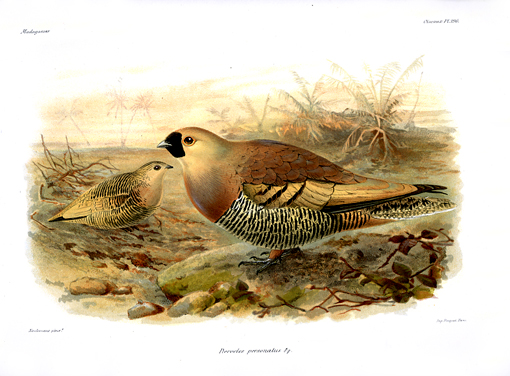
The Madagascar Sandgrouse is medium-sized, with males and females exhibiting distinct plumage differences. Adult males have a striking facial mask, characterized by a bold black band extending across their face, contrasting sharply with their pale throat and crown. Their upperparts are predominantly sandy brown, adorned with fine barring and spotting, which provides excellent camouflage against the ground. Females, while similarly colored, lack the prominent facial mask of the males, instead displaying a mottled brown face. Juveniles resemble females but are duller, with more pronounced streaking.
In flight, the Madagascar Sandgrouse has a distinctive silhouette. Its pointed wings and rapid wingbeats are characteristic, enabling it to cover long distances quickly in search of food and water. When perched, the sandgrouse's posture is upright, often blending seamlessly into its surroundings. This cryptic plumage serves as both a defense mechanism against predators and an advantage when ambushing prey.
Similar species that might cause confusion include other sandgrouse species within Madagascar, such as the Madagascar Buttonquail, which is smaller and lacks the distinctive facial markings. Observers should note the unique facial pattern and size to accurately identify the Madagascar Sandgrouse in the field.
Having trouble telling birds apart? Upload a photo to our bird identification tool for an instant species match.
Madagascar Sandgrouse Habitat and Range
Preferred Habitat
The Madagascar Sandgrouse is primarily associated with arid and semi-arid habitats, preferring open landscapes where it can forage efficiently. Its favored habitats include the spiny forests unique to Madagascar's southwestern regions, characterized by xerophytic vegetation adapted to dry conditions. These areas typically feature low-growing shrubs, sparse trees, and expansive open ground, ideal for the sandgrouse's ground-dwelling lifestyle.
The elevation range for the Madagascar Sandgrouse is generally low, as it inhabits flat or gently rolling terrain that facilitates its ground-foraging habits. Seasonal habitat shifts are minimal, as the species is non-migratory and remains in its preferred environments year-round. However, during particularly dry spells, the sandgrouse may wander further afield in search of water and food, though it rarely ventures into urban areas.
Unlike some bird species that adapt to human-modified landscapes, the Madagascar Sandgrouse remains strongly tied to its natural habitats, avoiding urban regions where suitable foraging and nesting grounds are scarce. Its presence is a reliable indicator of relatively undisturbed arid ecosystems within Madagascar.
Geographic Range
The range of the Madagascar Sandgrouse is confined to the island of Madagascar, with its core distribution centered in the southwestern and southern parts of the island. This includes regions such as the Toliara Province, where the sandgrouse is commonly found in spiny forests and open scrublands. It does not exhibit significant migratory behavior, remaining within these regions throughout the year.
During the breeding season, the population density of the Madagascar Sandgrouse can increase locally, as birds congregate in areas where food and water are more abundant. However, their overall range remains limited compared to other sandgrouse species found on the mainland of Africa or Asia. The sandgrouse's non-migratory nature means it does not rely on specific migration corridors, but rather adapts its movements within its existing range in response to seasonal changes in resource availability.
Density hotspots for the species can often be found in areas where conservation efforts have preserved large tracts of natural habitat, allowing the sandgrouse to thrive without the pressures of habitat loss and human disturbance. As a Madagascar endemic, the bird's presence is an integral part of the island's unique avian biodiversity.
Want to know which birds visit your area? Browse our backyard birds by location guides for region-specific species lists.
What Does the Madagascar Sandgrouse Eat?
The diet of the Madagascar Sandgrouse primarily consists of seeds and grains, which it forages from the ground in its arid habitat. This bird exhibits a preference for seeds of grasses and small shrubs, taking advantage of the availability of these food sources in its dry environment. During the wet season, when plant growth is more prolific, the sandgrouse may expand its diet to include a variety of newly germinated seeds and the occasional insect.
Seasonal diet changes are evident, as the sandgrouse adjusts its foraging techniques to match the availability of food. In the dry season, it relies heavily on its acute eyesight to locate seeds scattered across the ground, often foraging in groups to increase efficiency and reduce the risk of predation. The size of the prey, primarily small seeds, matches the bird's dietary needs, providing the necessary nutrients and energy for survival in a demanding environment.
The sandgrouse typically follows a feeding schedule that aligns with the cooler parts of the day, such as early morning and late afternoon, to avoid the intense midday heat. This behavior not only conserves energy but also takes advantage of the times when seeds are most accessible and visibility is optimal for foraging.
Madagascar Sandgrouse Behavior and Social Structure
The Madagascar Sandgrouse is a gregarious species, often observed in large flocks, particularly during the non-breeding season. This social structure provides several advantages, including increased foraging efficiency and enhanced protection against predators. Flocking behavior allows individuals to share information about the location of food and water resources, which can be crucial in the resource-scarce environments they inhabit.
Territorial behavior is not strongly pronounced in this species, as they tend to be nomadic within their range, searching for suitable feeding and nesting sites. However, during the breeding season, pairs may establish loose territories around their nesting sites, exhibiting some degree of territoriality to protect their young.
Courtship displays of the Madagascar Sandgrouse involve intricate aerial maneuvers and vocalizations by the males to attract females. Once paired, the birds engage in mutual preening and other bonding activities. In response to predators, the sandgrouse relies on its cryptic plumage and the safety of numbers, often taking flight in a coordinated manner to confuse and evade attackers.
The daily activity pattern of the sandgrouse includes periods of rest during the hottest parts of the day, with foraging and socializing occurring during the cooler morning and late afternoon hours. This routine helps the birds manage their energy expenditure and maintain hydration in their arid habitat.
Madagascar Sandgrouse Nesting and Reproduction
Nesting habits of the Madagascar Sandgrouse are adapted to their arid environment, where water and cover are limited. The species nests on the ground, selecting sites that offer some degree of natural concealment, such as under sparse shrubs or among rocks. The nest itself is a simple scrape in the ground, lined with a few pieces of vegetation or small pebbles to provide minimal insulation and camouflage.
Clutch size typically ranges from two to three eggs, a common trait among sandgrouse, allowing them to maximize reproductive success in challenging conditions. The eggs are well-camouflaged, with a mottled appearance that blends seamlessly with the surrounding substrate.
Both parents share incubation duties, which last approximately 23 to 25 days. This shared responsibility ensures that the eggs are consistently protected from predators and the harsh elements. After hatching, the chicks are precocial, leaving the nest shortly thereafter and following their parents to feeding sites. The adult sandgrouse employ their unique ability to transport water in their belly feathers to hydrate the chicks, a critical adaptation for survival.
The fledging timeline is relatively rapid, with chicks becoming independent within six to eight weeks. The Madagascar Sandgrouse generally raises one brood per year, with the timing closely aligned to the brief wet season to take advantage of improved food availability.
Madagascar Sandgrouse Sounds and Vocalizations
The vocalizations of the Madagascar Sandgrouse are relatively simple but serve important communicative functions within flocks and during the breeding season. The primary song consists of a series of soft, cooing notes repeated in a rhythmic pattern. These calls are used by males to establish territory and attract mates.
Call notes are generally soft and melodious, combining low-pitched 'coo' and 'koo' sounds that carry well across the open landscapes they inhabit. Alarm calls are sharper and more abrupt, designed to alert fellow sandgrouse to potential threats. These calls can resemble a short, urgent 'kik' sound, signaling the presence of predators.
During the dawn chorus, the sandgrouse's calls are more frequent and can be heard echoing across the landscape, particularly during the breeding season. These vocalizations, though not as complex as those of songbirds, play a crucial role in communication and coordination within the flock.
Interesting Facts About the Madagascar Sandgrouse
- 1The Madagascar Sandgrouse can travel up to 30 kilometers in a single journey to find water sources in its arid habitat.
- 2Unlike many birds, the Madagascar Sandgrouse uses its belly feathers to carry water back to its chicks, a critical survival adaptation.
- 3The sandgrouse's plumage provides excellent camouflage, making it nearly invisible against the sandy and rocky terrain it inhabits.
- 4This sandgrouse species can consume over 10,000 seeds per day, playing a significant role in seed dispersal and habitat regeneration.
- 5Their synchronized breeding season coincides with the brief wet season in Madagascar, ensuring chicks have access to abundant resources.
- 6Madagascar Sandgrouse are known to form large flocks outside of the breeding season, some numbering in the hundreds.
- 7Despite being a non-migratory species, the Madagascar Sandgrouse can cover extensive distances within its range in search of food.
Madagascar Sandgrouse Conservation Status
The Madagascar Sandgrouse currently holds a conservation status of Least Concern according to the IUCN Red List. Despite this, the species faces several threats that could impact its population in the future. Habitat loss due to agricultural expansion and deforestation poses significant risks, as these activities reduce the extent of suitable breeding and foraging areas. Population trends have remained relatively stable, but ongoing monitoring is necessary to ensure that any negative impacts are identified early. Conservation efforts in Madagascar focus on habitat preservation, emphasizing the importance of maintaining large, undisturbed tracts of land where the sandgrouse can thrive. Historical population changes are not well-documented, but the species' adaptability to its dry environment has likely buffered it from more severe declines seen in other less adaptable bird species. Continued protection of Madagascar's unique ecosystems is crucial for the long-term survival of the sandgrouse and the myriad other species that share its habitat.
Other Pteroclididae Species


Birds Similar to the Madagascar Sandgrouse
These species are often confused with the Madagascar Sandgrouse due to similar appearance or overlapping range.
