
Merida Flowerpiercer
Diglossa gloriosa
Order: Passeriformes / Family: Thraupidae
Wikimedia Commons
About the Merida Flowerpiercer
The Merida Flowerpiercer (Diglossa gloriosa) is a strikingly unique member of the Thraupidae family, endemic to the cloud forests of the Venezuelan Andes. This small passerine bird plays a significant ecological role by influencing the flowering dynamics of its habitat. Found primarily in the Sierra Nevada de Mérida, it thrives at elevations between 2,000 and 3,500 meters, where it is well-adapted to the cool, mist-laden environments. The Merida Flowerpiercer exhibits a specialized feeding strategy that involves piercing the bases of flowers to access nectar, thereby bypassing the typical pollination route. This bird is integral to the ecosystem because it inadvertently aids in pollination despite its nectar-robbing behavior.
Beyond its ecological impact, the Merida Flowerpiercer is a significant species for birdwatchers and researchers interested in the biodiversity of high-altitude Neotropical regions. Its presence indicates the health of montane forest ecosystems, making it a subject of interest in conservation studies. The bird's adaptability to seasonal changes in food availability showcases its resilience. During the breeding season, from March to August, it becomes more territorial, while in the non-breeding season, it may form small flocks to forage more efficiently. This seasonal behavioral shift highlights its adaptability to environmental pressures.
The Merida Flowerpiercer's role as a nectarivore influences plant reproductive strategies within its habitat. By targeting specific flower types, it affects which plants thrive, thereby shaping the vegetative landscape. Such interactions emphasize the interconnectedness of species within these highland habitats. Additionally, the bird's reliance on specific altitudinal zones makes it a vital species for studying the impacts of climate change on montane ecosystems. As temperatures rise, the available habitat for the Merida Flowerpiercer may shift, posing challenges for its survival and prompting further research into adaptive strategies.
The Merida Flowerpiercer belongs to the family Thraupidae, within the order Passeriformes. These birds typically live 5-7 years with a maximum recorded of 9 years.
How to Identify a Merida Flowerpiercer
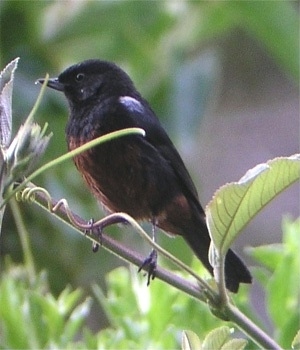
Identifying the Merida Flowerpiercer involves noting its distinctive plumage and behavior. Adults exhibit a sleek, dark plumage with a striking deep blue-black coloration on the upper parts, while their underparts present a contrasting lighter bluish-gray. This color contrast aids in distinguishing it from other sympatric species. Juvenile Merida Flowerpiercers, however, display a duller, more muted version of the adult colors, which can sometimes lead to confusion with other juvenile tanagers.
Male and female Merida Flowerpiercers show little sexual dimorphism, both sharing similar plumage colors, which is uncommon among many bird species. This similarity suggests that both sexes play significant roles in territory defense and foraging. While perched, the bird displays a characteristic upright posture, often flicking its wings and tail in a animated manner. In flight, the Merida Flowerpiercer presents a compact silhouette, with rapid wingbeats that allow for agile movements within dense foliage.
Observers might confuse it with the closely related Black Flowerpiercer (Diglossa humeralis), but the Merida Flowerpiercer's more vibrant blue tones and localized range help differentiate the two. Its interaction with the environment, such as its unique flowerpiercing technique, also assists in identification within its habitat.
Having trouble telling birds apart? Upload a photo to our bird identification tool for an instant species match.
Merida Flowerpiercer Habitat and Range
Preferred Habitat
The Merida Flowerpiercer inhabits the montane cloud forests of the Venezuelan Andes. These forests are characterized by their high humidity, dense canopy cover, and abundant epiphytes. The bird prefers elevations ranging from 2,000 to 3,500 meters, where the temperature remains cool and stable throughout the year. Within this elevation range, the flowerpiercer can be found in both primary and secondary growth forests, indicating some degree of adaptability to habitat disturbance.
During the breeding season, the Merida Flowerpiercer tends to remain in mature forest areas with dense understory, which provide ample nesting sites and food resources. In contrast, the non-breeding season may see the bird venturing into more open areas, such as forest edges and clearings, where it can form foraging flocks. Urban presence is minimal, as the species prefers the lush, undisturbed environments of its montane habitat. The bird's reliance on specific altitudinal zones makes its habitat particularly vulnerable to climate change and habitat fragmentation.
Geographic Range
The Merida Flowerpiercer is endemic to Venezuela, specifically confined to the Sierra Nevada de Mérida within the Andes. This restricted range makes it a species of particular interest to ornithologists studying endemism and biodiversity in high-altitude environments. Its breeding range overlaps extensively with its year-round range, as it does not migrate long distances. Instead, the bird remains within its preferred montane habitat throughout the year, adjusting its altitude slightly in response to seasonal changes in resource availability.
Population density is highest in protected areas like the Sierra Nevada National Park, where the forest remains relatively intact. Outside of these protected zones, habitat fragmentation poses a significant threat to the Merida Flowerpiercer's populations. The bird does not exhibit major migratory behavior, which confines its ecological impact to a limited geographic area. This sedentary nature, combined with its specialized habitat requirements, highlights the need for targeted conservation efforts within its range.
Want to know which birds visit your area? Browse our backyard birds by location guides for region-specific species lists.
What Does the Merida Flowerpiercer Eat?
The diet of the Merida Flowerpiercer primarily consists of nectar, which it accesses through its distinctive flower-piercing method. This technique involves using its specialized bill to puncture the base of flowers, allowing it to reach the nectar inside. This behavior is particularly prevalent during the flowering seasons of its preferred plant species, such as certain Ericaceae and Melastomataceae.
In addition to nectar, the Merida Flowerpiercer supplements its diet with insects and other small arthropods, particularly during the breeding season when protein demands increase. These are typically gleaned from foliage or caught in flight, showcasing the bird's agility and foraging versatility. The bird's feeding schedule aligns closely with the availability of floral resources, often peaking during the early morning and late afternoon when flowers are most abundant in nectar.
Seasonal diet changes are evident, as the bird shifts focus from predominantly nectar-based feeding to a more balanced intake of insects when flowers are scarce. This adaptability in diet plays a crucial role in the bird's survival and reproductive success within its montane habitat.
Merida Flowerpiercer Behavior and Social Structure
The Merida Flowerpiercer exhibits fascinating social and territorial behaviors, particularly during the breeding season. Pairs often establish and defend territories vigorously, engaging in vocal displays and chases to deter intruders. Courtship involves elaborate displays, where males flutter rapidly to showcase their plumage and vocal abilities to attract females.
Outside the breeding season, the Merida Flowerpiercer may form small foraging flocks, a behavior that enhances feeding efficiency and provides some protection against predators. These flocks are often mixed-species, allowing the flowerpiercer to interact with other nectarivorous and insectivorous birds, broadening their foraging opportunities.
Daily activity patterns show that the Merida Flowerpiercer is most active during the cooler parts of the day, specifically in the early morning and late afternoon. This schedule aligns with its feeding strategy, as nectar availability peaks during these times. In response to predators, the bird relies on its swift flight and dense foliage cover to evade threats. The species' alertness and agility are crucial for its survival, given its conspicuous foraging habits.
Merida Flowerpiercer Nesting and Reproduction
Nesting for the Merida Flowerpiercer involves constructing a compact cup-shaped nest, often located in dense shrubbery or among the epiphytes of its montane forest habitat. The nest, made from fine twigs, grass, and moss, provides a secure environment for egg laying. Nests are typically situated at heights ranging from 1 to 3 meters above ground, ensuring protection from ground-based predators.
The typical clutch size for the Merida Flowerpiercer is two to three eggs. These eggs are incubated primarily by the female over a period of 14 to 16 days. During incubation, the male plays a crucial role by providing food and defending the territory. Once the eggs hatch, both parents participate in feeding the nestlings, which fledge approximately 15 to 18 days post-hatching.
The species usually raises one brood per year, although favorable conditions may lead to a second. This reproductive strategy aligns with the resources available in its montane environment, ensuring that the young have optimal conditions for growth and development.
Merida Flowerpiercer Sounds and Vocalizations
The Merida Flowerpiercer's song is a series of high-pitched, melodious warbles, often delivered from a concealed perch within the forest canopy. This song serves both territorial and mate-attraction functions. Call notes consist of sharp, metallic chips that are used for communication between mates and signaling alarm.
During the dawn chorus, the Merida Flowerpiercer contributes with its distinctive song, which can be heard resonating through the montane forest. Alarm calls are typically more urgent and rapid, alerting other birds to potential danger. Compared to other birds in its habitat, the Merida Flowerpiercer's vocalizations are notably clear and consistent, making it easier to distinguish among the cacophony of forest sounds.
Interesting Facts About the Merida Flowerpiercer
- 1The Merida Flowerpiercer's bill is uniquely adapted to pierce flowers, a technique not common among most bird species.
- 2Despite being a nectarivore, the Merida Flowerpiercer plays an accidental pollinator role in its habitat.
- 3The bird's range is limited to the Venezuelan Andes, making it a key species for studying montane biodiversity.
- 4During the breeding season, the Merida Flowerpiercer becomes highly territorial, defending its chosen area vigorously.
- 5Its song contributes to the morning soundscape of the Venezuelan cloud forests, often heard before dawn breaks.
- 6The presence of the Merida Flowerpiercer indicates a healthy montane forest ecosystem, as it thrives in undisturbed habitats.
- 7Climate change poses a unique threat to the Merida Flowerpiercer, potentially altering its high-altitude habitat.
Merida Flowerpiercer Conservation Status
The Merida Flowerpiercer is currently listed as Least Concern by the IUCN, but its populations face pressures from habitat fragmentation and climate change. Deforestation for agriculture and urban expansion poses significant threats to its montane forest habitat, potentially leading to population declines. Conservation efforts focus on habitat preservation within protected areas like the Sierra Nevada National Park. These efforts aim to maintain the integrity of the montane ecosystems where the Merida Flowerpiercer thrives. Monitoring programs help track population trends and assess the effectiveness of conservation strategies. Historically, the bird's population was more robust, but recent environmental changes underscore the importance of continued conservation actions.
Other Thraupidae Species


Birds Similar to the Merida Flowerpiercer
These species are often confused with the Merida Flowerpiercer due to similar appearance or overlapping range.

