
Micronesian Myzomela
Myzomela rubratra
Order: Passeriformes / Family: Meliphagidae
Wikimedia Commons
About the Micronesian Myzomela
The Micronesian Myzomela (Myzomela rubratra) is a small, vibrant bird found predominantly on the islands of Micronesia, where its bright red plumage stands out against the lush green backdrops of its habitat. This bird belongs to the family Meliphagidae, known as honeyeaters, and is a key pollinator in the ecosystems it inhabits. The Micronesian Myzomela thrives in tropical and subtropical regions, particularly in forested areas. Its range extends across various islands, including the Federated States of Micronesia, Palau, and the Northern Mariana Islands. Its presence is not limited to forests; the bird is also found in coastal and urban settings, where it adapts fluidly to human-altered landscapes. As a nectarivore, the Micronesian Myzomela plays a significant role in pollinating native flora. This ecological role is vital for maintaining the biodiversity and health of the island ecosystems where it resides. During different seasons, the bird may exhibit variations in its foraging behavior, yet it consistently contributes to the pollination process. The Micronesian Myzomela is often observed engaging in brief, energetic flights as it moves between flowering plants. Its role extends beyond pollination, as it is also a crucial part of the food web, serving as prey for larger bird species and providing insight into the health of island ecosystems. The bird's adaptability to various habitats, coupled with its ecological significance, underscores its importance beyond its striking appearance.
The Micronesian Myzomela belongs to the family Meliphagidae, within the order Passeriformes. These birds typically live 5-7 years, with max recorded at 9 years.
How to Identify a Micronesian Myzomela
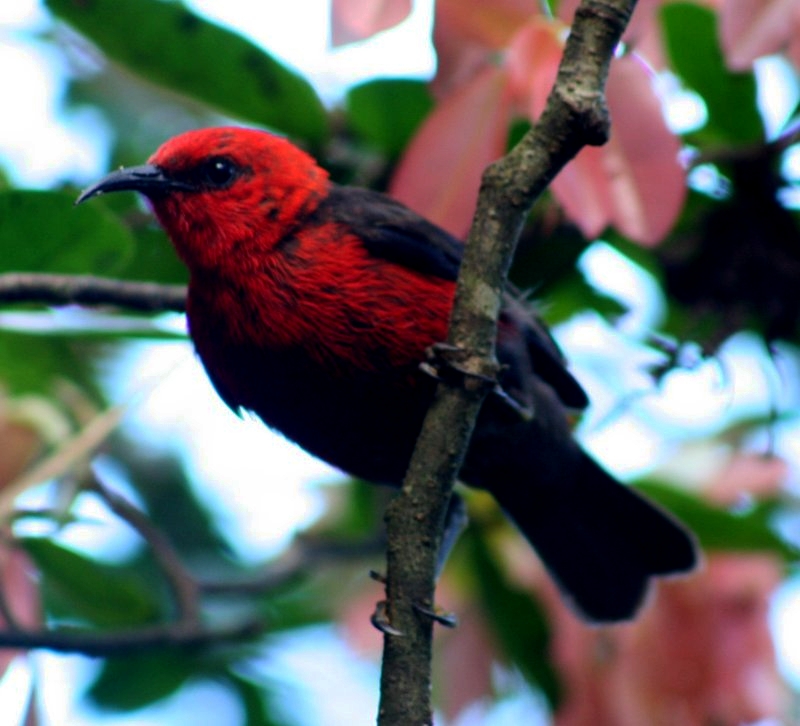
The Micronesian Myzomela is a small bird, measuring about 11-12 cm in length, with a distinctive red head, throat, and chest contrasted by its black wings and tail. Adult males display the most vibrant colors, while females and juveniles are slightly duller, often having a more orange hue. The differences in plumage between the sexes are subtle but can be discerned with careful observation, particularly in the intensity of the red coloration. Juveniles are generally browner with some red tinges emerging as they mature. In flight, the Micronesian Myzomela's silhouette is characterized by rapid wingbeats and agile maneuvering, typical of honeyeaters. Its perching posture is upright, often seen clinging to the sides of trees or hanging from branches while feeding. This species can be confused with other red-plumaged birds in its range, but its small size and unique combination of red and black make it distinguishable to the keen observer.
Having trouble telling birds apart? Upload a photo to our bird identification tool for an instant species match.
Micronesian Myzomela Habitat and Range
Preferred Habitat
The Micronesian Myzomela occupies a variety of habitats, ranging from dense tropical forests to mangroves and coastal areas. It is also frequently spotted in gardens and urban settings, showcasing its adaptability to different environments. Typically found at low elevations, this bird is not restricted to a single habitat type but thrives in areas abundant with flowering plants, which provide its primary food source of nectar. During certain seasons, the Micronesian Myzomela may shift towards areas with higher flower density to optimize its foraging efforts. While it is a common sight in rural areas, its presence in urban settings indicates a level of comfort with human proximity, allowing for easier observation in such locations.
Geographic Range
The Micronesian Myzomela is endemic to the islands of Micronesia, including the Federated States of Micronesia, Palau, the Northern Mariana Islands, and Guam. These birds are non-migratory, residing year-round on these islands where they have established stable populations. While they do not undergo long-distance migrations, the Micronesian Myzomela may exhibit local movements in response to changes in flowering patterns and nectar availability. High-density populations often occur in areas with abundant flowering plants, such as forest edges and coastal regions. The bird's adaptability allows it to occupy diverse habitats across its range, securing its status as a common and widespread species within its territory.
Want to know which birds visit your area? Browse our backyard birds by location guides for region-specific species lists.
What Does the Micronesian Myzomela Eat?
The primary diet of the Micronesian Myzomela consists of nectar, which it skillfully extracts from flowers using its specialized brush-tipped tongue. It shows a preference for flowering plants such as hibiscus and other native flora. During times when nectar is less abundant, the bird supplements its diet with small insects and spiders, providing additional protein. The foraging technique involves hovering or perching at flowers to access nectar efficiently. Seasonal changes in flower availability may lead to shifts in diet, with the bird increasing its intake of insects during lean nectar periods. Typically, the Micronesian Myzomela forages actively throughout the day, capitalizing on peak flowering times to maximize energy intake.
Micronesian Myzomela Behavior and Social Structure
The Micronesian Myzomela exhibits a range of interesting behaviors, including territoriality and social interactions. They are generally solitary or observed in pairs, particularly during breeding seasons when they become more territorial. Males often engage in striking aerial displays to court females, showcasing their agility and bright plumage. These birds are also known for their defensive behavior against intruders, often chasing away rival males or other small birds from their feeding territories. The Micronesian Myzomela is diurnal, active from early morning until late afternoon, with a peak in activity corresponding to the availability of nectar sources. In response to predators, these birds rely on their agile flight and sharp calls to evade threats.
Micronesian Myzomela Nesting and Reproduction
The nesting habits of the Micronesian Myzomela are characterized by meticulous construction and strategic placement. They build cup-shaped nests using grass, bark, and spider silk, placing them on tree branches or shrubs. Preferred nest sites are typically concealed within dense foliage to protect against predators. The clutch size generally consists of two to three eggs, with an incubation period lasting approximately 14 days. Both parents share responsibilities, including feeding and protecting the young. Fledging occurs about 12-14 days after hatching, with both parents continuing to care for the fledglings until they are independent. The species may raise multiple broods per year, depending on food availability and environmental conditions.
Micronesian Myzomela Sounds and Vocalizations
The Micronesian Myzomela produces a series of melodious and high-pitched notes, often described as a sweet, warbling song. These vocalizations serve multiple purposes, including attracting mates and establishing territory. Their call notes are sharp and quick, used to communicate with other myzomelas or signal alarm. During the dawn chorus, the bird's song is particularly prominent, adding a vibrant soundscape to its natural surroundings. While their calls are distinct, they can be somewhat reminiscent of other small songbirds, requiring practice to distinguish accurately.
Interesting Facts About the Micronesian Myzomela
- 1The Micronesian Myzomela is among the smallest honeyeaters, measuring just 11-12 cm in length.
- 2Despite its size, the bird has a disproportionately loud and complex song that rivals larger species.
- 3It uses its unique brush-tipped tongue to efficiently extract nectar from a wide variety of flowers.
- 4The bird's vibrant red plumage is a result of carotenoid pigments obtained from its diet.
- 5The Micronesian Myzomela can hover like a hummingbird to access hard-to-reach flowers, showcasing its agility.
- 6This species is highly adaptable, thriving in both densely forested areas and urban environments.
- 7Micronesian Myzomelas are integral to island ecosystems, acting as key pollinators for native plant species.
Micronesian Myzomela Conservation Status
Currently, the Micronesian Myzomela is listed as a species of Least Concern by the IUCN, with stable population trends across its range. However, habitat loss due to deforestation and urban expansion poses potential threats to its continued stability. Conservation efforts focus on habitat preservation and monitoring population changes. Historically, the species has shown resilience, but ongoing vigilance is necessary to ensure its long-term survival. Protection of critical habitats and awareness campaigns are crucial components of conservation strategies for this vibrant bird.


