
New Caledonian Crow
Corvus moneduloides
Order: Passeriformes / Family: Corvidae
Wikimedia Commons
About the New Caledonian Crow
The New Caledonian Crow (Corvus moneduloides) represents one of the most intelligent avian species, renowned for its sophisticated tool-making and use. These crows inhabit the archipelago of New Caledonia, situated in the southwest Pacific. They typically reside in dense forests, where their cognitive abilities are continually tested and honed. Unlike many bird species, the New Caledonian Crow exhibits complex problem-solving skills that are comparable to those of some primates, making them a focal point of numerous cognitive studies.
Ecologically, these crows play an essential role as both predators and scavengers, impacting the populations of various invertebrates and contributing to the ecosystem's health. Their presence in the forests aids in controlling insect populations, which can otherwise become pests. Furthermore, their behavior provides insight into the evolution of intelligence and tool use in animals.
The New Caledonian Crow has adapted to exploit the resources available in its environment efficiently. This includes using tools crafted from twigs, leaves, and other natural materials to extract insects and other prey from crevices. Such behavior is particularly pronounced during the breeding season, when the demand for food increases. Seasonally, crows may adjust their foraging strategies and locations to match the availability of resources, demonstrating their flexibility and intelligence.
In terms of conservation, the New Caledonian Crow is currently not considered endangered, but habitat destruction poses a potential threat. The preservation of New Caledonia's forests is crucial to sustaining the crow's population and the complex ecological relationships it maintains. Continued research into their behavior not only enriches our understanding of avian intelligence but also underscores the importance of protecting their natural habitats.
The New Caledonian Crow belongs to the family Corvidae, within the order Passeriformes. These birds typically live average 10 years with a maximum recorded of 20 years.
How to Identify a New Caledonian Crow
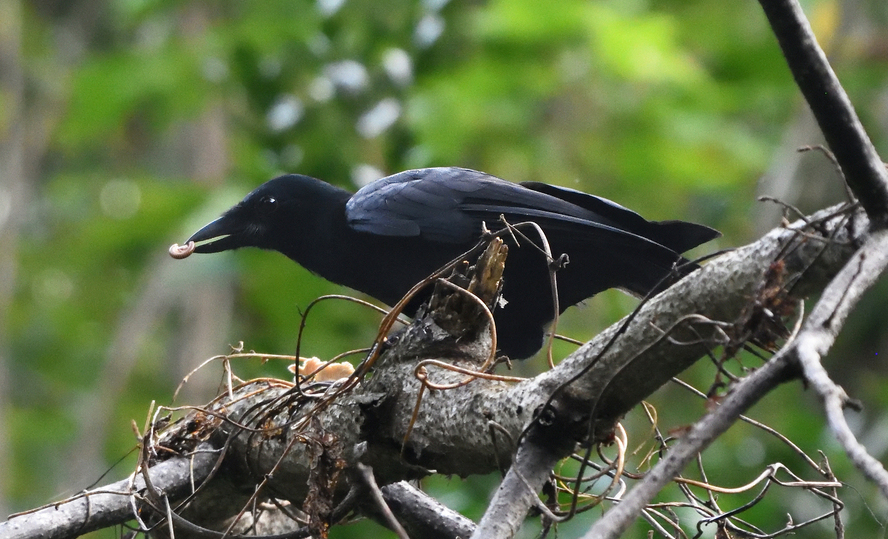
The New Caledonian Crow presents a distinctive appearance with its medium-sized body, glossy black plumage, and strikingly intelligent eyes. Adult crows measure about 40 cm in length with a wingspan reaching up to 56 cm. Their plumage is uniformly black, although it may exhibit a purplish sheen under certain lighting conditions. The bill is robust and slightly curved, well-suited for manipulating objects and crafting tools.
Juvenile crows resemble adults but may exhibit slightly duller plumage and less pronounced sheen. In terms of sexual dimorphism, males and females appear very similar, making it challenging to differentiate between them based on appearance alone. However, slight size variations may exist, with males being marginally larger on average.
In flight, the New Caledonian Crow displays a strong and steady wingbeat, with broad wings and a fan-shaped tail. Their flight silhouette is characteristic of the Corvidae family, aiding in identification. When perched, these crows exhibit a confident posture, often seen tilting their heads inquisitively as they assess their surroundings. Compared to other black crow species, the New Caledonian Crow's tool-using behavior and unique habitat preferences provide definitive identification markers.
Having trouble telling birds apart? Upload a photo to our bird identification tool for an instant species match.
New Caledonian Crow Habitat and Range
Preferred Habitat
The New Caledonian Crow thrives in the subtropical forests of New Caledonia, particularly favoring humid, dense forest regions with an abundance of resources. These areas provide the necessary materials for their tool-making activities and a rich supply of invertebrates for sustenance. They can be found from sea level to montane forests at elevations up to 1,500 meters.
Seasonal habitat shifts are minimal due to the relatively stable climate of New Caledonia, but minor adjustments may occur in response to food availability. While primarily associated with rural and forested environments, they occasionally venture into more open areas and edge habitats when foraging.
Unlike some corvids, the New Caledonian Crow does not typically inhabit urban areas, as their reliance on forest resources and natural materials for tool use ties them closely to more pristine environments. Conservation of these natural habitats is vital for maintaining the crow's ecological niche and supporting its complex behaviors.
Geographic Range
The New Caledonian Crow is endemic to the islands of New Caledonia, located in the southwest Pacific Ocean. This range encompasses the main island of Grande Terre as well as several smaller surrounding islands. Within this limited geographical area, the crow's distribution is fairly consistent, inhabiting both the eastern and western slopes of Grande Terre.
Due to New Caledonia's isolation, the New Caledonian Crow does not migrate and is considered a year-round resident within its habitat. As a result, these crows are not found outside the archipelago, making their population density most concentrated in the forested regions of New Caledonia.
Despite their restricted range, the population appears stable, benefiting from the relatively undisturbed forest environments. However, ongoing habitat monitoring is essential to ensure that any changes in land use or deforestation do not negatively impact their habitats and population dynamics.
Want to know which birds visit your area? Browse our backyard birds by location guides for region-specific species lists.
What Does the New Caledonian Crow Eat?
The diet of the New Caledonian Crow primarily consists of invertebrates, with a particular focus on beetle larvae and other insects. These crows are adept at extracting prey from difficult-to-reach places by using tools fashioned from twigs, leaves, and even their own feathers. Such tool use is not only a hallmark of their foraging strategy but also underscores their exceptional cognitive abilities.
Seasonal variations in food availability can lead to shifts in diet, with crows consuming more plant matter, such as seeds and fruits, during periods when insect prey is scarcer. They may also feed on small vertebrates and carrion if the opportunity arises.
Foraging occurs throughout the day, with peaks in activity observed during the morning and late afternoon when conditions are optimal. Their ability to adapt their diet based on resource availability highlights their ecological flexibility and ensures their survival in New Caledonia's diverse habitats.
New Caledonian Crow Behavior and Social Structure
The social structure of the New Caledonian Crow is complex, with both solitary and social behaviors observed. While they often forage alone or in pairs, they may also form small family groups or loose flocks, particularly outside the breeding season. These crows are highly territorial, with pairs defending their nesting and foraging areas against intruders.
Courtship displays involve a variety of vocalizations and physical gestures, with males presenting food or engaging in mutual preening with females as part of the bonding process. Such displays not only strengthen pair bonds but also ensure successful mating.
When faced with predators, New Caledonian Crows exhibit alertness and may employ mobbing tactics to drive them away. Their intelligence is evident in their ability to assess threats and respond appropriately, often using vocalizations to alert others in the vicinity.
Daily activity patterns revolve around foraging and tool use, with crows exhibiting clear peaks of activity during daylight hours. They spend considerable time crafting and using tools to access food, a behavior that occupies much of their day and underscores their remarkable problem-solving skills.
New Caledonian Crow Nesting and Reproduction
New Caledonian Crows build their nests high in the canopy of forest trees, utilizing twigs, leaves, and other plant materials to construct a sturdy platform. Nest sites are carefully selected, often located in well-concealed areas to protect from predators.
The typical clutch size ranges from two to three eggs, with incubation primarily undertaken by the female over approximately 18-20 days. During this period, the male plays a crucial role in providing food for the incubating female, ensuring she remains nourished.
Once hatched, the chicks remain in the nest for about 30-40 days, during which both parents contribute to feeding and caring for the young. Parental roles are well-defined, with both ensuring the chicks' survival through constant feeding and protection. The number of broods per year is typically one, with the breeding season aligning with periods of abundant food availability.
New Caledonian Crow Sounds and Vocalizations
The vocal repertoire of the New Caledonian Crow includes a variety of calls and songs, characterized by rhythmic caws and clicks. Their primary song comprises a series of repeated cawing notes, often used to communicate with mates or signal territory presence.
Alarm calls are harsher and more rapid, alerting other crows to potential dangers. These calls are crucial for maintaining group safety and are often accompanied by visual displays.
During the dawn chorus, New Caledonian Crows engage in vocal exchanges that establish daily territories and social connections. Compared to other crow species, their sounds may seem more subdued, yet they convey a rich array of information critical to their social structure.
Interesting Facts About the New Caledonian Crow
- 1The New Caledonian Crow can create tools with multiple steps, a skill rare among animals.
- 2Studies show that these crows can solve complex puzzles, sometimes outperforming young children.
- 3New Caledonian Crows have been observed crafting hooked tools from twigs, a behavior seen in no other non-human animal.
- 4They can remember human faces and use this skill to recognize potential threats or allies.
- 5These crows can use their tools to access food sources up to 30 cm deep within tree bark.
- 6Despite their intelligence, New Caledonian Crows have a relatively small brain compared to primates.
- 7Their tool-making skills are often passed down through generations, reflecting a form of cultural learning.
New Caledonian Crow Conservation Status
The New Caledonian Crow is listed as Least Concern by the IUCN, with a stable population trend. However, habitat loss due to logging and land development poses significant threats to their future. Conservation efforts focus on preserving New Caledonia's unique forest ecosystems, essential for the crow's survival. Historical population changes have been minimal, thanks in part to New Caledonia's relative isolation. Nonetheless, continued monitoring is necessary to prevent unforeseen declines. Efforts include habitat protection and raising awareness about the crow's ecological importance and unique cognitive abilities.


