
Nilgiri Flowerpecker
Dicaeum concolor
Order: Passeriformes / Family: Dicaeidae
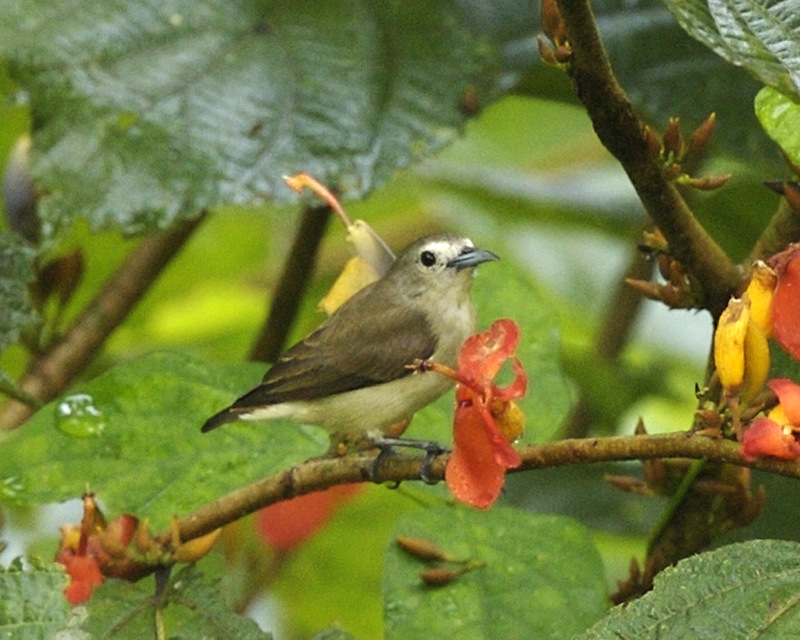
Wikimedia Commons
About the Nilgiri Flowerpecker
The Nilgiri Flowerpecker, scientifically known as Dicaeum concolor, is a small passerine bird that captivates birdwatchers with its lively presence in the diverse landscapes of southern India. Endemic to the Western Ghats and surrounding regions, this species often inhabits forest edges, gardens, and plantations where it plays a crucial role as a pollinator and seed disperser. Its ecological significance extends beyond its diminutive size, as it contributes to the health of forest ecosystems by aiding in the propagation of various plant species. Observers often spot these birds flitting around shrubs and small trees, especially those with bright berries and flowers, showcasing their preference for habitats rich in floral diversity.
In the Western Ghats, the Nilgiri Flowerpecker finds refuge in the lush, montane forests that are characterized by high humidity and a broad array of flowering plants. These forests offer an ideal setting for the bird's feeding habits and reproductive activities. The bird's presence in these biodiverse areas highlights its adaptability to both primary and secondary forests, including those altered by human activities like tea and coffee plantations. Despite the challenges posed by habitat fragmentation, the Nilgiri Flowerpecker maintains a stable presence across its range, indicating a level of resilience often seen in species with specialized diets and ecological roles.
Seasonal behaviors of the Nilgiri Flowerpecker include slight altitudinal movements in response to flowering seasons and fruit availability. During the monsoon season, when the Western Ghats become a verdant paradise, these birds increase their feeding activity, taking advantage of the abundance of food resources. This period also coincides with their breeding season, ensuring that ample nutrition supports the development of their young. Outside of breeding, these birds maintain a consistent presence, their activities dictated by the availability of flowering and fruiting plants. The Nilgiri Flowerpecker's adaptability to varying environmental conditions within its range underscores its importance as a keystone species in these lush habitats.
The Nilgiri Flowerpecker belongs to the family Dicaeidae, within the order Passeriformes. These birds typically live average 4-6 years; max recorded 8 years.
How to Identify a Nilgiri Flowerpecker
The Nilgiri Flowerpecker, a diminutive bird measuring approximately 8 to 10 cm in length, exhibits distinctive plumage that aids identification. Adults boast a primarily olive or grayish-olive body with a subtle sheen, enabling them to blend seamlessly into the foliage where they forage. The underparts are lighter, often appearing whitish or buff. This muted coloration provides effective camouflage against predators and keen-eyed observers alike. Males and females exhibit similar plumage, making sex differentiation challenging in the field. However, during the breeding season, males may exhibit slightly more vibrant plumage, a trait not always reliable for identification. Juveniles resemble adults but tend to have duller plumage, lacking the subtle sheen that characterizes mature birds.
When observing the Nilgiri Flowerpecker, note its compact and robust body structure, which is typical among the Dicaeidae family. The bird's short, stout bill is adapted for extracting nectar and consuming small fruits, a key characteristic that differentiates it from similar species. Observers might confuse the Nilgiri Flowerpecker with other small passerines like sunbirds, but a closer look reveals differences in bill shape and feeding behavior. In flight, the bird displays rapid, direct flight patterns, often moving swiftly between feeding sites.
Perching posture is another useful field mark, as the Nilgiri Flowerpecker often adopts a slightly forward-leaning position on branches, a behavior linked to its feeding habits. The bird's energetic movement is a constant, as it rarely remains still for long periods. Observing these traits can greatly assist in the accurate identification of the Nilgiri Flowerpecker, even amidst the rich biodiversity of its habitats.
Having trouble telling birds apart? Upload a photo to our bird identification tool for an instant species match.
Nilgiri Flowerpecker Habitat and Range
Preferred Habitat
The Nilgiri Flowerpecker thrives in diverse habitats ranging from forest edges to human-altered landscapes such as gardens and plantations. It predominantly inhabits the tropical and subtropical moist broadleaf forests of the Western Ghats, particularly favoring areas with abundant flowering plants. This bird shows a preference for altitudes between 600 and 2000 meters, although it can occasionally be found at lower elevations, especially during non-breeding seasons when it seeks food sources in gardens and orchards.
In addition to natural forests, the Nilgiri Flowerpecker adapts well to secondary forests and areas with significant human presence, such as tea and coffee plantations. These plantations offer a suitable habitat due to their floral diversity and constant availability of fruits and nectar. The bird's ability to exploit these modified environments is a testament to its ecological versatility.
Seasonal shifts in habitat use are primarily driven by flowering and fruiting patterns. During peak flowering seasons, the Nilgiri Flowerpecker gravitates towards areas with the highest floral abundance, ensuring a steady supply of nectar. This adaptability allows the bird to maintain its presence across various landscapes despite the ongoing challenges of habitat modification and fragmentation.
Geographic Range
The Nilgiri Flowerpecker is endemic to the Western Ghats of southern India, with its range extending into parts of the Eastern Ghats and occasionally into Sri Lanka. Within this region, the bird is a year-round resident, exhibiting minimal migratory behavior. Its presence is strongly associated with the montane and lowland forests of Kerala, Tamil Nadu, and Karnataka, where it finds ample food resources and suitable breeding conditions.
Population density tends to be higher in the Western Ghats' core areas, particularly in protected reserves like the Silent Valley National Park and the Periyar Tiger Reserve. These areas offer pristine habitats with minimal human disturbance, allowing the Nilgiri Flowerpecker to thrive. Outside these hotspots, the bird can still be found in fragmented forest patches and agricultural landscapes, although its numbers may be lower due to habitat degradation.
Despite its relatively limited range, the Nilgiri Flowerpecker's adaptability to various habitats within its geographic confines ensures its continued presence throughout the year. The bird's reliance on specific environmental conditions, such as the availability of flowering plants, further delineates its distribution, highlighting the importance of habitat conservation in its range.
Want to know which birds visit your area? Browse our backyard birds by location guides for region-specific species lists.
What Does the Nilgiri Flowerpecker Eat?
The diet of the Nilgiri Flowerpecker predominantly consists of nectar and small fruits, which it skillfully extracts using its specialized bill. This dietary preference underscores the bird's role as an important pollinator within its ecosystem. The bird often visits a variety of flowering plants, including Loranthus and other mistletoe species, to feed on their nectar. In addition to nectar, the Nilgiri Flowerpecker consumes small berries and fruits, which provide essential nutrients and energy.
Seasonal changes in the availability of food resources influence the bird's diet. During the flowering seasons, nectar becomes a primary food source, while fruit consumption increases during times when berries are more abundant. This flexibility in diet is crucial for the bird's survival, particularly in environments where food availability can fluctuate significantly.
Foraging typically occurs during the early morning and late afternoon, coinciding with peak nectar production in many plants. The Nilgiri Flowerpecker utilizes a hovering technique to access nectar, similar to that of hummingbirds, although it also perches while feeding. Its small size allows it to navigate dense foliage effectively, ensuring access to a wide range of food sources. This feeding behavior highlights the bird's adaptability and its critical ecological role in pollination and seed dispersal.
Nilgiri Flowerpecker Behavior and Social Structure
The Nilgiri Flowerpecker exhibits a variety of behaviors that reflect its adaptation to its environment and its ecological role. Primarily solitary or found in pairs, this bird shows a strong territorial instinct, particularly during the breeding season. Males often engage in displays to assert dominance over a territory, which includes areas with abundant flowering plants and fruits.
Courtship displays are subtle yet significant, involving vocalizations and aerial maneuvers. The male may present food items to the female as part of the courtship process, a behavior that demonstrates its ability to provide. Once paired, the birds maintain a close bond, with both participating in nesting duties.
In terms of social structure, the Nilgiri Flowerpecker is not typically gregarious, although it may join mixed-species foraging flocks outside the breeding season. This behavior provides safety in numbers and increases foraging efficiency. The bird's response to predators includes swift, darting flights into dense foliage, where it remains concealed and safe from threats.
Daily activity patterns of the Nilgiri Flowerpecker include periods of intense foraging interspersed with rest during the hotter parts of the day. Its consistent presence in gardens and forests underscores its adaptability and the importance of these environments for its daily survival.
Nilgiri Flowerpecker Nesting and Reproduction
The Nilgiri Flowerpecker constructs a small, purse-shaped nest, often crafted from plant fibers, spider webs, and lichens. These materials are meticulously woven together to form a compact structure, which the bird typically suspends from the fork of a branch. The choice of nesting site often correlates with the availability of food resources, ensuring that the parents have easy access to nourishment during the chick-rearing period.
Preferred nesting locations include trees and shrubs in forested areas, gardens, and even plantations, where the bird can find suitable materials and a degree of protection from predators. The clutch size for the Nilgiri Flowerpecker usually ranges from two to three eggs, which the female incubates exclusively for about 14 to 16 days.
After hatching, both parents participate in feeding the chicks, which fledge approximately 14 to 18 days post-hatching. The young birds receive care and feeding assistance from their parents for a brief period after leaving the nest, during which they learn crucial survival skills. Typically, the Nilgiri Flowerpecker produces one to two broods per year, depending on environmental conditions and food availability.
Nilgiri Flowerpecker Sounds and Vocalizations
The Nilgiri Flowerpecker's vocalizations are characterized by a series of high-pitched, rapid notes that often resemble a series of 'tseep' sounds. These calls serve multiple functions, including communication between mates and signaling territorial presence. The bird's song, although not complex, is a consistent and recognizable element of its presence in its habitat.
Alarm calls are sharper and more urgent, designed to alert other birds and deter potential predators. During the dawn chorus, the Nilgiri Flowerpecker's voice contributes to the symphony of sounds in its environment, though it is more subdued than those of some larger passerines.
Observers often describe the bird's song as reminiscent of the calls of other small passerines, yet distinct enough to serve as an identifying characteristic for those familiar with its vocal repertoire. The Nilgiri Flowerpecker's sounds, while not melodious, play a vital role in its social interactions and territorial behaviors.
Interesting Facts About the Nilgiri Flowerpecker
- 1The Nilgiri Flowerpecker measures just 8 to 10 cm in length, making it one of the smallest birds in its range.
- 2Despite its size, the Nilgiri Flowerpecker plays a significant role in pollination, particularly in mistletoe species.
- 3This bird is capable of hovering in place, a feeding technique it uses to access nectar from flowers.
- 4The Nilgiri Flowerpecker's nest is intricately woven with spider webs, demonstrating remarkable construction skills.
- 5These birds can be seen year-round in the Western Ghats, showcasing minimal migratory behavior and strong site fidelity.
- 6The Nilgiri Flowerpecker's call is often described as 'tseep,' a simple yet distinctive sound in its habitat.
- 7Both male and female Nilgiri Flowerpeckers participate in feeding their young, ensuring efficient parental care.
Nilgiri Flowerpecker Conservation Status
The Nilgiri Flowerpecker is currently listed as a species of Least Concern by the IUCN, indicating a stable population trend. However, ongoing habitat loss and fragmentation pose significant threats to its continued well-being. The expansion of agriculture and urbanization in the Western Ghats region has led to the degradation of its natural habitats, necessitating conservation efforts to ensure its survival. Conservation initiatives focus on preserving the rich biodiversity of the Western Ghats through the establishment of protected areas and the promotion of sustainable land-use practices. These efforts aim to mitigate the impacts of human activities and maintain the ecological integrity of the region's forests. Historically, the Nilgiri Flowerpecker has remained relatively resilient, with its adaptability to modified environments aiding its persistence. Continued monitoring of its population trends and habitat conditions will be crucial in maintaining its status and ensuring its role as a pollinator and seed disperser within its ecosystem.


