
Nilgiri Thrush
Zoothera neilgherriensis
Order: Passeriformes / Family: Turdidae
Wikimedia Commons
About the Nilgiri Thrush
The Nilgiri Thrush, scientifically known as Zoothera neilgherriensis, is a captivating bird species endemic to the Western Ghats of India. This thrush plays a significant role in the ecosystem as both a seed disperser and an insect controller. The Western Ghats, a UNESCO World Heritage site, provide a unique habitat that supports the thriving population of this bird. These birds prefer the dense, moist evergreen forests at elevations ranging from 600 to 2000 meters, where they can exploit the rich biodiversity for their survival.
During the breeding season, which occurs between March and June, Nilgiri Thrushes become more vocal, announcing their presence with a series of melodious calls. Their primary breeding grounds are found in the Nilgiris, Anamalai, and the Palani Hills, where the dense canopy offers protection and abundant food resources. Outside the breeding season, they exhibit more secretive behavior, often retreating deeper into the forest.
Ecologically, the Nilgiri Thrush contributes to forest regeneration through seed dispersal, primarily from the fruits it consumes. By controlling insect populations, particularly during the breeding season when their dietary needs increase, they help maintain a balanced ecosystem. This thrush is a shining example of the intricate interdependence between avian species and their habitats in the Western Ghats.
The Nilgiri Thrush belongs to the family Turdidae, within the order Passeriformes. These birds typically live average 7 years with a maximum recorded of 10 years..
How to Identify a Nilgiri Thrush
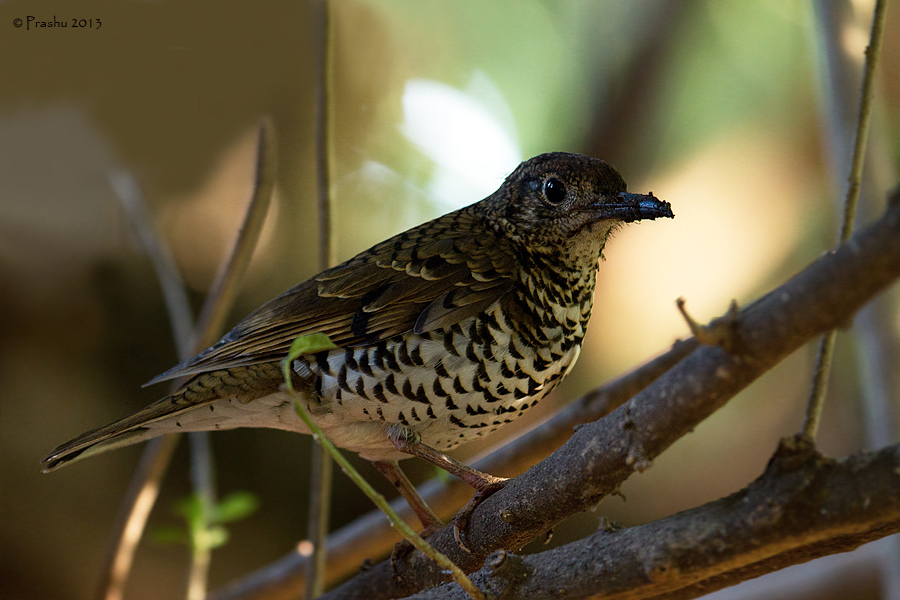
The Nilgiri Thrush presents a striking appearance with its olive-brown upperparts and heavily spotted underparts. Adults are easily identified by their white underparts marked with bold, blackish crescent-shaped spots. The head features a distinct white throat, bordered by a fine black line, and a yellowish-orange beak. The eye-ring is usually a pale yellow, providing a noticeable contrast against its darker head.
Juvenile Nilgiri Thrushes tend to exhibit less defined spotting and a more muted color palette compared to adults, with a buffier overall appearance. Males and females show little sexual dimorphism, making them challenging to distinguish without closer observation or during specific behaviors such as courtship. In-flight, the thrush displays a distinctive silhouette characterized by broad, rounded wings and a slightly long tail.
The species can be confused with other Zoothera thrushes, such as the Scaly Thrush, but can be distinguished by its unique plumage details and vocal patterns. When perched, the Nilgiri Thrush maintains an upright posture, often flicking its wings and tail, particularly when agitated or alert.
Having trouble telling birds apart? Upload a photo to our bird identification tool for an instant species match.
Nilgiri Thrush Habitat and Range
Preferred Habitat
The Nilgiri Thrush thrives in the dense, moist evergreen forests of the Western Ghats. These forests provide the bird with ample cover and resources, supporting its lifestyle and breeding activities. Typically, the thrush inhabits altitudes between 600 and 2000 meters, favoring areas with thick undergrowth and a rich canopy.
During the monsoon, when the lowland regions become waterlogged, these birds may shift to slightly higher elevations where conditions are more stable. While primarily a forest dweller, the Nilgiri Thrush can sometimes be found near forest edges or in secondary growth forests, especially if these areas offer dense vegetation and abundant food supplies.
Urban encroachment has limited the bird's habitat to less disturbed areas, making pristine forest regions crucial for its survival. Unlike some other thrush species, the Nilgiri Thrush rarely ventures into open or urbanized areas, maintaining a clear preference for secluded forest environments.
Geographic Range
The Nilgiri Thrush is endemic to the Western Ghats in southern India. Its range extends from the Nilgiri Hills in the north to the southern reaches of the Anamalai and Palani Hills. These regions, characterized by high biodiversity and unique ecological features, are vital for the thrush's survival.
The bird's breeding range is primarily concentrated in the higher altitudinal zones of these hills, where dense forest cover provides the necessary resources and protection. During the non-breeding season, the thrush may exhibit limited altitudinal migration, moving slightly downslope but remaining within the core range of the Western Ghats.
Population density hotspots are typically found in well-preserved forest areas within these hills, such as the Mukurthi National Park and Silent Valley National Park. These protected areas offer the thrush a sanctuary from habitat loss and fragmentation, which are significant threats to its population.
Want to know which birds visit your area? Browse our backyard birds by location guides for region-specific species lists.
What Does the Nilgiri Thrush Eat?
The Nilgiri Thrush primarily feeds on a diverse diet of insects and fruits, displaying flexibility that allows it to exploit various forest resources. Insects such as beetles, ants, and caterpillars form a substantial part of its diet, especially during the breeding season when protein demand increases.
Fruits and berries, sourced from a variety of forest plants, provide essential sugars and nutrients. The thrush's preference for fruit increases in the non-breeding season, aiding in seed dispersal across its habitat. This dietary shift aligns with the seasonal availability of these food sources in the Western Ghats.
Foraging behavior typically involves ground feeding, where the bird uses its keen eyesight to spot prey. It occasionally employs a 'hop and pause' technique to flush out insects from the undergrowth. Feeding generally occurs during the early morning and late afternoon, taking advantage of cooler temperatures and reduced competition.
Nilgiri Thrush Behavior and Social Structure
The Nilgiri Thrush exhibits a solitary nature, often seen alone or in pairs during the breeding season. It is highly territorial, with males aggressively defending their chosen breeding grounds through song and display. Courtship involves the male showcasing his plumage and singing to attract a mate.
Despite their solitary tendencies, these thrushes may join mixed-species flocks, primarily when foraging. This behavior offers protection and increases feeding efficiency by reducing the risk of predation. The Nilgiri Thrush is diurnal, with peak activities occurring during dawn and dusk when it forages and defends its territory.
Upon detecting a predator, such as a raptor or snake, the bird employs a series of alarm calls to alert nearby conspecifics. These vocalizations are sharp and repetitive, intended to deter the predator and warn other birds. During the non-breeding season, the thrush becomes more reclusive, spending more time in dense cover to avoid detection.
Nilgiri Thrush Nesting and Reproduction
Nilgiri Thrushes construct nests primarily composed of twigs, leaves, and moss, typically situated in the fork of a tree or dense shrub. These nests are usually located several meters above ground, providing safety from ground predators.
The typical clutch size ranges from 2 to 3 eggs, with the female solely responsible for incubation over approximately two weeks. During this period, the male plays a supportive role by providing food and maintaining territory security.
After hatching, both parents participate in feeding and caring for the chicks. The fledging period lasts about two weeks, during which the young develop essential skills for survival. Often, the thrushes raise one or two broods per year, depending on environmental conditions and food availability.
Nilgiri Thrush Sounds and Vocalizations
The Nilgiri Thrush is renowned for its melodious and complex song, characterized by clear, flute-like notes delivered in a repetitive sequence. Its song serves both territorial and mating purposes, often heard at dawn when the forest resonates with their calls.
Call notes are typically short and sharp, used for communication between mates or signaling alarm. These calls vary in pitch and intensity, depending on the context of the interaction. Alarm calls are particularly distinct, consisting of rapid, high-pitched sequences designed to alert others to danger.
Compared to other thrush species, the Nilgiri Thrush's song has a richer timbre and greater complexity, making it a treasured sound in its native forests. Its dawn chorus behavior contributes to the acoustic tapestry of the Western Ghats, reinforcing its presence and territorial claims.
Interesting Facts About the Nilgiri Thrush
- 1The Nilgiri Thrush can mimic the calls of other bird species, showcasing its impressive vocal range.
- 2Endemic to the Western Ghats, the Nilgiri Thrush plays a vital role in this biodiversity hotspot.
- 3During the breeding season, the Nilgiri Thrush’s song can be heard over a kilometer away.
- 4This species’ diet shifts seasonally, highlighting its adaptability to changing food availability.
- 5The Nilgiri Thrush’s distinctive song patterns are used by researchers to monitor populations.
- 6Unlike many thrushes, the Nilgiri Thrush rarely visits urban areas, preferring dense forests.
- 7The Nilgiri Thrush's nesting habits contribute to forest regeneration through seed dispersal.
Nilgiri Thrush Conservation Status
Currently, the Nilgiri Thrush is classified as Near Threatened on the IUCN Red List, with its population trend showing signs of decline. Habitat loss due to deforestation and land conversion for agriculture are primary threats impacting its numbers. Conservation efforts are focused on protecting the forest habitats of the Western Ghats. National parks and wildlife sanctuaries are crucial in providing safe havens for this species. Historical population changes highlight the impact of habitat fragmentation, necessitating ongoing conservation measures. Engagement with local communities and promoting sustainable land-use practices are vital components of conservation strategies. These efforts aim to balance human needs with the ecological integrity required to sustain the Nilgiri Thrush’s populations.


