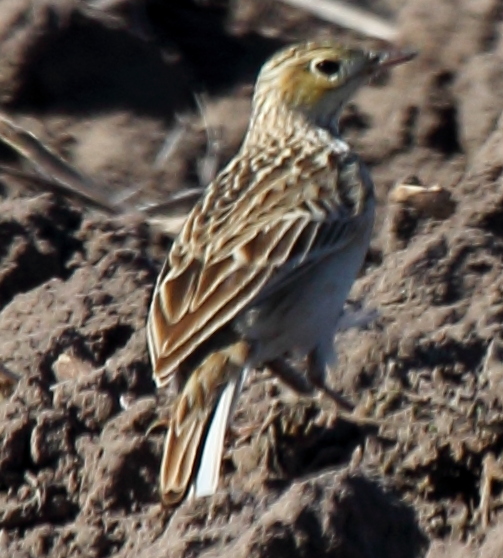
Ochre-breasted Pipit
Anthus nattereri
Order: Passeriformes / Family: Motacillidae

Wikimedia Commons
About the Ochre-breasted Pipit
The Ochre-breasted Pipit, known scientifically as Anthus nattereri, is a small passerine bird native to the grasslands of South America. This bird is a member of the family Motacillidae, which also includes wagtails and longclaws, and is known for its distinctive plumage and ecological significance within its habitat. The Ochre-breasted Pipit is primarily found in the Cerrado, a vast tropical savanna ecoregion of Brazil, and its presence is a key indicator of the health of these grassland ecosystems.
The Ochre-breasted Pipit plays a crucial role in the ecological dynamics of the Cerrado and other grasslands. It helps control insect populations, as it feeds on a variety of small invertebrates. This bird also serves as prey for larger predators, thus fitting neatly into the food web. The Ochre-breasted Pipit is often seen foraging on the ground, where its cryptic plumage provides excellent camouflage against the backdrop of dry grasses and low shrubs, aiding both in its hunting strategy and in evading predators.
Seasonally, the Ochre-breasted Pipit exhibits some nomadic tendencies, often moving in response to climatic changes that affect food availability. During the rainy season, these birds become more conspicuous as they engage in breeding activities. The Cerrado, home to the Ochre-breasted Pipit, experiences a distinct wet and dry season, influencing the bird's behavior and movements. While not considered a long-distance migratory bird, the Ochre-breasted Pipit may adjust its range locally within the vast expanses of the grasslands to find suitable conditions for feeding and breeding.
The Ochre-breasted Pipit is not only a species of interest to ornithologists but also serves as a symbol of the challenges facing grassland ecosystems. As its habitat undergoes transformation due to agricultural expansion and other anthropogenic factors, the Ochre-breasted Pipit stands as a sentinel species, alerting conservationists to the broader environmental changes occurring in the region.
The Ochre-breasted Pipit belongs to the family Motacillidae, within the order Passeriformes. These birds typically live average 3-5 years with a maximum recorded of 7 years.
How to Identify a Ochre-breasted Pipit
The Ochre-breasted Pipit is a small bird, measuring about 15 to 16 centimeters in length with a wingspan of approximately 25 to 28 centimeters. Its most striking feature is the warm ochre hue of its breast, which contrasts with its otherwise muted coloration. The upperparts are predominantly brown with fine streaking, providing excellent camouflage against the grasses of its habitat. The underparts transition from the ochre breast to a paler belly. The legs and bill are relatively slender, characteristic of pipits, aiding in their ground-foraging lifestyle.
Juvenile Ochre-breasted Pipits resemble adults but have a more pronounced streaking on the upperparts and a less intense ochre coloration on the breast. This distinction helps in identifying younger birds during field observations. There is little sexual dimorphism in this species, meaning males and females have similar plumage, which can make differentiation between sexes challenging without close observation.
In flight, the Ochre-breasted Pipit displays a characteristic undulating pattern, typical of pipits, with bursts of rapid wingbeats followed by glides. Its tail is relatively short and often flicked up and down when the bird is perched or walking. Confusion with other pipit species can occur, particularly with the more widespread South American Pipit. However, the ochre breast and specific vocalizations of Anthus nattereri serve as reliable distinguishing marks for experienced birders.
Having trouble telling birds apart? Upload a photo to our bird identification tool for an instant species match.
Ochre-breasted Pipit Habitat and Range
Preferred Habitat
The Ochre-breasted Pipit thrives in open grassland environments, with a particular affinity for the Cerrado region in Brazil. This habitat consists of a mosaic of grasslands interspersed with sparse woody vegetation, providing the ideal conditions for foraging and nesting. The bird is typically found at elevations ranging from 200 to 1,500 meters, though it is most commonly observed in the mid-elevation range where grasslands are extensive.
This species prefers areas with a mix of tall grasses and bare ground, allowing it to efficiently search for insects and other invertebrates. During the dry season, the Ochre-breasted Pipit may move to areas with more moisture, such as the edges of wetlands or seasonally flooded grasslands, where food remains available. Although primarily a rural species, the Ochre-breasted Pipit can occasionally be found on the outskirts of agricultural fields, particularly where traditional grazing practices preserve natural grassland characteristics.
The habitat preferences of the Ochre-breasted Pipit highlight the bird's reliance on intact grassland ecosystems, making it vulnerable to habitat destruction and modification due to agricultural expansion. Conservation efforts for this species often focus on preserving large tracts of native grassland and promoting agricultural practices that maintain habitat integrity.
Geographic Range
The Ochre-breasted Pipit is primarily found in the central and southern grasslands of South America. Its core range includes the Cerrado region in Brazil, extending into parts of Paraguay and northern Argentina. This distribution reflects the bird's preference for the open, savanna-like habitats that dominate these areas.
During the breeding season, the Ochre-breasted Pipit is most commonly observed within the central parts of its range, where grassland habitats are extensive and relatively undisturbed. Breeding territories are established in areas with dense grass cover and access to open ground for foraging. This species does not undertake long-distance migrations, but it exhibits local movements in response to environmental conditions, particularly the availability of food and water.
Population density hotspots are often associated with regions that maintain large expanses of native grassland, such as the Serra da Canastra National Park in Brazil and similar protected areas. These regions provide a refuge from the pressures of agricultural conversion and habitat fragmentation. However, outside protected areas, the Ochre-breasted Pipit faces challenges from habitat loss, making its range increasingly fragmented in some parts.
Want to know which birds visit your area? Browse our backyard birds by location guides for region-specific species lists.
What Does the Ochre-breasted Pipit Eat?
The Ochre-breasted Pipit primarily feeds on a diet of insects and other small invertebrates, which it skillfully picks from the ground. Its foraging technique involves walking or running across open ground, stopping frequently to probe the soil with its slender bill. Common prey items include beetles, grasshoppers, and caterpillars, which are abundant in its grassland habitat.
Seasonal variations in food availability influence the diet of the Ochre-breasted Pipit. During the wet season, when insect populations are at their peak, the bird can be seen taking advantage of the abundance by increasing its feeding activity. In contrast, the dry season may see the Ochre-breasted Pipit expanding its diet to include seeds and other plant materials, as insect availability declines.
The Ochre-breasted Pipit typically forages during the cooler parts of the day, such as early morning and late afternoon. This feeding schedule not only aligns with peak insect activity but also helps the bird avoid the harsh midday sun. The size of prey taken by the Ochre-breasted Pipit generally ranges from small to medium-sized insects, ensuring a steady intake of protein necessary for survival and reproduction.
Ochre-breasted Pipit Behavior and Social Structure
The Ochre-breasted Pipit is a solitary bird during the breeding season, exhibiting strong territorial behavior. Males establish and defend their territories through song and visual displays, often choosing elevated perches from which to sing and survey their domain. These territories are critical for attracting a mate and providing a safe environment for raising young.
Outside the breeding season, the Ochre-breasted Pipit may be observed in small, loose flocks, particularly when moving in search of food. This semi-social behavior allows the birds to benefit from increased vigilance against predators, as well as greater efficiency in locating food resources.
Courtship displays in this species are subtle but fascinating, involving a combination of song, flight displays, and posturing. Males will often perform short display flights, fluttering above potential nesting sites while singing.
In response to predators, the Ochre-breasted Pipit relies on its cryptic plumage and quick reflexes. If threatened, it may freeze in place or take to the air with an undulating flight pattern, designed to evade capture. Daily activity patterns are largely diurnal, with peak activity in the early morning and late afternoon when temperature conditions are most favorable.
Ochre-breasted Pipit Nesting and Reproduction
The Ochre-breasted Pipit constructs a simple yet effective nest, usually a small cup-shaped structure hidden within dense grass. Nests are built by the female and consist of grass stems, leaves, and fine rootlets, providing both camouflage and insulation for the eggs.
Preferred nesting locations include areas with tall grass cover, offering protection from predators and harsh environmental conditions. Clutch size typically ranges from two to four eggs, which are incubated by the female for about 12 to 14 days. During this period, the male plays an active role in defending the territory and bringing food to the nesting female.
Once the eggs hatch, both parents participate in feeding the chicks, which remain in the nest for another 10 to 12 days before fledging. After fledging, the young continue to rely on parental care for a short period as they learn to forage independently. The Ochre-breasted Pipit usually raises one or two broods per year, depending on environmental conditions and food availability.
Ochre-breasted Pipit Sounds and Vocalizations
The primary song of the Ochre-breasted Pipit is a melodious series of high-pitched notes, delivered in a rapid sequence. This song serves to establish territory and attract a mate during the breeding season. The song is often accompanied by display flights, adding a visual element to the acoustic performance.
In addition to its song, the Ochre-breasted Pipit produces a variety of call notes used for communication between individuals. These include a soft "tsip" call, frequently heard when birds are foraging in loose flocks. Alarm calls are sharper and more urgent, designed to alert conspecifics of nearby danger.
The dawn chorus of the Ochre-breasted Pipit is a particularly vibrant time for vocal activity, with males singing persistently from early morning to declare their presence and readiness for breeding. Compared to other grassland birds, the Ochre-breasted Pipit's song is relatively complex and musical, making it a delightful addition to the soundscape of its habitat.
Interesting Facts About the Ochre-breasted Pipit
- 1The Ochre-breasted Pipit can walk up to 2 kilometers per day while foraging, highlighting its active lifestyle.
- 2Despite its small size, the Ochre-breasted Pipit plays a big role in controlling pest insect populations in the Cerrado.
- 3The intricate song of the Ochre-breasted Pipit can carry up to 500 meters in open grasslands, helping males establish wide territories.
- 4Ochre-breasted Pipits have been known to mimic the calls of other grassland birds, showcasing their vocal versatility.
- 5The Ochre-breasted Pipit is one of the few pipit species adapted to the unique Cerrado ecosystem, reflecting its specialized niche.
- 6Studies show that Ochre-breasted Pipits prefer nesting sites with at least 60% grass cover, emphasizing their reliance on grassland habitats.
- 7The species' ochre breast feathers are not only attractive but also serve as a critical camouflage mechanism against predators.
Ochre-breasted Pipit Conservation Status
The Ochre-breasted Pipit is currently classified as Near Threatened on the IUCN Red List. This status reflects a declining population trend, mainly due to habitat loss and degradation. The conversion of grasslands to agriculture, particularly soy and cattle farming, poses a significant threat to the species' habitat. Conservation efforts for the Ochre-breasted Pipit focus on habitat preservation and the promotion of sustainable agricultural practices. Protected areas, such as national parks and reserves, play a critical role in safeguarding essential grassland habitats. Historically, the population of the Ochre-breasted Pipit has been much more widespread, but increasing anthropogenic pressures have led to a contraction of its range. Continued monitoring and research are necessary to better understand the species' ecology and inform effective conservation strategies.