
Oriental Stork
Ciconia boyciana
Order: Ciconiiformes / Family: Ciconiidae
Wikimedia Commons
About the Oriental Stork
The Oriental Stork, Ciconia boyciana, is a remarkable species endemic to East Asia, primarily inhabiting regions like China, Japan, and the Russian Far East. This large, stately bird stands out with its impressive wingspan, often exceeding 2 meters, and its stark contrast of white body feathers against black primary feathers. Historically revered in many cultures, the Oriental Stork plays a significant role in ecosystems as both a predator and a symbol of good fortune. Its presence in wetlands and riverine environments indicates healthy ecosystems, where it preys on a variety of aquatic organisms. Seasonally, the Oriental Stork migrates between its breeding grounds in northeastern China and Russia and its wintering areas in southeastern China and occasionally in Japan and Korea. This migration underscores the connectivity of habitats across geographic boundaries and highlights the stork's role in dispersing nutrients and impacting local food webs. During the breeding season, the Oriental Stork relies on specific wetland habitats for nest-building, typically choosing tall trees or man-made structures in floodplains. These nesting sites provide a vantage point and safety from terrestrial predators. In winter, the stork shifts to more diverse habitats, including rice paddies and marshlands, reflecting its adaptability and the cultural landscapes it inhabits. The stork's ecological role extends beyond predation, as it influences fish and amphibian populations, contributing to the balance of these communities. Its feeding activities aerate soil and promote nutrient cycling, benefiting other species within these ecosystems. The Oriental Stork's reliance on wetlands for both breeding and feeding underscores the importance of these habitats, which are increasingly threatened by human activities such as agriculture and urban development. Conservation efforts have become pivotal in preserving these critical habitats and ensuring the survival of this emblematic species.
The Oriental Stork belongs to the family Ciconiidae, within the order Ciconiiformes. These birds typically live average 20-25 years with max recorded 40 years.
How to Identify a Oriental Stork
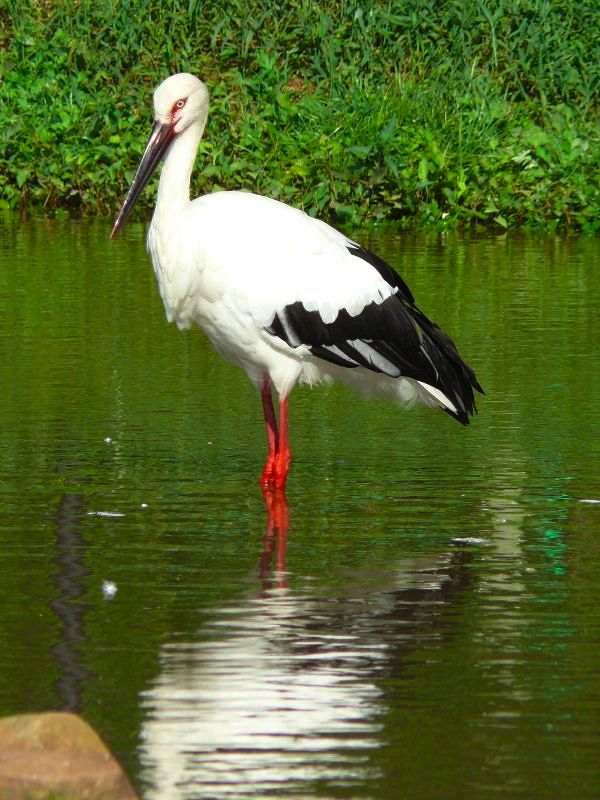
The Oriental Stork is easily identified by its large size, standing over 110 cm tall. Adult storks exhibit a predominantly white plumage with striking black flight feathers that create a stark contrast when the bird is in flight, reminiscent of the White Stork but larger and with a heavier build. The black bill and legs further distinguish it from other stork species. Juveniles are similar in appearance but may have a duller overall plumage and less pronounced black wingtips. Males and females are similar in appearance, making sexing in the field challenging without behavioral context. In flight, the Oriental Stork's wings are broad and rounded, with a slight upward curve at the tips, giving it a distinctive silhouette. When perched, the stork maintains an upright posture, often on one leg, with its neck retracted in an S-shape, a common characteristic of the Ciconiidae family. Misidentification with the White Stork (Ciconia ciconia) can occur due to their similar size and coloration; however, the Oriental Stork's black bill and larger size are key differentiators.
Having trouble telling birds apart? Upload a photo to our bird identification tool for an instant species match.
Oriental Stork Habitat and Range
Preferred Habitat
The Oriental Stork primarily inhabits wetland environments, including freshwater marshes, riverbanks, and floodplains. These areas, rich in aquatic life, provide essential resources for feeding and nesting. During the breeding season, the stork prefers tall trees in wetland margins or man-made structures like power pylons for nesting, often at elevations up to 500 meters. Such locations offer a strategic advantage for monitoring potential threats and accessing food resources. In winter, the stork exhibits flexibility, occupying rice paddies, coastal estuaries, and even urban fringes where water bodies are present. These seasonal habitat shifts reflect the bird's adaptability to changing environmental conditions and the availability of food. While largely rural in its habitat preferences, the Oriental Stork occasionally ventures into suburban areas, particularly where natural wetlands have been supplanted by agricultural landscapes.
Geographic Range
The Oriental Stork's breeding range is concentrated in northeastern China, specifically in Heilongjiang and Liaoning provinces, and extends into the Amur region of Russia. During the winter months, the stork migrates to southeastern China, frequently seen in Jiangsu, Zhejiang, and Fujian provinces. Though less common, some individuals winter in southwestern Japan and parts of Korea. Migration corridors are primarily along the eastern flyways of Asia, where stopover sites include critical wetlands and river basins that support the stork's needs during its long journey. Population density hotspots are observed in the Sanjiang Plain of China, which supports a significant portion of the global population during the breeding season. Conservation efforts in these areas are crucial to maintaining connectivity between breeding and wintering grounds, facilitating successful migrations.
Want to know which birds visit your area? Browse our backyard birds by location guides for region-specific species lists.
What Does the Oriental Stork Eat?
The Oriental Stork is a carnivorous feeder, primarily preying on fish, amphibians, and small reptiles. Its diet varies seasonally, with fish dominating during the breeding season due to their abundance in wetland habitats. In winter, the stork's diet may expand to include insects, crustaceans, and occasionally small mammals, depending on availability. The stork employs a foraging technique characterized by slow wading through shallow waters, often using its long bill to probe mud and vegetation in search of concealed prey. Prey size typically ranges from small fish to medium-sized frogs, with the stork adapting its hunting strategy accordingly. Feeding takes place primarily in the early morning and late afternoon, aligning with the activity patterns of its prey.
Oriental Stork Behavior and Social Structure
The Oriental Stork exhibits a solitary or loosely social structure outside of the breeding season, with individuals or small groups feeding together in areas of abundant food. Territorial during breeding, the stork establishes large territories around its nesting site, defending against intruders with aggressive displays that include bill-clattering and aerial chases. Courtship displays involve synchronized flights and mutual preening between pairs, strengthening pair bonds. These displays are essential for successful mating and subsequent breeding. The stork's response to predators is vigilant, with adults frequently mobbing potential threats to discourage predation on eggs or chicks. Daily activity patterns are diurnal, with peak activity occurring at dawn and dusk when foraging conditions are optimal. Flocking behavior is observed during migration, though these flocks are often loose and variable in composition.
Oriental Stork Nesting and Reproduction
Oriental Storks construct large platform nests made of sticks and lined with softer materials such as grass and feathers. These nests are typically situated high in trees or on artificial structures, offering protection from ground predators. The clutch size generally ranges from two to five eggs, with an incubation period of approximately 30 to 32 days. Both parents share incubation duties, demonstrating a strong biparental care system. After hatching, the young fledge in about 60 to 70 days, during which both parents are actively involved in feeding and protecting the chicks. The species typically raises one brood per year, though in favorable conditions, a second brood may be attempted.
Oriental Stork Sounds and Vocalizations
The Oriental Stork is relatively silent compared to other birds, lacking a true song. Instead, communication relies heavily on bill-clattering, a rhythmic and resonant display often used during courtship and territorial disputes. This sound, akin to a rapid clacking of wooden blocks, serves to establish presence and deter rivals. Alarm calls are rare but consist of harsh, low-pitched grunts used when threats approach. During the dawn chorus, the stork's contributions are minimal, with most vocalizations limited to bill-clattering and occasional soft croaks, distinguishing it from more vociferous species.
Interesting Facts About the Oriental Stork
- 1The Oriental Stork can live up to 30 years in the wild, showcasing its adaptability and resilience.
- 2During migration, the Oriental Stork can travel over 1,500 kilometers, crossing international borders in East Asia.
- 3The Oriental Stork's nest can be as large as 2 meters in diameter, accommodating multiple chicks.
- 4In Japanese culture, the Oriental Stork is considered a symbol of longevity and prosperity, often featured in folklore.
- 5Captive breeding programs have successfully reintroduced the Oriental Stork to areas where it was once extinct, particularly in Japan.
Oriental Stork Conservation Status
The Oriental Stork is classified as Endangered by the IUCN, with its population declining due to habitat destruction, pollution, and human disturbance. Wetland drainage for agriculture and urban expansion are primary threats, reducing available breeding and feeding areas. Conservation efforts focus on habitat restoration, legal protection, and captive breeding programs, particularly in China and Japan. Historical population declines have seen some reversal due to these efforts, but continued vigilance is necessary to ensure the species' survival in the wild.


