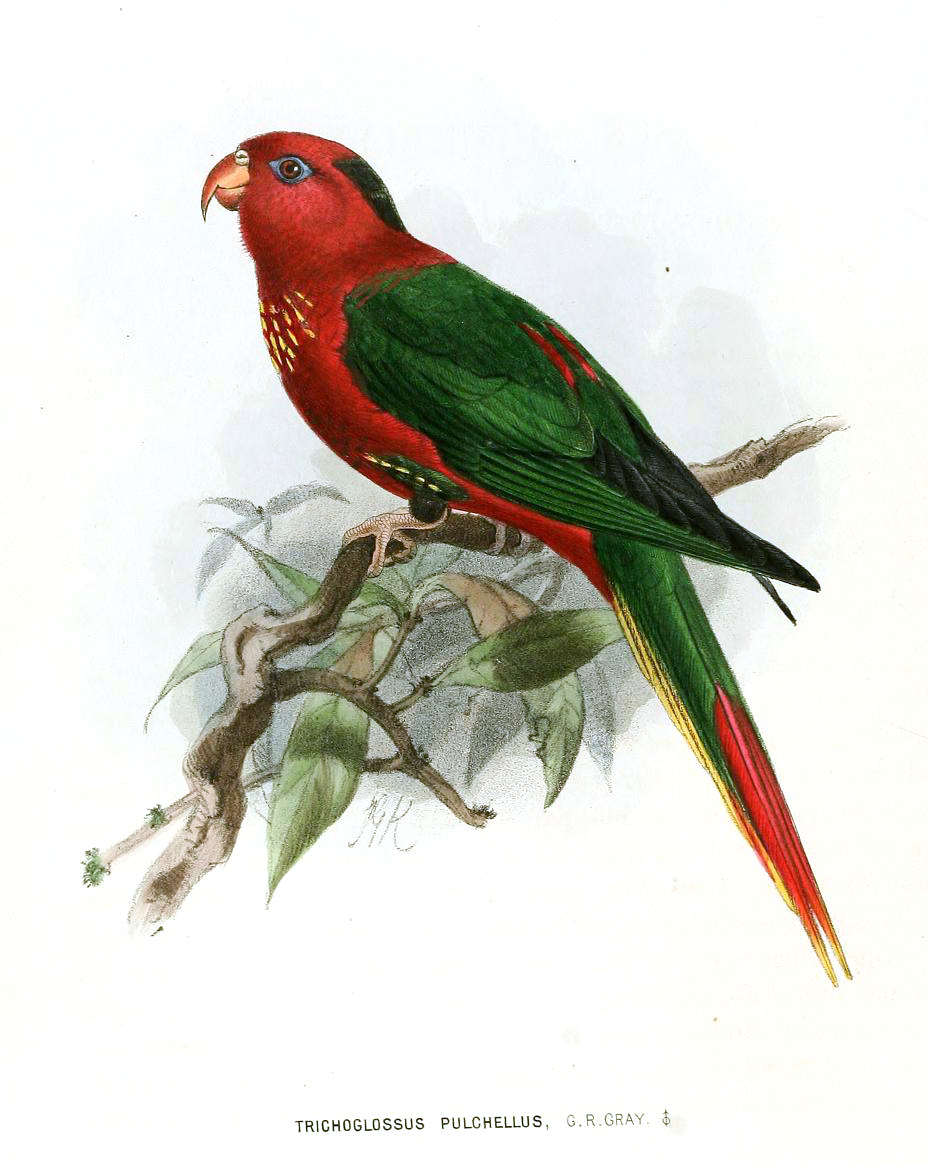
Ornate Lorikeet
Saudareos ornata
Order: Psittaciformes / Family: Psittaculidae

Wikimedia Commons
About the Ornate Lorikeet
The Ornate Lorikeet (Saudareos ornata) is a vibrant and striking member of the family Psittaculidae, renowned for its vivid coloration and dynamic presence in the forests of Indonesia. This small to medium-sized parrot is primarily found on the islands of Sulawesi, the Moluccas, and surrounding areas. Its bright appearance makes it not only a favorite among bird enthusiasts but also a significant ecological player in its native habitats.
The Ornate Lorikeet exhibits a kaleidoscope of colors, with its head adorned in rich shades of red and yellow, while its back and wings showcase a striking green hue. This colorful plumage is not just for show; it plays a crucial role in the bird's interactions within its ecosystem, particularly in pollination. As a nectar-feeder, the Ornate Lorikeet aids in the pollination of various flowering plants, thereby contributing to the health and sustainability of its forest environment.
In addition to its ecological significance, the Ornate Lorikeet is an indicator species for the health of its habitat. Changes in its population can signal shifts in environmental conditions, often alerting conservationists to the effects of habitat destruction and climate change. The bird's preference for lush, undisturbed forests underscores the importance of preserving these environments, not only for the Ornate Lorikeet but for the myriad of species that share its habitat.
Seasonally, the Ornate Lorikeet exhibits some migratory patterns, albeit limited to local movements within its range. It tends to follow the flowering cycles of key plant species, ensuring a steady supply of nectar. This behavior highlights the interconnectedness of the species within its ecosystem, as the timing of flowering can influence lorikeet movements and vice versa. Through its vibrant presence and active role in its environment, the Ornate Lorikeet epitomizes the intricate balance of tropical ecosystems.
The Ornate Lorikeet belongs to the family Psittaculidae, within the order Psittaciformes. These birds typically live average 12-15 years with a maximum recorded of 20 years..
How to Identify a Ornate Lorikeet
The Ornate Lorikeet is unmistakable due to its vivid plumage and distinct markings. Adults display a predominantly green body with a striking red face and forehead. Yellow and blue streaks adorn the head, giving it a truly ornate appearance. The underparts are a mix of green and blue, while the tail feathers are tinged with orange.
Juveniles are slightly duller compared to adults, lacking the intense brilliance of the red and yellow hues. However, they still carry the characteristic green base color. Male and female Ornate Lorikeets are similar in appearance, making gender identification challenging without behavioral observations.
In flight, the Ornate Lorikeet presents a rapid, direct silhouette, characterized by its swift wingbeats and the flash of colors as the sunlight reflects off its plumage. When perching, it often adopts an upright posture, using its strong beak and feet to navigate the branches and foliage of its forest home. The bird's bright coloration can sometimes lead to confusion with other lorikeet species, but its unique combination of red, yellow, and green hues sets it apart.
Having trouble telling birds apart? Upload a photo to our bird identification tool for an instant species match.
Ornate Lorikeet Habitat and Range
Preferred Habitat
The Ornate Lorikeet is primarily associated with tropical and subtropical forests, particularly favoring lowland and montane rainforests. It thrives in dense, humid environments where flowering plants abound. These habitats provide the nectar-rich diet essential for the lorikeet's survival.
Typically found at elevations ranging from sea level to about 1,500 meters, this species shows a preference for undisturbed forest canopies. While primarily a forest dweller, it occasionally ventures into secondary growth areas and cultivated lands, especially when natural food sources are scarce.
Seasonal habitat shifts are often dictated by the availability of food, particularly flowering plants. Although primarily a resident species, the Ornate Lorikeet may exhibit local movements in response to changes in its environment. It is less commonly found in urban settings, as it relies heavily on the natural forest canopy for feeding and nesting.
Geographic Range
The Ornate Lorikeet is native to the island nation of Indonesia, particularly the islands of Sulawesi and the Moluccas. Its range extends to nearby islands where suitable habitat conditions exist. Within this region, the lorikeet is considered a resident species, with populations remaining relatively stable year-round.
Breeding and non-breeding ranges overlap significantly, as the Ornate Lorikeet tends to stay within its established territory. However, it may engage in short-distance movements to exploit areas with abundant food supplies. Migration corridors are not well-defined for this species, as it does not undertake long-distance migrations.
Population density hotspots are often correlated with areas of high plant diversity and undisturbed forest. Regions such as central Sulawesi and certain parts of the Moluccas host significant populations, playing a crucial role in maintaining the overall health of the species.
Want to know which birds visit your area? Browse our backyard birds by location guides for region-specific species lists.
What Does the Ornate Lorikeet Eat?
The diet of the Ornate Lorikeet primarily consists of nectar, which it obtains from a variety of flowering plants. It plays a vital role in pollination, transferring pollen as it moves from flower to flower. In addition to nectar, the lorikeet consumes fruits, especially those with soft flesh, and occasionally seeds and insects.
Seasonal changes in diet are closely linked to the availability of flowering plants. During periods when nectar sources are scarce, the Ornate Lorikeet may rely more heavily on fruits, demonstrating its adaptability.
Foraging techniques include probing flowers with its specialized brush-tipped tongue to extract nectar efficiently. The bird often feeds in flocks, which can enhance the search for food and provide protection from predators. Feeding typically occurs throughout the day, with peak activity in the early morning and late afternoon when temperatures are cooler.
Want to attract Ornate Lorikeets to your yard? See our recommended feeders and seed types for the best results.
Ornate Lorikeet Behavior and Social Structure
The Ornate Lorikeet is a highly social bird, often observed in flocks ranging from small groups to larger aggregations. This social structure facilitates communication and cooperation when locating food sources. The lorikeet exhibits territorial behavior, defending feeding and nesting areas from intruders.
Courtship displays involve mutual preening and vocalizations, strengthening pair bonds. Once paired, the birds remain monogamous, often staying together throughout the breeding season.
Flocking patterns are dynamic, with groups forming and dispersing based on food availability. The Ornate Lorikeet's response to predators includes loud alarm calls and swift, coordinated flight, making it a challenging target for avian predators. Daily activity patterns revolve around feeding, social interaction, and rest, with periods of intense activity interspersed with quieter times.
Ornate Lorikeet Nesting and Reproduction
Ornate Lorikeets typically nest in tree cavities, often selecting sites high in the forest canopy. These cavities provide protection from predators and the elements. The birds may also use abandoned woodpecker holes or natural crevices.
Nesting materials include twigs, leaves, and bark, which the lorikeets arrange to form a suitable nesting chamber. The typical clutch size ranges from two to four eggs, with an incubation period of about 23 days. Both parents share incubation duties, though the female often takes a more prominent role.
After hatching, chicks remain in the nest for several weeks, relying on parental care for food and protection. Fledging occurs approximately eight weeks after hatching, with the young remaining under parental supervision until they gain independence. The Ornate Lorikeet typically raises one brood per year, though in optimal conditions, a second brood may be attempted.
Ornate Lorikeet Sounds and Vocalizations
The Ornate Lorikeet's vocalizations are characterized by high-pitched, rapid chattering sounds. These calls serve various purposes, from maintaining flock cohesion to marking territory. The primary song is a series of sharp, rhythmic notes, often described as shrill and lively.
Call notes vary depending on context, with softer calls used in close-range communication and louder calls when alerting other birds to potential threats. Alarm calls are distinct and urgent, prompting immediate attention from nearby flock members.
During the dawn chorus, Ornate Lorikeets contribute a lively and energetic presence, their voices mingling with those of other forest inhabitants. The overall sound is reminiscent of a busy aviary, full of life and activity.
Interesting Facts About the Ornate Lorikeet
- 1The Ornate Lorikeet has a specialized tongue with brush-like tips that allow it to effectively extract nectar from flowers.
- 2Unlike many parrots, the Ornate Lorikeet primarily relies on a liquid diet, making it uniquely adapted to its ecological niche.
- 3Ornate Lorikeets can travel in flocks numbering up to 20 individuals, showcasing their highly social nature.
- 4The vibrant red and yellow colors on the Ornate Lorikeet's head serve as a visual signal during social interactions.
- 5Despite their bright colors, Ornate Lorikeets are remarkably well-camouflaged among the tropical foliage.
- 6The Ornate Lorikeet's rapid flight and agility in navigating dense forests help it evade predators effectively.
- 7These lorikeets are capable of mimicking sounds, though their vocal repertoire is generally limited compared to other parrot species.
Ornate Lorikeet Conservation Status
The Ornate Lorikeet is currently classified as Least Concern by the IUCN, with stable population trends. However, habitat destruction poses a significant threat, particularly deforestation for agriculture and urban development. Conservation efforts focus on habitat preservation and the establishment of protected areas within key regions of Indonesia. Historical population changes have been relatively modest, though localized declines have occurred due to habitat loss. Continued monitoring and conservation initiatives are crucial to ensure the long-term survival of the Ornate Lorikeet. Efforts to curb illegal pet trade and promote sustainable land use practices are also key components of its conservation strategy.
Attracting Ornate Lorikeets to Your Feeder
The Ornate Lorikeet is a regular visitor to backyard bird feeders across its range. At the Eye On The Fly feeding station, we observe Ornate Lorikeets regularly and capture footage with our feeder cameras.