
Pale-throated Wren-Babbler
Spelaeornis kinneari
Order: Passeriformes / Family: Timaliidae
Wikimedia Commons
About the Pale-throated Wren-Babbler
The Pale-throated Wren-Babbler (Spelaeornis kinneari) is a diminutive bird that belongs to the family Timaliidae within the order Passeriformes. It is particularly notable for its cryptic coloration and elusive nature, which make it a sought-after species for birdwatchers visiting its native range. Found primarily in the dense understoreys of subtropical montane forests, this bird inhabits regions such as northern Vietnam and southern China, specifically in the provinces of Yunnan and Guangxi. The dense bamboo thickets and rhododendron underbrush of these areas provide essential cover and foraging opportunities for the Pale-throated Wren-Babbler. This bird plays a vital ecological role as both a consumer and a prey species within its ecosystem. By feeding on a variety of insects and other small arthropods, it helps control their populations, thus maintaining a balanced food web. In turn, it serves as prey for larger avian predators, contributing to the diverse trophic dynamics of its habitat. Seasonally, the Pale-throated Wren-Babbler does not exhibit significant migratory behavior, remaining within its montane forest habitat year-round. However, slight altitudinal movements may occur in response to food availability and climatic conditions. These movements are generally limited and not well-documented due to the bird's secretive nature. The bird’s preference for thick vegetation and steep, rugged terrain makes it a challenging subject for field studies, adding to its allure among ornithologists and bird enthusiasts. The Pale-throated Wren-Babbler's presence in these forests indicates a healthy, undisturbed ecosystem, and its study can provide insights into the conservation status of its habitat.
The Pale-throated Wren-Babbler belongs to the family Timaliidae, within the order Passeriformes. These birds typically live average 5-7 years with max recorded 9 years.
How to Identify a Pale-throated Wren-Babbler
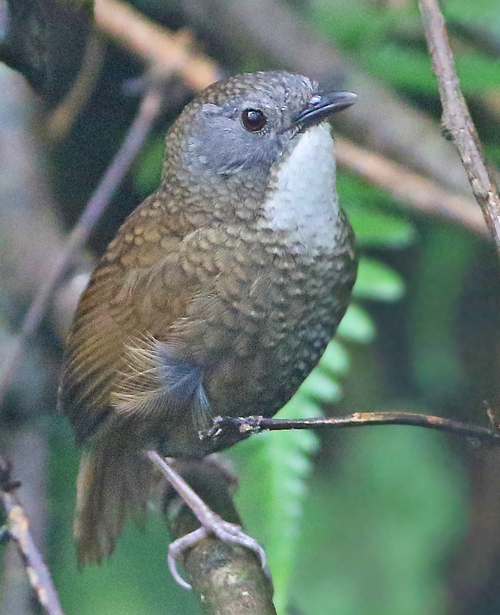
The Pale-throated Wren-Babbler is a small bird, measuring approximately 10 to 12 cm in length. It is characterized by its unassuming brown plumage, which provides excellent camouflage against the forest floor and surrounding vegetation. Its most distinctive feature is its pale throat and upper breast, which contrast subtly with the darker brown of its head and back. The bird's underparts are generally a lighter brown, transitioning to a paler shade on the belly. Juveniles resemble adults but may display slightly duller coloration and less distinct throat markings. Males and females appear similar in plumage, making them difficult to distinguish in the field. This species can be confused with other wren-babblers, particularly those within the same genus, such as the Rufous-throated Wren-Babbler. However, the Pale-throated Wren-Babbler's paler throat is a key differentiating feature. In flight, the bird's short, rounded wings and rapid, undulating flight pattern can help identify it. When perched, this species often adopts a low, skulking posture, moving stealthily through the underbrush.
Having trouble telling birds apart? Upload a photo to our bird identification tool for an instant species match.
Pale-throated Wren-Babbler Habitat and Range
Preferred Habitat
The Pale-throated Wren-Babbler inhabits dense montane forests, primarily at elevations ranging from 1,200 to 2,400 meters. These forests are often characterized by a mix of bamboo, rhododendron, and other broadleaf plant species that provide essential cover and foraging opportunities. The bird's preference for such lush, dense habitats means it is rarely found in open or disturbed areas. Its presence is almost exclusively within rural, untouched forest environments, where human activity is minimal. Seasonal habitat shifts are not prominent in this species, which remains within the same general area throughout the year. However, slight shifts in elevation may occur depending on climatic conditions and food availability, though these movements are not well-documented.
Geographic Range
The breeding range of the Pale-throated Wren-Babbler is confined to a relatively small area within Southeast Asia. It is primarily found in northern Vietnam and southern China, including the provinces of Yunnan and Guangxi. Within this range, the bird inhabits montane forests, often at elevations of 1,200 to 2,400 meters. The population density of this species is generally low, but it can be locally common in areas where suitable habitat exists. There are no known long-distance migratory behaviors in this species, and it is considered a resident bird, maintaining a year-round presence within its range. The restricted range of the Pale-throated Wren-Babbler makes it particularly susceptible to habitat loss and environmental changes, emphasizing the need for targeted conservation efforts in its native regions.
Want to know which birds visit your area? Browse our backyard birds by location guides for region-specific species lists.
What Does the Pale-throated Wren-Babbler Eat?
The diet of the Pale-throated Wren-Babbler consists primarily of insects and other small arthropods, which it gleans from the forest floor and low vegetation. Common prey items include ants, beetles, and spiders, as well as insect larvae. This bird employs a methodical foraging technique, moving slowly and deliberately through dense underbrush in search of hidden prey. Seasonal variations in diet are not well-documented, but the bird likely adapts its feeding habits according to the availability of prey species throughout the year. The Pale-throated Wren-Babbler primarily forages during the day, with peak activity observed in the early morning and late afternoon when insect activity is highest. Its small size allows it to exploit food sources that larger birds might overlook, and its cryptic plumage provides additional concealment while foraging.
Pale-throated Wren-Babbler Behavior and Social Structure
The Pale-throated Wren-Babbler is a shy and elusive bird, typically found singly or in pairs rather than in large flocks. Its social structure is relatively simple, with pair bonds forming during the breeding season. These birds are territorial and will defend their chosen habitat from other wren-babblers, often using vocalizations to assert dominance. Courtship displays are subtle and involve mutual foraging and vocal exchanges between potential mates. The bird's response to predators involves relying on its cryptic plumage and dense habitat for concealment, rather than active defense or alarm calls. Daily activity patterns are largely diurnal, with peak foraging occurring during the cooler morning and late afternoon hours. This bird's behavior makes it a challenging but rewarding subject for observation, particularly during breeding season when activity may increase.
Pale-throated Wren-Babbler Nesting and Reproduction
The Pale-throated Wren-Babbler builds its nest close to the ground, often within dense vegetation that provides concealment from predators. The nest is a small, cup-shaped structure made from grasses, leaves, and other plant materials, sometimes lined with softer materials for added comfort. Typical clutch size ranges from two to four eggs, with incubation lasting approximately 12 to 14 days. Both male and female participate in incubation and subsequent feeding of the hatchlings. After hatching, the young fledge within 10 to 14 days, although parental care may continue for a short period after fledging. The number of broods per year is not well-documented, but it is likely that the Pale-throated Wren-Babbler may attempt to raise multiple broods if conditions permit.
Pale-throated Wren-Babbler Sounds and Vocalizations
The song of the Pale-throated Wren-Babbler is a series of clear, high-pitched notes delivered in rapid succession, often described as a 'tinkling' sound. This song is used primarily during the breeding season to establish territory and attract mates. Call notes are softer and less distinct, often serving as contact calls between mates or family groups. Alarm calls are rarely heard, as the bird prefers to rely on its cryptic coloration and dense habitat for protection. The dawn chorus includes the Pale-throated Wren-Babbler's song, which adds to the rich tapestry of sounds typical of its montane forest habitat.
Interesting Facts About the Pale-throated Wren-Babbler
- 1The Pale-throated Wren-Babbler's song is often compared to the sound of tinkling bells, making it easier to identify by ear than by sight.
- 2This species is one of the smallest members of the Timaliidae family, measuring just 10 to 12 cm in length.
- 3Despite its small size, the Pale-throated Wren-Babbler plays a crucial role in its ecosystem by controlling insect populations.
- 4The bird's preferred habitat, dense montane forests, often makes it difficult for ornithologists to study due to its remote and rugged nature.
- 5The Pale-throated Wren-Babbler's elusive behavior and cryptic plumage make it one of the more challenging birds to spot in its native range.
- 6Its restricted range in Southeast Asia highlights the importance of habitat conservation for its continued survival.
- 7Unlike many birds, the Pale-throated Wren-Babbler does not engage in long-distance migration, remaining within its montane forest habitat year-round.
Pale-throated Wren-Babbler Conservation Status
The Pale-throated Wren-Babbler is currently classified as Near Threatened by the IUCN, with a declining population trend. Primary threats include habitat loss due to logging and agricultural expansion, which reduce the availability of suitable montane forest environments. Conservation efforts focus on preserving and restoring these critical habitats, particularly in regions where the bird's population is most concentrated. Historical data on population changes are limited, but ongoing habitat fragmentation suggests a persistent threat to this species' survival. Conservationists advocate for protected areas and sustainable land management practices to ensure the long-term viability of this unique bird.


