
Peach-fronted Conure
Aratinga aurea
Order: Psittaciformes / Family: Psittacidae
Wikimedia Commons
About the Peach-fronted Conure
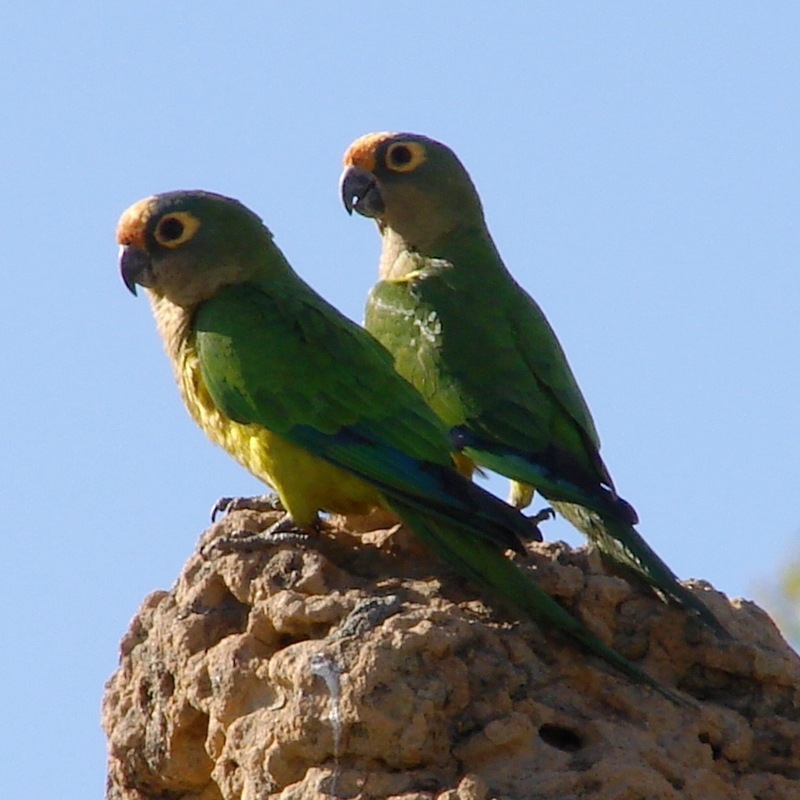
The Peach-fronted Conure, scientifically known as Aratinga aurea, is a striking parrot native to the tropical and subtropical regions of South America. This medium-sized bird, belonging to the family Psittacidae, is notably recognized for the bright orange patch on its forehead, which gives it its name. The rest of its plumage is primarily green, making it well-camouflaged in its natural environment. Found primarily in Brazil, Bolivia, Paraguay, and northern Argentina, the Peach-fronted Conure prefers open savannas, lightly wooded areas, and edges of forests.
These birds play a crucial role in their ecosystems, as they help in seed dispersal, contributing to the health and regeneration of their habitats. The Peach-fronted Conure is also significant for bird enthusiasts and aviculturists due to its engaging personality and striking appearance. They exhibit a strong social structure and are often seen in small flocks, which enhances their capacity for coordinated foraging and predator evasion.
Seasonally, the Peach-fronted Conure may engage in slight altitudinal movements in response to food availability, but they are generally non-migratory. During the breeding season, which typically occurs during the wet season from November to April, these conures become more territorial, though they maintain their sociable nature. Their populations are relatively stable, thanks to their adaptability to different environments and their presence in protected areas.
The Peach-fronted Conure belongs to the family Psittacidae, within the order Psittaciformes. These birds typically live average 15 years with max recorded up to 25 years..
How to Identify a Peach-fronted Conure
The Peach-fronted Conure is a small to medium-sized parrot, measuring approximately 25-28 cm in length. The most distinctive feature of this bird is its peach-colored forehead, which stands out against its predominantly green plumage. The wings and back are a rich green, while the underparts display a lighter, almost lime green shade. The tail is long and tapered, with a blend of green and blue feathers.
Juvenile Peach-fronted Conures closely resemble adults but may exhibit a duller orange on the forehead, which brightens as they mature. Males and females are generally similar in appearance, making visual sexing challenging without close observation. In flight, this conure exhibits strong, direct flight patterns with rapid wing beats, and its silhouette is characterized by pointed wings and an elongated tail.
Although similar species such as the Cactus Conure can cause confusion, the Peach-fronted Conure's distinctive orange forehead and the absence of red patches on the wings serve as reliable identifying markers. When perched, these birds display an upright posture, often engaging in mutual preening or playful interactions.
Having trouble telling birds apart? Upload a photo to our bird identification tool for an instant species match.
Peach-fronted Conure Habitat and Range
Preferred Habitat
The Peach-fronted Conure thrives in a variety of habitats across its range in South America. It predominantly inhabits open savannas, cerrado regions, and the edges of subtropical and tropical forests. These areas provide a mix of trees and open ground, which is ideal for foraging and nesting.
This species is also adaptable to human-modified environments, often seen in agricultural landscapes and near settlements. However, they tend to avoid dense forests and are more commonly found at elevations ranging from sea level to 1,200 meters. Seasonal shifts in habitat are minor, as they are largely resident birds, but they may move slightly within their range to follow food resources.
In urban settings, the Peach-fronted Conure is less common than in rural areas, but it can occasionally be found in parks and gardens where fruiting trees are present. Its adaptability to various habitats contributes to its stable population status.
Geographic Range
The Peach-fronted Conure's range is primarily concentrated in South America, extending across several countries including Brazil, Bolivia, Paraguay, and Argentina. Within Brazil, they are widely distributed across the central and eastern regions, occupying the cerrado and adjacent habitats. In Bolivia and Paraguay, they are found in similar open and semi-open areas, while in Argentina, their range is confined to the northern regions where suitable habitats are available.
These conures are non-migratory, maintaining year-round residency within their range. However, they may undertake localized movements in search of food, especially during periods of scarcity. Population density is notably higher in areas with abundant food sources and suitable nesting sites.
While the Peach-fronted Conure does not undertake long-distance migrations, the presence of natural corridors such as riverine forests and open savannas facilitates their movement across their range. These habitats not only provide essential resources but also serve as linkages between different populations, ensuring genetic flow and diversity.
Want to know which birds visit your area? Browse our backyard birds by location guides for region-specific species lists.
What Does the Peach-fronted Conure Eat?
The diet of the Peach-fronted Conure is primarily composed of seeds, fruits, and flowers, reflecting its role as a frugivore and granivore in its ecosystem. They are particularly fond of the seeds of various grasses and small trees, which they skillfully extract with their strong beaks. In addition to seeds, they consume a wide variety of fruits, including berries and small fleshy fruits, which provide them with essential nutrients and hydration, especially during the dry season.
These conures also feed on the flowers and nectar of certain plants, contributing to pollination. Their diet varies seasonally, with a greater emphasis on fruits during the wet season when they are more abundant, and a shift towards seeds during the dry months when other food sources are limited.
Foraging typically occurs in the morning and late afternoon to avoid the midday heat. The Peach-fronted Conure forages both in trees and on the ground, often seen in small groups, which allows them to cover a larger area and efficiently locate food. Their foraging behavior includes using their beaks and feet to manipulate food items, showcasing their dexterity and intelligence.
Peach-fronted Conure Behavior and Social Structure
The Peach-fronted Conure is a highly social bird, often found in small flocks ranging from 10 to 20 individuals. These flocks exhibit a strong social bond, engaging in mutual preening and vocal communication to maintain group cohesion. Their social structure is evident in their coordinated foraging activities and collective vigilance against predators.
During the breeding season, these conures demonstrate increased territorial behavior, defending their nesting sites against intruders. Courtship displays involve vocalizations, mutual preening, and synchronized movements, strengthening the pair bond between mates.
Flocking patterns are dynamic, with groups frequently merging and splitting based on food availability and social interactions. In response to predators, such as raptors, the Peach-fronted Conure emits loud alarm calls and takes swift evasive flight, often seeking refuge in dense foliage.
Daily activity patterns include foraging during early morning and late afternoon, resting during the hottest part of the day. Despite their sociable nature, these birds are also known for their playful antics, engaging in acrobatic maneuvers and object manipulation, which are thought to enhance their cognitive abilities and social cohesion.
Peach-fronted Conure Nesting and Reproduction
Peach-fronted Conures typically nest in tree cavities, which provide protection from predators and environmental elements. They prefer cavities in tall trees, often at heights ranging from 5 to 15 meters above the ground. In areas where natural cavities are scarce, they may also use abandoned woodpecker holes or artificial nest boxes.
The nesting season aligns with the wet season, from November to April, when food is abundant. The female lays a clutch of 3 to 6 white eggs, which she incubates for approximately 22 to 25 days. During this period, the male plays a crucial role in provisioning food for the incubating female.
Once hatched, the chicks remain in the nest for about 6 to 8 weeks, during which both parents are involved in feeding and caring for the young. The fledging period is a critical time, as the young birds learn essential survival skills from their parents before becoming independent.
Peach-fronted Conures may raise one or two broods per year, depending on environmental conditions and food availability. Their choice of nesting sites and parental care strategies contribute to their reproductive success in diverse habitats.
Peach-fronted Conure Sounds and Vocalizations
The Peach-fronted Conure is known for its loud, harsh calls, which are often described as high-pitched and screechy. These vocalizations serve various purposes, including communication within flocks, territorial displays, and alarm signals. Their primary call consists of a series of rapid, sharp notes that carry over long distances, allowing them to maintain contact with flock members.
In addition to their typical calls, Peach-fronted Conures also produce softer, more melodious sounds during courtship and when engaging in mutual preening. These calls are characterized by a lower pitch and a more rhythmic quality, reflecting the social and affectionate nature of these birds.
Alarm calls are distinct from other vocalizations, featuring a rapid succession of sharp, piercing notes that alert flock members to potential threats. These calls are particularly effective in coordinating evasive maneuvers and enhancing group survival.
During the dawn chorus, Peach-fronted Conures are especially vocal, contributing to the vibrant soundscape of their habitat. Their vocal repertoire, while not as varied as some other parrot species, is nonetheless a key aspect of their social behavior and ecological interactions.
Interesting Facts About the Peach-fronted Conure
- 1Peach-fronted Conures can live up to 25 years in captivity, making them long-term companions for owners.
- 2These conures are known to mimic sounds and simple words, although they are not as prolific talkers as some larger parrots.
- 3They are highly intelligent, capable of learning tricks and solving puzzles, which makes them popular pets.
- 4Peach-fronted Conures can form lifelong pair bonds, displaying strong loyalty to their mates.
- 5Their natural habitats, the cerrado and savannas, are considered biodiversity hotspots in South America.
- 6Despite their bright colors, these conures blend well into their environment, using camouflage to evade predators.
- 7The Peach-fronted Conure is one of the few parrot species that thrive in both natural and human-modified environments.
Peach-fronted Conure Conservation Status
The Peach-fronted Conure is currently listed as Least Concern on the IUCN Red List, indicating a stable population trend. Despite this status, these birds face several threats, including habitat destruction due to agricultural expansion and deforestation. In some areas, they are also captured for the pet trade, although this impact is relatively low compared to other parrot species. Conservation efforts focus on habitat preservation and the enforcement of trade regulations to ensure sustainable populations. Protected areas within their range, such as national parks and wildlife reserves, play a crucial role in safeguarding critical habitats and supporting biodiversity. Historically, the Peach-fronted Conure has maintained a stable population due to its adaptability to a range of environments. Continued monitoring and conservation initiatives are essential to mitigate potential threats and ensure that these vibrant birds remain a common and cherished sight across their range.


