
Philby's Partridge
Alectoris philbyi
Order: Galliformes / Family: Phasianidae
Wikimedia Commons
About the Philby's Partridge
Philby's Partridge (Alectoris philbyi) is a striking member of the Phasianidae family, notable for its adaptation to the rugged mountain ranges of southwestern Arabia. This bird is endemic to the highland regions of Yemen and Saudi Arabia, where it occupies steep, rocky slopes and arid high-altitude plateaus. Its presence in these challenging terrains underscores its ecological significance as a specialized ground-dwelling bird, adapted to a niche that few others can exploit.
The partridge plays a crucial role in the local ecosystem by participating in seed dispersion and serving as prey for native raptors. Its adaptation to this harsh environment has important implications for biodiversity, as it supports a complex food web that includes both predators and plants. Philby's Partridge is also a cultural symbol in its native regions, often appearing in local folklore and art.
Seasonally, Philby's Partridge exhibits consistent behavior, remaining largely sedentary but adjusting its activities to the availability of resources. During the dry season, the bird might move slightly to find water, though it generally stays within its established territory. This reliance on specific habitats makes the partridge a key indicator species for the health of its environment, reflecting changes in habitat quality or climate conditions.
The Philby's Partridge belongs to the family Phasianidae, within the order Galliformes. These birds typically live average 5 years, with a maximum recorded of 8 years.
How to Identify a Philby's Partridge
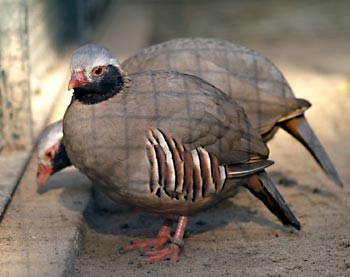
Philby's Partridge is a medium-sized bird, characterized by its striking black throat and chin, which contrast sharply with its white face and neck. Its plumage is predominantly sandy brown, providing excellent camouflage among the rocky terrains it inhabits. The bird's chestnut flanks, marked with fine black barring, differentiate it from similar species such as the Chukar Partridge.
Males and females are similar in appearance, though males are typically slightly larger and may have more pronounced facial coloration. Juveniles resemble adults but are duller and lack the distinct black and white facial patterns. In flight, Philby's Partridge exhibits a rapid wingbeat, typical of ground-dwelling birds, with a rounded silhouette that can aid identification.
The partridge's posture is upright when perching, often seen scanning its surroundings from a rocky outcrop. This posture, combined with its unique facial markings, makes it distinguishable even at a distance. Observers should note the bird's tendency to remain motionless when alarmed, a behavior that enhances its cryptic appearance against the rugged terrain.
Having trouble telling birds apart? Upload a photo to our bird identification tool for an instant species match.
Philby's Partridge Habitat and Range
Preferred Habitat
Philby's Partridge inhabits arid, mountainous regions in southwestern Arabia, thriving at elevations between 1,500 and 3,000 meters. These areas are characterized by rocky slopes, sparse vegetation, and dry riverbeds known as wadis. The bird is particularly associated with steep, rugged cliffs and plateaus, where it can find both shelter and foraging opportunities.
This partridge is predominantly found in rural rather than urban settings, as its habitat requirements are closely tied to natural, undisturbed landscapes. Seasonal habitat shifts are minimal, though the bird may temporarily relocate to lower elevations during extreme weather conditions. The presence of Philby's Partridge in these habitats is indicative of the ecological uniqueness of southwestern Arabia, highlighting the importance of preserving these environments.
Geographic Range
Philby's Partridge is geographically restricted to the southwestern Arabian Peninsula, with a range that includes the highlands of Yemen and parts of southwestern Saudi Arabia. It is a resident species, showing little to no migratory behavior, largely due to the stable climate and abundance of resources within its range.
Breeding populations are concentrated in the Asir and Sarawat mountain ranges, where they are most densely populated. The bird's range is largely dictated by the availability of suitable rocky and arid habitats, which are limited to these mountainous regions.
Though the partridge's range is relatively small, it is stable, with no significant expansion or contraction observed in recent years. The population density hotspots in areas like the Haraz Mountains are critical for maintaining the species' numbers and genetic diversity.
Want to know which birds visit your area? Browse our backyard birds by location guides for region-specific species lists.
What Does the Philby's Partridge Eat?
Philby's Partridge primarily consumes seeds, which form the bulk of its diet, but it also includes a variety of plant materials such as leaves and roots. During the breeding season, the diet expands to incorporate insects, providing essential proteins for growing chicks. The bird exhibits opportunistic foraging behavior, taking advantage of seasonal abundance in its arid environment.
Foraging typically occurs in the early morning and late afternoon when temperatures are cooler. The partridge uses its strong legs to scratch the ground, uncovering seeds and insects hidden beneath the surface. Its diet may shift slightly with the seasons, relying more on insects during wetter periods and seeds during drier months.
Philby's Partridge's feeding habits contribute to seed dispersion across its range, playing a vital role in the regeneration of plant communities in its arid habitat. Its ability to thrive on a varied diet highlights its adaptability to the challenging conditions of the Arabian highlands.
Philby's Partridge Behavior and Social Structure
Philby's Partridge is a social bird, often found in small coveys outside of the breeding season. These coveys, typically composed of family groups, provide safety in numbers and facilitate cooperative foraging. During the breeding season, however, pairs become territorial, defending their nesting sites aggressively against intruders.
Courtship displays involve males showcasing their plumage and performing a series of calls to attract females. This behavior is most pronounced during the early mornings and late afternoons. The partridge's response to predators is cautious; it often remains motionless to blend into its surroundings or takes a short, rapid flight to nearby cover.
Daily activity patterns are largely dictated by temperature, with the bird being most active during cooler parts of the day. It spends the hottest hours resting in shaded areas or under cover, conserving energy and avoiding predators. Such behavior illustrates its adaptation to the challenging conditions of its environment, balancing the risks and resources available.
Philby's Partridge Nesting and Reproduction
Philby's Partridge constructs its nest on the ground, typically in a shallow scrape lined with plant material and pebbles. Preferred nesting sites are well-concealed locations among rocks or dense vegetation, offering protection from predators. The female lays a clutch of 6 to 12 eggs, with incubation lasting approximately 24 days.
Both parents participate in rearing the young, although the female primarily incubates the eggs. Once hatched, the precocial chicks leave the nest almost immediately, following their parents to learn foraging techniques. The fledging period is relatively short, with chicks becoming independent within a few weeks.
Philby's Partridge usually raises one brood per year, though favorable conditions might allow for a second. Parental roles are clearly defined, with both contributing to the protection and feeding of the young. This reproductive strategy ensures the survival of the species in its demanding habitat.
Philby's Partridge Sounds and Vocalizations
The primary song of Philby's Partridge is a series of clear, whistling notes that rise and fall in pitch, resembling a melodic whistle. These calls are most commonly heard during the breeding season as males establish territories and attract mates.
Call notes include a variety of clucks and churrs, used for communication within coveys and to signal alarm. The alarm calls are sharper and more urgent, alerting other birds to potential dangers.
During the dawn chorus, the bird's vocalizations contribute to the soundscape of the highlands, creating an auditory backdrop that is both distinctive and integral to the environment. The calls of Philby's Partridge, while not as complex as some songbirds, are a vital component of its behavioral repertoire, facilitating social interactions and territorial defense.
Interesting Facts About the Philby's Partridge
- 1Philby's Partridge can survive in some of the driest regions of the world, illustrating its remarkable adaptation to arid environments.
- 2The bird's striking plumage is not just for show; it provides excellent camouflage against the rocky slopes it inhabits.
- 3Philby's Partridge plays a key role in its ecosystem by aiding in seed dispersion, supporting plant regeneration.
- 4Despite its remote habitat, Philby's Partridge has cultural significance in Yemen, often appearing in local folklore.
- 5This partridge's population is restricted to a small range, emphasizing the importance of habitat conservation efforts.
- 6Philby's Partridge can be elusive, often relying on its ability to remain motionless to avoid detection by predators.
- 7The bird's diet shifts seasonally, adapting to the availability of seeds and insects in its high-altitude environment.
Philby's Partridge Conservation Status
Philby's Partridge is currently listed as Near Threatened on the IUCN Red List, with populations showing a declining trend. The primary threats to its survival include habitat destruction due to agriculture, overgrazing, and human encroachment. Conservation efforts focus on habitat protection and management, aiming to mitigate these impacts. Historically, the species has experienced fluctuations in population numbers, often correlating with changes in land use practices. Conservationists emphasize the need for continued monitoring and research to better understand its ecological requirements and resilience to environmental changes. Efforts to preserve Philby's Partridge also involve raising awareness among local communities about its ecological and cultural importance. By fostering a sense of stewardship, conservation initiatives aim to secure a sustainable future for this remarkable bird.


