
Piratic Flycatcher
Legatus leucophaius
Order: Passeriformes / Family: Tyrannidae
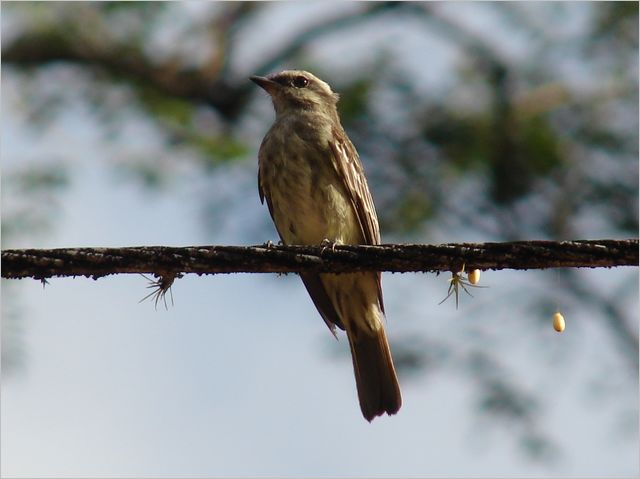
Wikimedia Commons
About the Piratic Flycatcher
The Piratic Flycatcher, scientifically known as Legatus leucophaius, is a small passerine bird belonging to the family Tyrannidae. This bird occupies a unique niche within its ecosystem, primarily found across a wide range of tropical and subtropical regions in the Americas. Its distribution extends from Mexico through Central America and into much of South America, reaching as far south as Argentina and Paraguay. The Piratic Flycatcher is named for its unique nesting behavior, where it often usurps the nests of other birds, earning the 'piratic' moniker. This aggressive and opportunistic behavior can have significant impacts on the local avifauna, as it directly competes with other bird species for breeding resources. This species is typically found in open areas with scattered trees, edges of forests, and secondary growth. It adapts well to both lowland and foothill regions and thrives in environments that provide ample opportunities to exploit the nests of other species. The Piratic Flycatcher's ecological role includes acting as a pest controller, as it feeds primarily on insects and small vertebrates. With its keen eyesight and agile flight, it captures a variety of arthropods, contributing to the control of insect populations. This dietary preference makes it an essential component of the ecosystems it inhabits. The species exhibits some seasonal movement, with individuals in the northern part of their range migrating southward during the breeding season. This movement ensures a continual presence in suitable habitats throughout the year, allowing the Piratic Flycatcher to maintain its competitive edge in securing nesting sites.
The Piratic Flycatcher belongs to the family Tyrannidae, within the order Passeriformes. These birds typically live average 5-6 years, with a maximum recorded of 10 years..
How to Identify a Piratic Flycatcher
Adult Piratic Flycatchers exhibit a distinctive plumage that aids in their identification. They have olive-brown upperparts with a subtle rufous tinge on the wings and tail, while the underparts are primarily white with a faint yellow wash on the belly. The head features a bold black mask across the eyes, which contrasts with the white supercilium and throat. Juveniles resemble adults but tend to have duller plumage with less pronounced facial markings. Both males and females look similar, lacking significant sexual dimorphism, which can make gender-specific identification challenging in the field. The Piratic Flycatcher can be confused with other flycatchers due to its size and coloration, but its bold eye stripe and piratic behavior are distinguishing characteristics. In flight, the bird's silhouette is marked by a medium-length tail and broad wings. When perched, it often adopts an upright posture, scanning for prey or potential nest sites. Observers can differentiate it from similar species by its unique call and behavior of commandeering nests.
Having trouble telling birds apart? Upload a photo to our bird identification tool for an instant species match.
Piratic Flycatcher Habitat and Range
Preferred Habitat
The Piratic Flycatcher inhabits a variety of open and semi-open environments. It prefers edges of tropical forests, secondary growth, and clearings with scattered trees. The species is adaptable, thriving in elevations ranging from sea level up to 1800 meters. In some regions, it is also present in plantations and gardens, demonstrating a degree of tolerance for human-altered landscapes. Seasonal shifts may occur, with some birds migrating altitudinally or latitudinally in response to breeding opportunities. While not typically found in dense urban areas, it is not uncommon in suburban settings where natural habitats intersect with development. Its habitat selection is heavily influenced by the availability of nests to usurp, making it a dynamic and opportunistic species in terms of habitat preference.
Geographic Range
The Piratic Flycatcher's range is extensive, covering parts of Central and South America. During the breeding season, it is prevalent in northern South America, including Colombia, Venezuela, and Ecuador. The species migrates seasonally, with some populations moving to the southern United States and Mexico in search of favorable nesting conditions. Its wintering range extends from northern South America to parts of Central America, with some individuals found as far south as Bolivia and Brazil. Throughout its range, the Piratic Flycatcher is more commonly observed in areas with abundant nesting opportunities, often correlating with regions that have high densities of other bird species. This opportunistic distribution is a testament to its adaptability and competitive nature.
Want to know which birds visit your area? Browse our backyard birds by location guides for region-specific species lists.
What Does the Piratic Flycatcher Eat?
The diet of the Piratic Flycatcher consists primarily of insects, which it captures in mid-air with agile maneuvers. It employs a sit-and-wait foraging strategy, perching in open areas before darting out to snatch prey. Its diet includes a wide variety of arthropods such as beetles, flies, and moths, as well as small vertebrates like lizards and frogs on occasion. Seasonal changes in prey abundance can influence its diet, with a greater reliance on available insect populations during the wet season. The Piratic Flycatcher often forages alone or in pairs, typically during the early morning or late afternoon when prey is most active. This dietary flexibility allows it to thrive in diverse habitats and maintain its role as an efficient predator of insects.
Piratic Flycatcher Behavior and Social Structure
The Piratic Flycatcher exhibits a range of interesting behaviors, particularly in its social structure and territoriality. It is known for its aggressive nest usurping, wherein it commandeers the nests of other bird species to use for its own breeding purposes. This behavior is usually accompanied by loud vocalizations and displays intended to intimidate the original nest owners. During the breeding season, it becomes highly territorial, defending its claimed nest vigorously against intruders. Courtship displays involve males performing aerial acrobatics combined with vocalizations to attract females. Outside the breeding season, the Piratic Flycatcher may form loose flocks with other flycatchers, especially during migration. In response to predators, it employs a series of alarm calls and takes evasive flight to evade capture. This species is most active during the day, with peak activity occurring in the early morning and late afternoon.
Piratic Flycatcher Nesting and Reproduction
The Piratic Flycatcher is notorious for its nesting strategy, which involves taking over the nests of other bird species. It typically targets domed or enclosed nests built by other small to medium-sized birds. Once a suitable nest is located, the flycatcher will aggressively displace the original inhabitants, often destroying any existing eggs or young. The female then lays her eggs in the commandeered nest, usually numbering between two and three eggs per clutch. Incubation lasts approximately 16 days, with both parents sharing duties of feeding and protecting the young after hatching. The fledging period is relatively short, with chicks leaving the nest around 15 days after hatching. The Piratic Flycatcher can have multiple broods per breeding season, depending on the availability of nests and ecological conditions.
Piratic Flycatcher Sounds and Vocalizations
The Piratic Flycatcher's vocalizations are a key aspect of its behavior. Its primary song consists of a series of sharp, metallic notes, delivered in rapid succession. This song is often described as a 'pik-pik-pik' sound, used predominantly during the breeding season to establish territory and attract mates. Additionally, it produces a variety of call notes, including a harsh 'churr' sound that serves as an alarm call when potential predators are nearby. At dawn, the Piratic Flycatcher participates in a chorus of calls, contributing to the vibrant soundscape of its habitat. The clarity and volume of its calls make them a reliable field mark for birders trying to locate this elusive flycatcher.
Interesting Facts About the Piratic Flycatcher
- 1The Piratic Flycatcher derives its name from its habit of 'pirating' nests from other bird species, a unique behavior among flycatchers.
- 2Despite its aggressive nesting behavior, the Piratic Flycatcher is a relatively small bird, measuring about 16 cm in length.
- 3This species is a skilled aerial hunter, capable of catching insects mid-flight with remarkable precision.
- 4Piratic Flycatchers are known to migrate long distances, with some individuals traveling over 2000 kilometers between breeding and wintering grounds.
- 5The bird's distinctive call is often used by birders as a key identifier, especially during the breeding season when it is most vocal.
- 6The Piratic Flycatcher can adapt to a variety of habitats, from tropical lowlands to foothills, showcasing its ecological versatility.
- 7Unlike many other birds, the Piratic Flycatcher does not build its own nest but relies on the availability of nests from other species.
Piratic Flycatcher Conservation Status
The Piratic Flycatcher is currently classified as Least Concern by the IUCN, with a stable population trend across its range. Although it faces some threats from habitat loss due to deforestation and agricultural expansion, its adaptability to altered environments helps mitigate such impacts. Conservation efforts primarily focus on preserving its natural habitats and ensuring the ecological balance that supports its nesting strategy. Historically, the Piratic Flycatcher has maintained stable populations, largely due to its wide range and flexible behavior. Continued monitoring of population trends and habitat conditions is essential to ensure its ongoing survival.


