
Plain Pigeon
Patagioenas inornata
Order: Columbiformes / Family: Columbidae
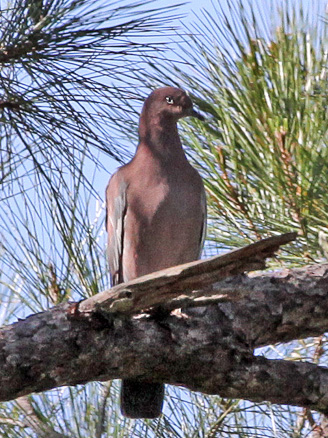
Wikimedia Commons
About the Plain Pigeon
The Plain Pigeon (Patagioenas inornata) is a member of the Columbidae family, noted for its unadorned gray-brown plumage which belies its captivating presence in the Cuban, Puerto Rican, and Hispaniolan landscapes. This medium-sized pigeon plays a crucial ecological role as a seed disperser, particularly in the tropical and subtropical forests of the Caribbean. It thrives in lowland forests, savannas, and occasionally in cultivated areas, where it supports forest regeneration by transporting seeds across significant distances. The Plain Pigeon is not merely a resident of thick woodlands; it can also be found in open areas and farmland, demonstrating a degree of adaptability which is essential for its survival in varied environments. During the breeding season, which typically aligns with the rainy season, the Plain Pigeon becomes more vocal and active, engaging in characteristic cooing that resonates through its habitat. Although its coloration may seem plain at first glance, the Plain Pigeon exhibits a subtle beauty upon closer inspection, with delicate nuances in its feathering that reflect the sun in soft browns and grays. Its ecological significance extends beyond aesthetics, as it contributes to the dynamic balance of its ecosystem. By engaging in mutualistic relationships with various plant species, it ensures the propagation of flora, which in turn supports a multitude of other animal species. The Plain Pigeon's ecological interactions are pivotal during the seasonal shifts in its habitat. As dry spells alternate with wet seasons, the bird adjusts its diet and foraging habits, showcasing its adaptability. Its presence in fragmented forests and edge habitats further highlights its ability to persist in human-altered landscapes. The Plain Pigeon is a testament to the resilience of avian life in the face of environmental challenges, embodying the intricate connections within its ecosystem.
The Plain Pigeon belongs to the family Columbidae, within the order Columbiformes. These birds typically live average 6-8 years, max recorded 11 years.
How to Identify a Plain Pigeon
The Plain Pigeon is medium-sized, measuring approximately 35-38 cm in length. Its plumage is predominantly gray-brown, lacking the iridescent hues seen in some of its relatives. The tail is long and rounded, with a darker band near the tip. The wings display a subtle contrast between the darker primaries and paler coverts. Unlike juveniles, which have a slightly mottled appearance, adults show a more uniform coloration. Males and females are similar in appearance, although males may exhibit slightly more pronounced chest coloring. In flight, the Plain Pigeon’s silhouette is marked by broad wings and a steady, direct flight pattern. When perched, it assumes an upright posture, often seen in small groups or solitary. It can be confused with the Red-billed Pigeon or White-crowned Pigeon, but the absence of distinctive coloration on the beak or crown aids in proper identification. The Plain Pigeon’s lack of distinctive markings is its defining characteristic, setting it apart from other visually striking pigeon species.
Having trouble telling birds apart? Upload a photo to our bird identification tool for an instant species match.
Plain Pigeon Habitat and Range
Preferred Habitat
The Plain Pigeon inhabits tropical and subtropical forests, preferring lowland areas such as Cuba, Puerto Rico, and Hispaniola. It frequents both primary and secondary forests and can adapt to open woodlands and agricultural fields. This flexibility allows it to navigate fragmented landscapes, often residing at elevations from sea level up to 1,200 meters. During certain seasons, the bird may shift to wetter areas or edge habitats, but it generally avoids dense urban environments. Its presence in both rural and semi-urban areas demonstrates its ability to coexist with human development, as long as sufficient forested areas remain.
Geographic Range
The Plain Pigeon’s breeding range includes several Caribbean islands, notably Cuba, Puerto Rico, and Hispaniola. It is a non-migratory species, residing year-round in these regions. Sporadic sightings in other parts of the Caribbean demonstrate occasional dispersal, but it remains largely confined to its established range. Within its primary habitats, population densities can vary, with some locales such as the forests of western Puerto Rico supporting higher concentrations. While it does not undertake large-scale migrations, the Plain Pigeon may move locally in response to food availability and environmental conditions.
Want to know which birds visit your area? Browse our backyard birds by location guides for region-specific species lists.
What Does the Plain Pigeon Eat?
The Plain Pigeon primarily consumes seeds and fruits, making it an important seed disperser in its ecosystem. Its diet includes a variety of native fruits, such as those from the Cecropia and Ficus species, as well as seeds from cultivated crops when available. Seasonal changes influence its diet, with a higher intake of fruits during the wet season when fruiting is abundant. Foraging typically occurs in the early morning and late afternoon, when temperatures are cooler. The bird employs a methodical approach to foraging, often seen picking through the forest floor or perching in fruit-laden trees to access its preferred foods. The size of prey is generally small to medium, consistent with its feeding habits.
Plain Pigeon Behavior and Social Structure
The Plain Pigeon exhibits a social structure that varies with the season. During the breeding season, pairs form strong bonds, engaging in mutual preening and gentle cooing. Courtship displays are subtle, involving soft vocalizations and occasional wing flicks. Outside the breeding period, these pigeons may gather in small flocks, particularly when feeding. Territorial behavior is most pronounced during nesting, where pairs defend their chosen sites vigorously. The Plain Pigeon responds to predators with a rapid, direct flight to nearby cover. Its daily activity peaks during cooler hours, with periods of rest during the midday heat. The bird's adaptability in both solitary and social contexts demonstrates its resilience in various environmental conditions.
Plain Pigeon Nesting and Reproduction
The Plain Pigeon constructs simple platform nests primarily from twigs and leaves. Nests are typically situated in trees or shrubs, at heights ranging from 2 to 10 meters above the ground. The usual clutch size is one to two eggs, with incubation duties shared by both parents over a period of approximately 14 to 18 days. Once hatched, the young are fed regurgitated food by both parents and fledge around 20 to 25 days later. The species can produce multiple broods in a single year, particularly when environmental conditions are favorable. Parental roles are well-defined, with both members of the pair contributing to nest defense and chick rearing.
Plain Pigeon Sounds and Vocalizations
The Plain Pigeon’s primary song consists of a series of soft, low-pitched coos that rise and fall in a rhythmic pattern. These vocalizations are gentle yet persistent, often heard during the dawn chorus as the bird establishes its presence within its territory. Calls include soft grunts and coos, used in communication between mates and flock members. Alarm calls are a sharper, more abrupt series of notes, alerting others to potential threats. The Plain Pigeon’s vocal repertoire, while not as varied as some songbirds, serves essential functions in social bonding and territory establishment.
Interesting Facts About the Plain Pigeon
- 1The Plain Pigeon can fly at speeds up to 50 km/h, allowing it to cover large areas in search of food.
- 2Despite its name, the Plain Pigeon has a complex social structure, engaging in cooperative behaviors within flocks.
- 3The Plain Pigeon can consume up to 10% of its body weight in food daily, crucial for energy maintenance.
- 4In Puerto Rico, the Plain Pigeon is locally known as 'Paloma Sabanera', highlighting its preference for open areas.
- 5The Plain Pigeon plays a key role in forest regeneration by dispersing seeds over considerable distances.
- 6Historical records suggest that the Plain Pigeon was once far more abundant across the Caribbean region.
- 7The Plain Pigeon’s subtle plumage provides excellent camouflage in its natural habitat, aiding in predator avoidance.
Plain Pigeon Conservation Status
The Plain Pigeon is currently classified as Near Threatened on the IUCN Red List. Population trends show a decline primarily due to habitat loss and hunting pressures. Deforestation and agricultural expansion are the leading threats, reducing suitable habitat and nesting sites. Conservation efforts focus on habitat preservation and legal protection, particularly in Puerto Rico where reforestation projects aim to restore critical areas. Historically, the species has experienced fluctuations in population sizes, reflecting changes in land use and conservation policy effectiveness.
Other Columbidae Species


Birds Similar to the Plain Pigeon
These species are often confused with the Plain Pigeon due to similar appearance or overlapping range.
