
Plain Thornbird
Phacellodomus inornatus
Order: Passeriformes / Family: Furnariidae
Wikimedia Commons
About the Plain Thornbird
The Plain Thornbird (Phacellodomus inornatus) is a small, nondescript passerine bird belonging to the family Furnariidae. This bird is widely distributed across parts of South America, particularly in countries like Argentina, Bolivia, and Paraguay. Its presence is most notable in subtropical and tropical dry forests, as well as in shrublands where it thrives in open and semi-open habitats. The Plain Thornbird plays a significant role in its ecosystem by contributing to the control of insect populations, as it primarily feeds on a variety of insects found within its habitat. As an insectivore, it helps maintain the balance of the ecosystem by controlling pest populations that could otherwise become problematic. During the breeding season, which generally occurs from September to December, the Plain Thornbird becomes highly vocal and more actively searches for nest-building materials. This period is crucial as it marks the time when they build their large, conspicuous stick nests, which are often placed in thorny trees or dense bushes to protect against predators. The nests themselves are architectural marvels, sometimes reaching over a meter in length and showcasing the bird's remarkable engineering skills. In addition to their ecological role, the Plain Thornbird serves as an indicator species for the health of dry forest ecosystems in the regions where it resides. Their presence often signals a relatively undisturbed habitat, as they prefer areas with ample vegetation that supports their nesting and feeding needs. Seasonal behaviors of the Plain Thornbird include an increase in territorial calls and displays during the breeding season, while outside of this period, they may form small groups to forage.
The Plain Thornbird belongs to the family Furnariidae, within the order Passeriformes. These birds typically live average 4 years with max recorded 7 years.
How to Identify a Plain Thornbird
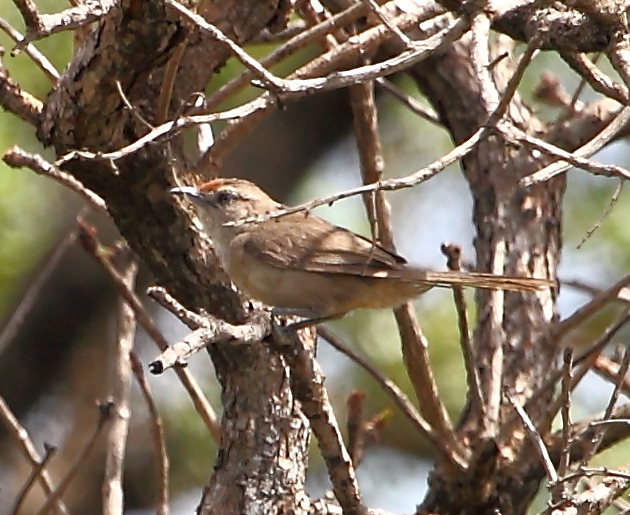
The Plain Thornbird is characterized by its unassuming brown plumage, which provides effective camouflage against the dry forest backdrop. Adult birds typically display a uniform brown coloration with subtle variations of lighter brown on the underparts. This lack of distinctive markings gives the bird its 'plain' namesake, though close observation reveals a slightly rufous tinge on the wings and tail. Juveniles resemble adults but may appear slightly duller with less defined plumage. There is little sexual dimorphism in this species, meaning that males and females appear quite similar. However, during the breeding season, males may exhibit slightly brighter plumage as part of courtship displays. The Plain Thornbird can be confused with similar species such as the Firewood-gatherer, but it can be distinguished by its larger size and less rufous coloring. In flight, the Plain Thornbird exhibits a steady, direct flight pattern with bursts of flapping and short glides. When perching, it often adopts an upright posture, making use of its strong legs to grasp branches firmly.
Having trouble telling birds apart? Upload a photo to our bird identification tool for an instant species match.
Plain Thornbird Habitat and Range
Preferred Habitat
The Plain Thornbird thrives primarily in subtropical and tropical dry forests and shrublands. These habitats offer the dense vegetation required for nesting and abundant insect life for feeding. The bird is often found at elevations ranging from sea level up to about 1,500 meters, favoring areas with low to moderate canopy cover. Seasonal shifts in habitat are minimal, but during wetter months, they may venture into slightly denser forest areas where insect prey becomes more abundant. While the Plain Thornbird is predominantly found in rural settings, it can occasionally be spotted in urban parks and gardens where suitable nesting sites exist. However, its presence in urban environments is limited due to its preference for more natural, undisturbed areas.
Geographic Range
The range of the Plain Thornbird spans several South American countries, including Argentina, Bolivia, and Paraguay, with its presence also recorded in parts of Uruguay and Brazil. In Argentina, it is most prevalent in the northern and central regions, thriving in areas such as the Gran Chaco and the Pampas. In Bolivia, the bird occupies both the lowland and montane forests, while in Paraguay, it is found in the dry Chaco and other similar habitats. The Plain Thornbird is a non-migratory species, remaining in its range year-round. Within its range, population density often peaks in areas where dry forests and shrublands are extensive and relatively undisturbed. There are no significant migration corridors for this species, as they tend to be resident birds that maintain established territories.
Want to know which birds visit your area? Browse our backyard birds by location guides for region-specific species lists.
What Does the Plain Thornbird Eat?
The diet of the Plain Thornbird consists primarily of insects and other small invertebrates. It forages by gleaning insects from foliage, branches, and tree trunks, using its sharp, pointed bill to extract prey from crevices and under bark. Common prey items include beetles, caterpillars, and spiders. During the breeding season, when energy demands increase, the Plain Thornbird may broaden its diet to include small fruits and seeds. This seasonal dietary shift ensures a steady food supply even when insect availability fluctuates. Foraging occurs mostly during the cooler parts of the day, such as early morning and late afternoon, to avoid the midday heat. The bird's methodical, deliberate foraging technique allows it to exploit a wide range of feeding sites within its territory.
Plain Thornbird Behavior and Social Structure
Plain Thornbirds exhibit a complex array of behaviors that include both social and territorial elements. Outside the breeding season, they can be observed in small family groups, which forage together and engage in mutual preening. However, during the breeding season, these birds become highly territorial, with males often engaging in vocal displays to defend their territory from intruders. These displays can include a series of loud, repetitive calls that serve both to establish territory and attract a mate. Courtship involves mutual displays where pairs engage in synchronized movements and calls. This species is generally monogamous, forming long-term pair bonds that last across breeding seasons. When faced with predators, Plain Thornbirds exhibit a variety of defensive behaviors, including mobbing and loud alarm calls to alert nearby birds. Daily activity patterns are diurnal, with peak activity occurring during the early morning and late afternoon.
Plain Thornbird Nesting and Reproduction
The nesting behavior of the Plain Thornbird is particularly noteworthy due to its elaborate nest construction. These birds build large stick nests, which can measure over a meter in length. Nest construction involves gathering sticks and twigs, which are then intricately woven to form a sturdy structure. These nests are typically located in thorny trees or dense bushes, offering protection from predators. A typical clutch consists of 2 to 4 eggs, with both parents participating in the incubation process, which lasts approximately 14 to 18 days. Once hatched, the chicks remain in the nest for about 18 to 22 days before fledging. Both parents share in feeding and caring for the young, ensuring that the chicks receive adequate nutrition and protection. The species generally raises one brood per year, though in optimal conditions, a second brood may be attempted.
Plain Thornbird Sounds and Vocalizations
The Plain Thornbird's vocalizations are a distinctive feature of its behavior, especially during the breeding season. Its primary song consists of a series of loud, repetitive notes that rise and fall in pitch, often described as a rhythmic 'chee-chee-chee-chee.' These songs are used to establish territory and attract mates. In addition to its song, the bird produces a variety of call notes, including sharp 'chik-chik' sounds used in communication between mates and as alarm calls. During the dawn chorus, the Plain Thornbird's song can be heard prominently as it competes with the vocalizations of other bird species. The alarm calls serve to alert other birds of potential threats and are typically more abrupt and sharp compared to the song.
Interesting Facts About the Plain Thornbird
- 1The Plain Thornbird constructs one of the largest nests relative to its size, with some nests reaching over 1 meter in length.
- 2Despite its plain appearance, the Plain Thornbird is a skilled architect, building complex nests with multiple chambers.
- 3The nests of the Plain Thornbird can weigh several kilograms, requiring strong branches to support them.
- 4In some regions, the presence of Plain Thornbird nests is used by researchers to indicate undisturbed habitat conditions.
- 5Plain Thornbirds use both visual and auditory cues to communicate with their mates, showcasing intricate behavioral adaptations.
- 6The species name 'inornatus' means 'unadorned' in Latin, reflecting the bird's plain appearance.
- 7Plain Thornbirds often reuse their nests for several breeding seasons, adding new material each year.
Plain Thornbird Conservation Status
The IUCN currently lists the Plain Thornbird as a species of Least Concern, indicating a stable population trend. However, habitat loss due to agricultural expansion and deforestation poses a threat to its long-term viability. Conservation efforts focus on preserving dry forest habitats and promoting sustainable land use practices. Historically, the population of the Plain Thornbird has remained relatively stable, though localized declines have occurred in areas heavily impacted by human activity. Continued monitoring and habitat protection are crucial to ensuring the species' future survival in its native range.


