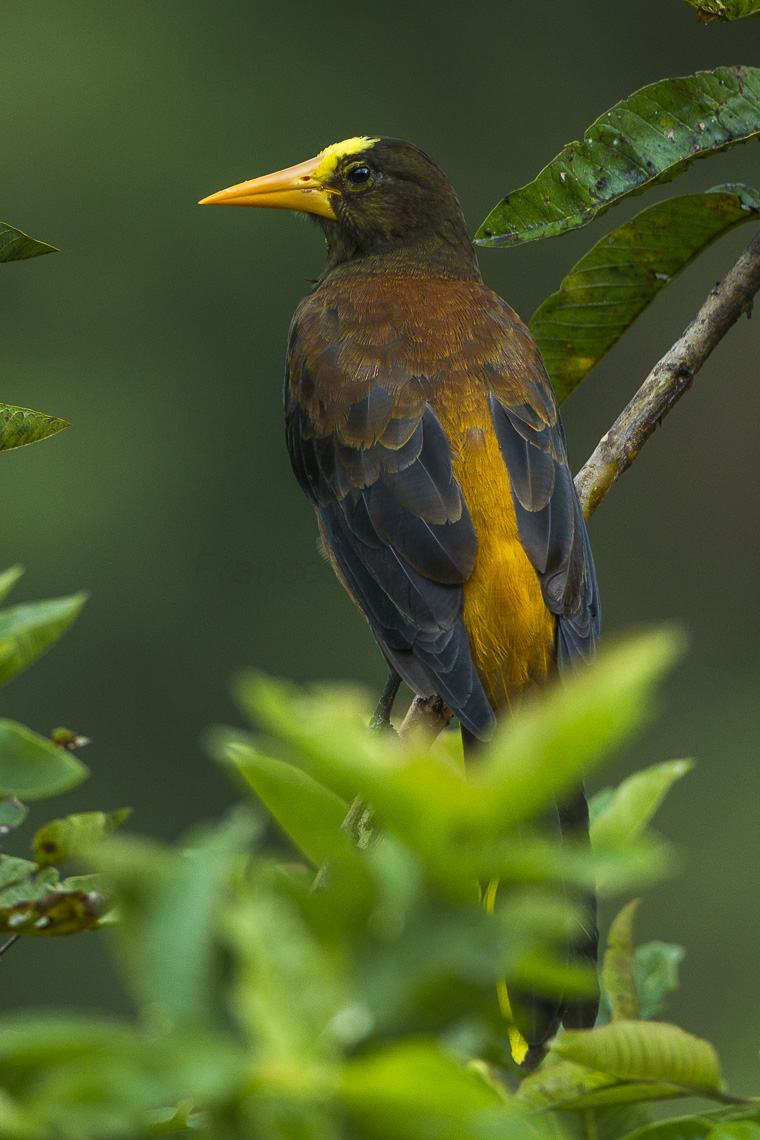
Psarocolius auricollis
Psarocolius auricollis
Order: Passeriformes / Family: Icteridae
About the Psarocolius auricollis
The Psarocolius auricollis, more commonly known as the Yellow-rumped Cacique, plays a pivotal role in the neotropical ecosystems of South America. This bird belongs to the family Icteridae and is a member of the order Passeriformes, which encompasses a diverse group of perching birds. The species is particularly prevalent in the Amazon Basin, including regions in Brazil, Peru, and Colombia. Its presence extends to the lowland rainforests, where it contributes significantly to seed dispersion and the control of insect populations, thus maintaining ecological balance. The Yellow-rumped Cacique is not only vital for its ecological contributions but also serves as an indicator species for the health of its habitat. During the breeding season, which corresponds with the rainy season in these tropical regions, the caciques are especially active. They engage in complex social behaviors, forming colonies that can number dozens to hundreds of individuals. These colonies are often seen in proximity to active wasp nests, a strategy that reduces predation risk. Psarocolius auricollis exhibits fascinating seasonal behaviors, particularly in their nesting and foraging patterns. As the dry season approaches, these birds may shift their habitat slightly, favoring areas with abundant fruiting trees, which provide both sustenance and nesting materials. Their adaptability in diet and habitat selection underscores their resilience in the face of changing environmental conditions. Furthermore, the Yellow-rumped Cacique is a polygynous species, with males maintaining territories that encompass several female nests. This social structure influences their communal roosting and intricate vocalizations, which are crucial for mate attraction and territory defense. In terms of ecological significance, the Yellow-rumped Cacique's role as a seed disperser cannot be underestimated. By consuming a variety of fruits and subsequently dispersing seeds over large areas, they aid in forest regeneration. Their foraging also helps control insect populations, as they consume caterpillars and other insects, providing a natural pest control service. The presence of Psarocolius auricollis in these biodiverse rainforests highlights the intricate web of interactions that sustain tropical ecosystems.
The Psarocolius auricollis belongs to the family Icteridae, within the order Passeriformes. These birds typically live average 10-14 years, with a maximum recorded of 20 years..
How to Identify a Psarocolius auricollis
The Yellow-rumped Cacique stands out with its glossy black plumage contrasted by a bright yellow rump and lower back, a feature that gives the bird its name. Adult males and females exhibit similar coloration, although males are generally larger. The adult male can measure up to 32 cm in length, while females are slightly smaller, around 28 cm. Both sexes possess a distinctive yellow collar at the back of the neck. Juveniles are similar in appearance to adults but display a more muted plumage with less sheen. The bill is pale whitish to light blue, contrasting with the darker feathering. In flight, the Yellow-rumped Cacique presents a striking silhouette, with long broad wings and a slightly forked tail which is often fanned out. This species can sometimes be confused with the Russet-backed Oropendola, another member of the Icteridae family. However, the Oropendola lacks the bright yellow rump and is generally larger with a different vocalization pattern. When perched, Psarocolius auricollis often adopts a horizontal posture, showcasing its bright rump and distinctive collar, features that make field identification straightforward.
Having trouble telling birds apart? Upload a photo to our bird identification tool for an instant species match.
Psarocolius auricollis Habitat and Range
Preferred Habitat
Psarocolius auricollis predominantly inhabits the lowland rainforests of the Amazon Basin. This species thrives in dense, humid forests where it can find ample food and nesting sites. Typically found at elevations from sea level up to 1000 meters, the Yellow-rumped Cacique is adaptable, though it prefers areas with a high density of fruiting trees. In addition to primary forests, they also inhabit secondary forests and edge habitats, which offer abundant feeding opportunities. During seasonal shifts, particularly in the dry season, these birds may venture into open areas or forest edges in search of food. While they are primarily forest-dwellers, Psarocolius auricollis can sometimes be observed in more urbanized areas, especially where large trees and parks provide suitable resources. Their adaptability to different forest types ensures their presence across a range of habitats within their geographic range.
Geographic Range
The Yellow-rumped Cacique's range spans a broad swath of the Amazon Basin, covering parts of several South American countries such as Brazil, Peru, Ecuador, Colombia, and Bolivia. This bird is a resident species, largely non-migratory, although it may exhibit local movements in response to food availability and breeding conditions. Its population is densest in the central Amazon, particularly in regions with extensive undisturbed rainforest. In Brazil, it is commonly found in states like Amazonas and Acre. In Peru, the species is present in lowland forests along the eastern slopes of the Andes. Despite being predominantly found in rainforests, Psarocolius auricollis can also be seen in riparian zones and floodplain forests, where water levels influence vegetation and food supply. These areas provide rich foraging grounds and nesting sites, contributing to the bird's widespread distribution across its range.
Want to know which birds visit your area? Browse our backyard birds by location guides for region-specific species lists.
What Does the Psarocolius auricollis Eat?
Psarocolius auricollis has an omnivorous diet, with a strong preference for fruits and insects. The bird's primary food sources include a variety of fruits, such as those from fig trees and palm fruits, which are abundant in its rainforest habitat. In addition to fruits, the Yellow-rumped Cacique consumes insects, particularly caterpillars, beetles, and other arthropods, providing a balance between plant and animal matter in its diet. Seasonal changes impact its diet; during the breeding season when insects are plentiful, the cacique increases its consumption of protein-rich invertebrates to support the energy demands of reproduction. The bird forages by hopping through the canopy and sometimes engages in aerial sallies to catch flying insects. Its ability to exploit different food sources and foraging techniques demonstrates the species' adaptability to varying environmental conditions. This versatility ensures their survival across the diverse and dynamic ecosystems of the Amazon Basin.
Psarocolius auricollis Behavior and Social Structure
The Yellow-rumped Cacique exhibits a complex social structure, often forming large colonies that enhance their survival prospects. These colonies are typically located near wasp nests, a strategy that offers protection from predators due to the wasps' defensive nature. Within these colonies, males are polygynous and maintain territories encompassing the nests of several females. Courtship involves elaborate displays, including vocalizations and posturing to attract potential mates. The cacique's vocal repertoire is extensive, used for communication within the colony and to deter intruders. This species is highly social, often seen foraging in groups, which aids in finding food and providing safety in numbers. The Yellow-rumped Cacique is diurnal, with peak activity during the early morning and late afternoon. Their response to predators involves mobbing and alarm calls, which alert the colony to threats. This behavior highlights the cacique's strong emphasis on community and cooperation as key survival strategies.
Psarocolius auricollis Nesting and Reproduction
The nesting habits of Psarocolius auricollis are remarkable for their complexity and communal nature. The species builds pendulous nests, which hang from the tips of branches, often in colonies that can include dozens to hundreds of nests. These nests are constructed primarily from plant fibers, vines, and grasses, woven together to form a secure structure. Preference is given to trees near water, providing both resources and protection. Clutch size typically ranges from two to three eggs, with an incubation period lasting around 14 to 16 days. Both parents participate in feeding the young, though females take a more active role in incubation. Fledging occurs approximately 24 to 28 days post-hatching, with chicks gaining independence shortly thereafter. The Yellow-rumped Cacique usually produces one to two broods per year, depending on environmental conditions and resource availability.
Psarocolius auricollis Sounds and Vocalizations
The Yellow-rumped Cacique produces a varied array of sounds, with its primary song characterized by a series of clear, melodious whistles interspersed with harsher notes. These vocalizations serve multiple purposes, including mate attraction and territory defense. The bird's call notes are sharp and distinct, often used in social interactions within the colony. Alarm calls are rapid and piercing, effectively warning of predators. During the dawn chorus, Psarocolius auricollis contributes prominently, its song rising above the cacophony of the rainforest. The quality of its song, both rhythmic and diverse, resembles a flute-like tone, making it distinctive among its peers.
Interesting Facts About the Psarocolius auricollis
- 1The Yellow-rumped Cacique often nests near wasp colonies, utilizing the wasps as natural deterrents to predators.
- 2Males of Psarocolius auricollis are polygynous, maintaining territories that include several female nests.
- 3Their nests can be over a meter long, showcasing intricate weaving skills with plant fibers.
- 4The species plays a crucial ecological role by dispersing seeds of various fruit trees across the rainforest.
- 5Psarocolius auricollis can form colonies with up to several hundred individuals, enhancing their communal defense strategies.
- 6Despite their vibrant plumage, Yellow-rumped Caciques are adept at blending into the dense canopy during foraging.
- 7Their vocalizations are known to mimic the sounds of other birds, a tactic used in communication and distraction.
Psarocolius auricollis Conservation Status
The Yellow-rumped Cacique is currently listed as Least Concern by the IUCN, with a population trend that appears stable. Nevertheless, habitat loss due to deforestation and land conversion poses significant threats. Conservation efforts focus on preserving large tracts of rainforest, which are crucial for the species' survival. Historically, the population has been resilient, adapting to changes in its environment. However, continued monitoring and habitat protection are vital to ensure its long-term persistence in the wild. Engagement with local communities to promote sustainable land use forms a key part of conservation strategies.
Other Icteridae Species


Birds Similar to the Psarocolius auricollis
These species are often confused with the Psarocolius auricollis due to similar appearance or overlapping range.