
Pohnpei Fruit-dove
Ptilinopus ponapensis
Order: Columbiformes / Family: Columbidae
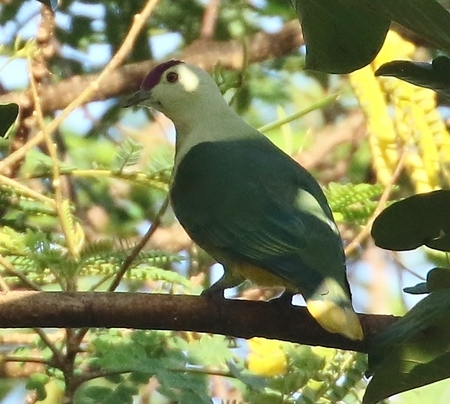
Wikimedia Commons
About the Pohnpei Fruit-dove
The Pohnpei Fruit-dove (Ptilinopus ponapensis) is an enchanting resident of the lush, tropical forests of Pohnpei, an island in the Federated States of Micronesia. This fruit-dove plays a significant role in its ecosystem, primarily through seed dispersal, which contributes to the health and regeneration of tropical forests. The bird's vibrant plumage and gentle demeanor make it a cherished species among birdwatchers and local communities alike. Found exclusively on Pohnpei, the Pohnpei Fruit-dove is a fine example of island endemism, showcasing how isolation fosters unique evolutionary paths.
The dove's reliance on fruit from native trees underscores its ecological importance. It assists in maintaining the biodiversity and structural integrity of its habitat. The island's forests, characterized by thick canopies and a variety of flora, provide both food and shelter to the Pohnpei Fruit-dove. Its presence indicates a healthy ecosystem, as fruit-doves are sensitive to habitat degradation and fragmentation.
Seasonal behaviors of the Pohnpei Fruit-dove include variations in feeding habits and subtle changes in vocal activity. During the wet season, when fruit is plentiful, their diet is diverse, and they participate in more vocal displays. Conversely, in the dry season, they may become more subdued, relying on a narrower range of food sources. Understanding these patterns helps conservationists monitor environmental changes and the bird's adaptability to them.
The Pohnpei Fruit-dove belongs to the family Columbidae, within the order Columbiformes. These birds typically live typically lives around 8-12 years in the wild..
How to Identify a Pohnpei Fruit-dove
Identifying the Pohnpei Fruit-dove involves noting several key features. Adults typically exhibit bright green plumage with a slight iridescent quality, making them well-camouflaged in the verdant canopy. A distinguishing feature is their reddish crown, which contrasts with the green of their body. The underparts are lighter, often with a yellowish wash. Juveniles resemble adults but may show less vibrant coloration, lacking the defined reddish crown.
There is no significant difference between males and females in terms of plumage, a common trait among many fruit-dove species. However, during the breeding season, males might exhibit slightly more intense coloration as part of their courtship display. In flight, the Pohnpei Fruit-dove shows a compact silhouette with rounded wings and a short tail, distinguishing it from other birds in the region.
Perching posture is another clue for identification. These doves often sit quietly on branches, relying on their coloration for concealment. They typically remain motionless for long periods, making them challenging to spot unless actively vocalizing or feeding. While similar in appearance to other Pacific fruit-doves, the Pohnpei Fruit-dove's restricted range and specific crown coloration help avoid confusion with related species.
Having trouble telling birds apart? Upload a photo to our bird identification tool for an instant species match.
Pohnpei Fruit-dove Habitat and Range
Preferred Habitat
The Pohnpei Fruit-dove inhabits tropical lowland forests, thriving in areas with dense foliage and abundant fruiting trees. These forests provide the necessary resources for feeding and nesting. The species shows a preference for undisturbed areas, where large trees and thick underbrush offer both sustenance and protection.
Typically found at elevations ranging from sea level to about 700 meters, the dove rarely ventures into mountainous regions. Seasonal shifts in habitat use are minimal due to Pohnpei's consistent tropical climate, although they may move locally in response to fruit availability.
While primarily forest-dwellers, Pohnpei Fruit-doves occasionally visit gardens and semi-urban areas where native vegetation persists. However, they avoid heavily urbanized environments, reinforcing their dependence on intact forest ecosystems.
Geographic Range
The Pohnpei Fruit-dove's range is exceptionally limited, confined to the island of Pohnpei in the Federated States of Micronesia. This island-endemic species has no known migration patterns, remaining a resident throughout the year.
Pohnpei provides the necessary ecological niche for the fruit-dove, and the species is widespread across the island's intact forests. However, population density varies, with higher concentrations found in areas with less human disturbance and abundant fruiting trees.
Due to its restricted range, the Pohnpei Fruit-dove is particularly vulnerable to habitat loss. Conservation of its habitat is critical for its continued survival, as there are no alternative regions or islands to which it can disperse.
Want to know which birds visit your area? Browse our backyard birds by location guides for region-specific species lists.
What Does the Pohnpei Fruit-dove Eat?
The diet of the Pohnpei Fruit-dove primarily consists of a variety of fruits, which they forage from the canopy of tropical trees. They exhibit a preference for figs and other native fruits, which they ingest whole, aiding in seed dispersal.
During the wet season, the abundance of fruit allows them to feed opportunistically, consuming a wide range of available produce. In contrast, the dry season poses more of a challenge, as they may need to travel further or adapt to a limited selection of fruit.
Their foraging technique involves short flights between branches, plucking fruit with precision. Typically, they feed during the morning and late afternoon, when temperatures are cooler, and activity levels of other animals are lower.
Pohnpei Fruit-dove Behavior and Social Structure
Socially, Pohnpei Fruit-doves are solitary or found in pairs, especially during the breeding season. They exhibit territorial behavior, with males defending their chosen area through vocalizations and displays. Courtship involves males performing gentle bowing displays to attract females, often accompanied by soft cooing sounds.
Flocking behavior is rare, and they seldom form groups larger than small family units. Their response to predators includes remaining motionless and relying on their plumage for concealment. In contrast, if threatened directly, they may take a swift, direct flight to denser cover.
Daily activities follow a pattern aligned with food availability, with peaks at dawn and dusk. These periods are optimal for foraging due to lower temperatures and reduced competition for food resources.
Pohnpei Fruit-dove Nesting and Reproduction
Pohnpei Fruit-doves construct simple nests, usually situated in the fork of a tree branch. The nest consists of twigs and leaves, providing a basic platform for the single egg typically laid per breeding cycle.
The incubation period lasts about 14-16 days, with both parents sharing the responsibility. Post-hatching, fledging occurs approximately 12-14 days later. During this period, parental roles include feeding and protection, with both sexes actively involved.
Generally, the species produces one brood per year, although favorable conditions may allow for a second attempt. Nesting success heavily depends on habitat quality and the absence of significant disturbance.
Pohnpei Fruit-dove Sounds and Vocalizations
The primary call of the Pohnpei Fruit-dove is a soft, repetitive cooing, often described as soothing and melodic. This call typically serves as a territorial signal and a communication tool between mates.
Alarm calls are sharper and more abrupt, serving to warn of potential threats. During the dawn chorus, males often engage in prolonged vocal displays, marking territory and attracting mates.
Compared to other columbids, their vocalizations are less varied, focusing on a few distinct calls that serve specific purposes within their social and environmental context.
Interesting Facts About the Pohnpei Fruit-dove
- 1The Pohnpei Fruit-dove is one of the few species entirely endemic to a single island, highlighting its unique evolutionary path.
- 2Despite their vibrant plumage, Pohnpei Fruit-doves can be incredibly difficult to spot due to their excellent camouflage in foliage.
- 3The species plays a crucial role in seed dispersal, particularly for native trees, thereby aiding in forest regeneration.
- 4Pohnpei Fruit-doves are primarily solitary, forming pairs only during the breeding season, a trait not common in all dove species.
- 5Their diet adaptation during the dry season demonstrates their ecological flexibility, a trait essential for survival on an isolated island.
- 6The Pohnpei Fruit-dove's call is distinct yet subtle, often going unnoticed unless actively listened for by keen birdwatchers.
- 7Conservationists consider the Pohnpei Fruit-dove an indicator species, as its presence signifies a healthy forest ecosystem.
Pohnpei Fruit-dove Conservation Status
The Pohnpei Fruit-dove is currently listed as Near Threatened by the IUCN, with population trends showing a gradual decline. Primary threats include habitat loss due to deforestation and land conversion for agriculture. Conservation efforts focus on protecting Pohnpei's remaining forests and enhancing habitat connectivity to support the species' survival. Historical changes in land use and increasing human presence on the island have exacerbated the need for effective conservation measures. Collaborative efforts between local communities and international organizations aim to mitigate threats and promote sustainable practices that benefit both the dove and Pohnpei's broader ecosystem.


