Puerto Rican Vireo
Vireo latimeri
Order: Passeriformes / Family: Vireonidae

Wikimedia Commons
About the Puerto Rican Vireo
The Puerto Rican Vireo, Vireo latimeri, is a small yet remarkable bird native to the island of Puerto Rico. This species holds significant ecological importance, serving as both a predator of insects and a prey item within its ecosystem. Found predominantly in the karst forests of the northern and central regions, the Puerto Rican Vireo thrives in subtropical and tropical moist lowland and montane forests. Its presence is vital for controlling insect populations, which in turn supports the health of the forest ecosystem.
The Puerto Rican Vireo's role extends beyond simple pest control; it also contributes to the complex food web by serving as prey for larger avian predators. The species is most active during the breeding season, typically from March to July, when it engages in various courtship and territorial behaviors. During this time, the males become particularly vocal, singing to establish and defend territories and attract mates. The melodious song of the Puerto Rican Vireo is a hallmark of the island's soundscape during the warmer months.
Although primarily resident throughout the year, the Puerto Rican Vireo may exhibit minor altitudinal movements in response to seasonal food availability. This adaptability helps the species survive across different climatic conditions prevalent on the island. As an endemic species, the Puerto Rican Vireo represents a unique component of Puerto Rico's biodiversity. Its continued survival is crucial for maintaining the ecological balance within its habitat, especially as human activities and environmental changes pose growing threats.
The Puerto Rican Vireo belongs to the family Vireonidae, within the order Passeriformes. These birds typically live 5-7 years with a maximum recorded lifespan of 10 years.
How to Identify a Puerto Rican Vireo
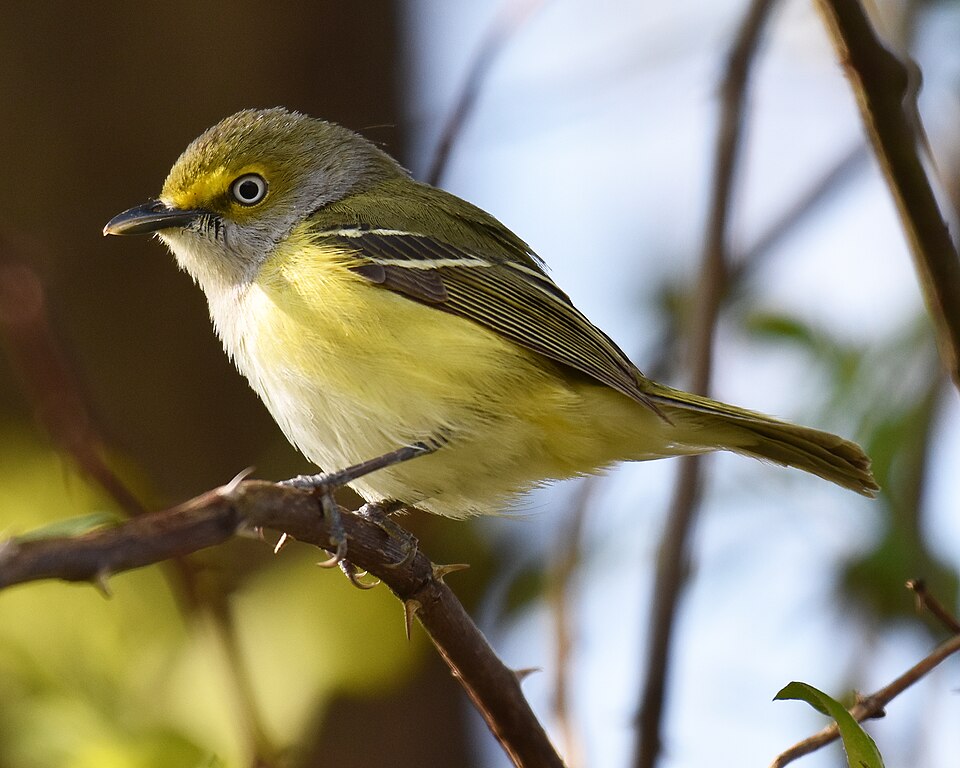
The Puerto Rican Vireo features a distinctive appearance that aids in its identification. Adult birds exhibit a gray cap and nape, contrasting with their olive-green back and wings. The underparts are a striking yellow, which becomes more vibrant during the breeding season. The eye is surrounded by a faint white ring, and the dark bill is slightly hooked at the tip, a characteristic feature of the Vireonidae family.
Juvenile Puerto Rican Vireos resemble adults but have a more muted coloration. Their plumage lacks the vivid yellow seen in mature individuals, and the olive tones are less pronounced, making them appear duller overall. No significant sexual dimorphism exists between male and female Puerto Rican Vireos, which share similar size and plumage characteristics.
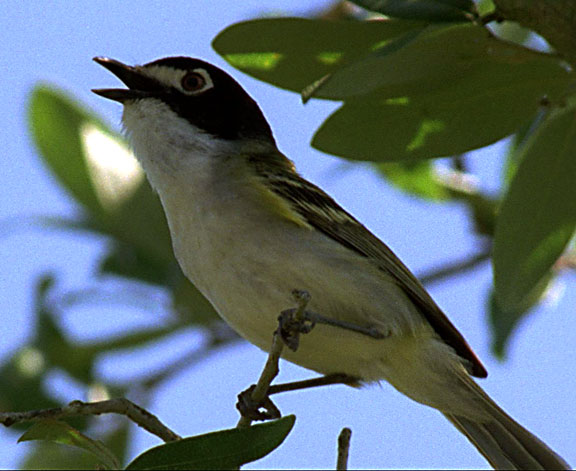
In flight, the Puerto Rican Vireo displays a compact silhouette with a steady, undulating flight pattern. When perched, it often adopts an upright posture, frequently flicking its wings and tail. This behavior, coupled with its distinctive coloration, helps distinguish it from similar species such as the Black-whiskered Vireo, which lacks the Puerto Rican Vireo's vibrant yellow underparts.
Having trouble telling birds apart? Upload a photo to our bird identification tool for an instant species match.
Puerto Rican Vireo Habitat and Range
Preferred Habitat
The Puerto Rican Vireo primarily inhabits subtropical and tropical moist forests, thriving in both lowland and montane environments. It shows a preference for karst regions, where limestone formations create a unique and biodiverse ecosystem. These areas, particularly in the northern and central parts of Puerto Rico, provide an abundance of food resources and suitable nesting sites.
The species can also adapt to disturbed habitats, including secondary growth forests and plantations, although it tends to avoid heavily urbanized areas. The elevation range for the Puerto Rican Vireo typically spans from sea level up to 1,200 meters, with some seasonal shifts in habitat preference influenced by food availability.
While primarily forest-dwelling, the Puerto Rican Vireo can occasionally be found in scrubby edges and open woodlands, particularly during the non-breeding season. Its presence in a variety of forest types underscores its adaptability, although intact native forests remain crucial for its long-term conservation.
Geographic Range
The Puerto Rican Vireo is endemic to the island of Puerto Rico, where it is a year-round resident. Its range encompasses the entire island, although population densities vary across different regions. The species is particularly abundant in the karst forests of the northern and central areas, where suitable habitat conditions prevail.
While the Puerto Rican Vireo does not undertake long-distance migrations, it may exhibit localized movements in response to seasonal changes in food availability. These movements are typically altitudinal, with individuals potentially relocating to lower elevations during periods of reduced insect abundance in the highlands.
Despite its limited geographic range, the Puerto Rican Vireo is considered widespread across Puerto Rico. Its adaptability to various forest types and resilience against moderate habitat disturbance contribute to its relatively stable population status, although ongoing conservation efforts remain essential to mitigate threats from habitat loss and degradation.
Want to know which birds visit your area? Browse our backyard birds by location guides for region-specific species lists.
What Does the Puerto Rican Vireo Eat?
The diet of the Puerto Rican Vireo primarily consists of insects and other arthropods, which it forages from the foliage and branches of trees. This insectivorous diet includes caterpillars, beetles, ants, and spiders, playing a critical role in regulating these populations within its habitat.
During the breeding season, the demand for protein-rich food increases, prompting the Puerto Rican Vireo to intensify its foraging efforts. It employs a variety of techniques, such as gleaning from leaves and probing into crevices, to capture its prey. The bird often forages alone or in pairs, meticulously inspecting vegetation for hidden insects.
Seasonal changes in food availability can influence the Puerto Rican Vireo's diet, with some individuals occasionally consuming small fruits and seeds when insect populations decline. This dietary flexibility aids the species in surviving periods of food scarcity, highlighting its adaptability within the forest ecosystem.
Puerto Rican Vireo Behavior and Social Structure
The Puerto Rican Vireo exhibits a range of behaviors that reflect its territorial and social nature. During the breeding season, males become highly vocal, using their song to establish and defend territories. This vocalization serves both as a deterrent to rival males and an attractant to potential mates.
The species generally maintains a solitary or paired existence, with limited flocking behavior observed outside the breeding season. Puerto Rican Vireos exhibit strong territorial instincts, vigorously defending their chosen areas from intruders. This territoriality is particularly evident during the breeding period, when males patrol boundaries and engage in displays to ward off competitors.
Courtship involves a series of displays and vocalizations, with males showcasing their plumage and singing to entice females. Once paired, both sexes participate in nest building and incubation, reflecting a cooperative breeding strategy. The Puerto Rican Vireo's daily activity patterns revolve around foraging, with peak activity occurring during the cooler morning and late afternoon hours.
Puerto Rican Vireo Nesting and Reproduction
The Puerto Rican Vireo constructs a cup-shaped nest, typically situated in the fork of a tree branch or within dense foliage. Nest materials include grasses, twigs, and plant fibers, woven together to create a secure structure. The choice of nest location often involves selecting a site that offers both concealment from predators and proximity to food resources.
A typical clutch consists of 2 to 3 eggs, which both parents incubate over a period of approximately 14 days. This shared parental responsibility extends to feeding and caring for the hatchlings, which remain in the nest for about 10 to 12 days before fledging.
The Puerto Rican Vireo may produce two broods per year, depending on environmental conditions and resource availability. This reproductive strategy helps maintain population numbers, although habitat loss and predation pose ongoing threats to successful breeding.
Puerto Rican Vireo Sounds and Vocalizations
The song of the Puerto Rican Vireo is a distinctive series of melodious, whistled notes, often described as 'chip-a-chip-chip' or 'here-i-am, here-i-am'. This repetitive and rhythmic sequence plays a crucial role in territory establishment and mate attraction.
In addition to its primary song, the Puerto Rican Vireo produces a variety of call notes, including sharp 'chip' sounds used for communication between mates or to signal alarm. These calls can become more frequent and intense when the bird perceives a threat, such as a predator approaching the nest.
The dawn chorus of the Puerto Rican Vireo is particularly notable, with males singing vigorously at first light to reaffirm territorial boundaries and ward off rivals. This vocal behavior is a quintessential element of the island's avian soundscape, resonating through the forests during the breeding season.
Interesting Facts About the Puerto Rican Vireo
- 1The Puerto Rican Vireo is one of only three vireo species endemic to the Caribbean region, highlighting its unique biodiversity.
- 2Despite its small size, the Puerto Rican Vireo has a remarkably powerful song that can carry over long distances, aiding in territory establishment.
- 3The Puerto Rican Vireo's nest is often strategically placed to minimize the risk of predation, utilizing dense foliage for cover.
- 4During the breeding season, the Puerto Rican Vireo may sing up to 20 times per minute, showcasing its vocal prowess.
- 5The Puerto Rican Vireo's diet is highly adaptable, occasionally including small fruits, which supplements its primarily insectivorous diet.
- 6In the past, the Puerto Rican Vireo was subject to habitat loss due to agricultural expansion, but conservation efforts have helped stabilize its population.
- 7The species' scientific name, Vireo latimeri, honors H.B. Latimer, who contributed to the study of Puerto Rican avifauna.
Puerto Rican Vireo Conservation Status
The Puerto Rican Vireo is currently listed as Least Concern by the IUCN, with population trends considered stable. Despite its relatively secure status, the species faces threats from habitat loss due to deforestation and land development. Additionally, introduced predators such as rats and domestic cats pose significant risks to nests and young birds. Conservation efforts for the Puerto Rican Vireo focus on habitat preservation and restoration, particularly in key regions like the karst forests. Protecting these critical habitats ensures the survival of not only the vireo but also the myriad of other species that share its ecosystem. Historically, the Puerto Rican Vireo has shown resilience in the face of moderate habitat disturbance, yet continued vigilance and conservation action remain essential to safeguard its future. Partnerships between government agencies, NGOs, and local communities play a crucial role in these conservation efforts, promoting sustainable land use practices and environmental awareness.