
Purple-capped Fruit-Dove
Ptilinopus ponapensis
Order: Columbiformes / Family: Columbidae
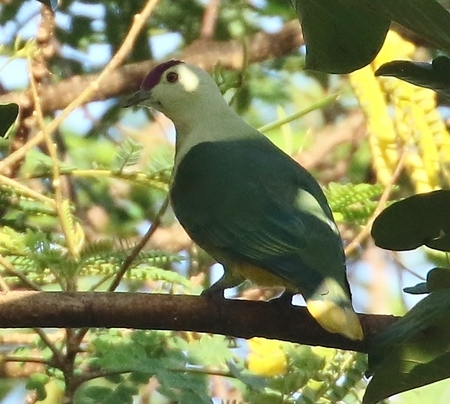
Wikimedia Commons
About the Purple-capped Fruit-Dove
The Purple-capped Fruit-Dove, scientifically known as Ptilinopus ponapensis, is a striking member of the Columbidae family. Inhabiting the lush tropical rainforests of Ponape Island in Micronesia, this species plays a critical role in the ecosystem as a seed disperser. With its vivid plumage and distinctive behaviors, the Purple-capped Fruit-Dove is a key species for birdwatchers and ornithologists alike. As a frugivore, it assists in maintaining the health of its forest environment by aiding in the propagation of fruiting tree species. During the breeding season, which aligns with the wet season from October to April, the Purple-capped Fruit-Dove becomes more vocal and visible as males display their vibrant plumage to attract mates. This period coincides with the abundance of fruit, ensuring a reliable food supply for both adults and fledglings. Outside of the breeding season, these doves may be more challenging to spot as they blend seamlessly into the canopy. They exhibit territorial behavior, with males often engaging in brief but intense displays to defend their feeding and nesting grounds. The species is endemic to Ponape Island, making it a subject of interest for conservationists concerned with the impacts of habitat loss and climate change on island ecosystems. The ecological significance of the Purple-capped Fruit-Dove extends beyond its role as a seed disperser, as it is also an indicator of forest health. Its presence in an area often signifies a rich, biodiverse environment. As such, efforts to conserve and protect its habitat have broader implications for the preservation of tropical biodiversity.
The Purple-capped Fruit-Dove belongs to the family Columbidae, within the order Columbiformes. These birds typically live typically lives 5-7 years, with some individuals reaching up to 9 years..
How to Identify a Purple-capped Fruit-Dove
The Purple-capped Fruit-Dove is easily identifiable by its vibrant purple crown, which contrasts sharply with its predominantly green body. Adult males and females are similar in appearance, though females may display slightly duller hues. Juveniles lack the intense purple cap, presenting instead with a more uniform green plumage that makes them less conspicuous. In flight, the Purple-capped Fruit-Dove exhibits a compact silhouette with broad wings and a short tail. The underwings flash a pale green, providing a brief glimpse of their hidden beauty. When perched, they often adopt a horizontal stance, with their tail slightly lowered. This species may be confused with other fruit-doves in the region, such as the Crimson-crowned Fruit-Dove, but the distinctive purple cap sets it apart. They are often found in pairs or small family groups, which can aid in their identification as they forage quietly in the canopy.
Having trouble telling birds apart? Upload a photo to our bird identification tool for an instant species match.
Purple-capped Fruit-Dove Habitat and Range
Preferred Habitat
The Purple-capped Fruit-Dove inhabits the dense tropical rainforests of Ponape Island, thriving in the humid, lush environments that characterize this region. They are typically found at elevations ranging from sea level to 600 meters, where they seek out fruiting trees in the forest canopy. These doves show a preference for primary and mature secondary forests, where their food sources are plentiful. During the breeding season, they may venture closer to forest edges and clearings, likely due to the abundance of fruit. Unlike some other dove species, they do not typically adapt to urban environments, preferring the tranquility and resources of their native forests.
Geographic Range
Endemic to Ponape Island, the Purple-capped Fruit-Dove has a very restricted range. This island, part of the Federated States of Micronesia, provides the unique habitat essential for their survival. The lack of migratory behavior means they are year-round residents, relying on the island's continuous fruit availability. Within this confined range, they occupy specific forested areas, with population densities varying according to habitat quality and fruit abundance. As a result, they are considered a key indicator species for the health of Ponape's tropical ecosystems.
Want to know which birds visit your area? Browse our backyard birds by location guides for region-specific species lists.
What Does the Purple-capped Fruit-Dove Eat?
The diet of the Purple-capped Fruit-Dove primarily consists of a variety of fruits, with a preference for figs and other small, fleshy fruits found in the rainforest canopy. During the wet season, when fruit is abundant, these doves can consume large quantities, enabling them to store energy for the less fruitful dry months. They employ a straightforward foraging technique, plucking fruits directly from branches while perching or during short, agile flights. Occasionally, they may consume small invertebrates, though these are not a significant portion of their diet. Their feeding schedule is diurnal, with peak activity occurring in the early morning and late afternoon, aligning with periods of cooler temperatures.
Purple-capped Fruit-Dove Behavior and Social Structure
The Purple-capped Fruit-Dove exhibits a solitary or paired social structure, with individuals often seen foraging alone or in pairs. Territorial behavior is pronounced during the breeding season, with males engaging in vocal displays and posturing to ward off potential rivals. Courtship displays involve males puffing out their chest feathers and performing a slow, deliberate bowing motion to attract females. Although generally quiet, these doves will emit soft cooing calls during courtship and when establishing territory. They display a strong fidelity to their chosen territory, defending it vigorously against intruders. In response to predators, they rely on their camouflaged plumage to remain undetected, often freezing motionless among the foliage. Their daily activity peaks in the cooler hours of dawn and dusk, when they are most active in feeding and social interactions.
Purple-capped Fruit-Dove Nesting and Reproduction
The Purple-capped Fruit-Dove constructs a simple, flimsy platform nest made of twigs and leaves, typically positioned high in the forest canopy to avoid ground predators. Nest locations are usually well-concealed within dense foliage, providing protection from the elements and predators. The female lays a single white egg per clutch, which both parents incubate over a period of approximately 18-20 days. After hatching, the chick remains in the nest for about 15-18 days before fledging. Both parents share in the feeding and care of the young, regurgitating partially digested fruit to provide nourishment. The species typically raises one brood per year, although they may attempt a second if conditions are favorable.
Purple-capped Fruit-Dove Sounds and Vocalizations
The vocalizations of the Purple-capped Fruit-Dove are soft and melodious, characterized by a series of low cooing notes that can be difficult to detect over the ambient sounds of the rainforest. Their primary song consists of a rhythmic series of coos that rise and fall in pitch, creating a soothing, almost hypnotic effect. Alarm calls are more abrupt and staccato, designed to alert nearby doves of potential threats. During the dawn chorus, their calls blend harmoniously with those of other forest birds, contributing to the rich tapestry of sound typical of tropical mornings.
Interesting Facts About the Purple-capped Fruit-Dove
- 1The Purple-capped Fruit-Dove is one of only a few species endemic to Ponape Island, highlighting its unique role in the local ecosystem.
- 2This dove's diet is so fruit-centric that it often helps in dispersing seeds across the forest, aiding in plant regeneration.
- 3Despite their vivid plumage, Purple-capped Fruit-Doves can be surprisingly difficult to spot due to their exceptional camouflage.
- 4The species' preference for high canopy nesting offers protection from ground-based predators, showcasing an adaptation to their forest habitat.
- 5Their soft cooing calls are easily lost amidst the rainforest sounds, demonstrating their subtle presence in their natural habitat.
- 6Purple-capped Fruit-Doves are non-migratory, making them a constant presence in Ponape's tropical forests year-round.
- 7The species' reliance on fruiting trees means any significant habitat change could have immediate effects on their population.
Purple-capped Fruit-Dove Conservation Status
The IUCN currently lists the Purple-capped Fruit-Dove as Near Threatened, with a stable population trend. Primary threats include habitat destruction due to logging and land conversion for agriculture, which reduce the availability of fruiting trees essential for their survival. Conservation efforts focus on protecting remaining forest areas and promoting sustainable land-use practices. Historically, the population has fluctuated with changes in land use and forest cover, making ongoing monitoring and habitat protection critical for their continued survival.


