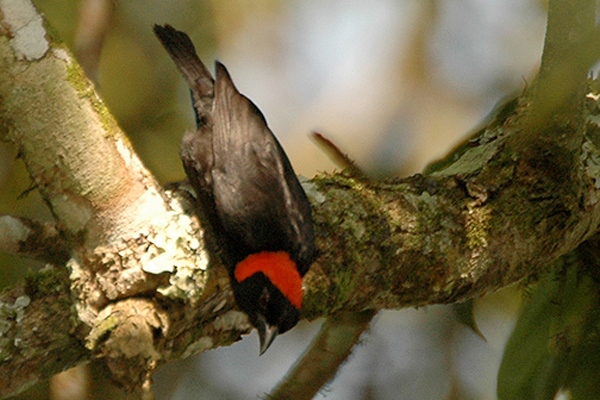
Rachel's Malimbe
Malimbus racheliae
Order: Passeriformes / Family: Ploceidae

Wikimedia Commons
About the Rachel's Malimbe
Rachel's Malimbe (Malimbus racheliae) is a striking bird native to the lush tropical forests of Central Africa. It plays a vital role in its ecosystem by participating in seed dispersal and pest control. This species is predominantly found in the lowland rainforests of countries like Cameroon, Gabon, and the Democratic Republic of the Congo, where it thrives in the dense canopy. The ecological niche of Rachel's Malimbe extends to forest edges and secondary growth areas, showcasing its adaptability to varying forest conditions. During the breeding season, which coincides with the rainy months, Rachel's Malimbe becomes more active and vocal, making it easier to observe. The bird's brilliant red and black coloration serves not only as a form of communication among its kind but also as a visual deterrent to potential predators. Its presence in the ecosystem helps control insect populations, thereby maintaining the health of the forest. As a part of the Ploceidae family, Rachel's Malimbe shares behavioral traits with other weaver birds, including complex social structures and intricate nest construction. These birds contribute significantly to the biodiversity of their habitat, as they are both prey and predator within the intricate web of forest life. Rachel's Malimbe relies heavily on the integrity of forest environments, emphasizing the importance of preserving these areas against deforestation and habitat fragmentation. Human-induced changes in land use pose a threat to the continuity of its habitat, necessitating conservation efforts to ensure the survival of this and many other forest-dwelling species. Observing Rachel's Malimbe in its natural habitat provides insight into the delicate balance of tropical ecosystems and the interconnectedness of flora and fauna within them.
The Rachel's Malimbe belongs to the family Ploceidae, within the order Passeriformes. These birds typically live average 5-6 years, with longevity up to 8 years recorded..
How to Identify a Rachel's Malimbe
Rachel's Malimbe is easily identified by its striking color pattern. Adult males and females both display a vivid red head and upper breast, contrasting sharply with their black wings, back, and tail. This bold coloration makes them stand out in the dense forest canopy. Juveniles, however, have a more subdued appearance with olive-brown tones replacing the vivid red of the adults. As they mature, they gradually acquire the distinctive adult plumage over several months. Males and females look similar, but keen observers note that males may have slightly brighter red plumage. The bird's robust body, measuring about 18 centimeters in length, and its strong, conical bill are characteristic of the Ploceidae family. In flight, Rachel's Malimbe exhibits a distinct silhouette with its short, rounded wings and relatively long tail. When perched, it maintains an upright posture, often seen clinging to branches or vines as it forages. While its vivid coloration is unique, birders might confuse it with the Scarlet-chested Sunbird or other red and black forest birds. However, its combination of features, particularly the shape and structure of its bill, distinguishes it from these similar species.
Having trouble telling birds apart? Upload a photo to our bird identification tool for an instant species match.
Rachel's Malimbe Habitat and Range
Preferred Habitat
Rachel's Malimbe inhabits the humid lowland rainforests of Central Africa. These forests, characterized by high biodiversity and dense canopy cover, offer an ideal environment for the species. It is commonly found in countries such as Cameroon, Gabon, and the Democratic Republic of the Congo. The bird prefers primary forests but is also observed in secondary growth and forest edges, indicating some adaptability. Rachel's Malimbe typically resides at elevations ranging from sea level to about 1,200 meters. Unlike some forest species, it shows limited tolerance for heavily urbanized environments, mainly staying within forested areas, although it may occasionally venture into rural gardens and plantations, especially those adjacent to forested zones. Seasonal shifts in habitat use are minimal due to the relatively stable climate of equatorial forests, allowing the bird to maintain a year-round presence in its preferred habitat.
Geographic Range
The range of Rachel's Malimbe is concentrated in Central Africa, where it occupies a relatively narrow band of tropical rainforest. It is primarily a resident bird found in countries like Cameroon, Gabon, and the Democratic Republic of the Congo, where the humid lowland forests provide a stable habitat. This species does not exhibit regular long-distance migrations, although it might undertake local movements in response to food availability. Within its range, population densities tend to be higher in undisturbed forest areas compared to fragmented or degraded landscapes. Rachel's Malimbe's distribution is largely influenced by the presence of intact forest ecosystems, which are becoming increasingly threatened by logging and agricultural expansion. Despite these threats, certain regions, such as protected areas and national parks, continue to serve as refuges where the species maintains relatively stable populations.
Want to know which birds visit your area? Browse our backyard birds by location guides for region-specific species lists.
What Does the Rachel's Malimbe Eat?
The diet of Rachel's Malimbe consists primarily of insects, which it forages for in the dense forest canopy. Its strong, conical bill is well-adapted for picking insects off leaves and branches. During the breeding season, the bird's diet may include a higher proportion of protein-rich prey to support its chicks' growth. In addition to insects, Rachel's Malimbe occasionally consumes fruit and nectar, especially when insect abundance is low. This dietary flexibility helps it survive in various forest conditions. The bird often forages in mixed-species flocks, benefiting from the vigilance and foraging efficiency of group activity. It typically feeds during the cooler parts of the day, such as early morning and late afternoon, when insect activity is highest. The size of its prey ranges from small beetles and caterpillars to larger grasshoppers, reflecting the bird's ability to exploit a range of food sources within its habitat.
Rachel's Malimbe Behavior and Social Structure
Rachel's Malimbe exhibits complex social behaviors and is often observed in small, cohesive groups. These groups communicate through a series of calls and displays, which help maintain social bonds and coordinate activities such as foraging and nesting. Territorial behavior is particularly evident during the breeding season when males defend their nesting sites against intruders. Courtship involves elaborate displays, where the male showcases his vibrant plumage and performs a series of movements to attract a mate. Rachel's Malimbe is primarily diurnal, with activity peaking during the early morning and late afternoon. This pattern allows it to maximize foraging efficiency while avoiding the midday heat. When faced with predators, the bird relies on its agility and the cover of the dense canopy to evade capture. It may also join mixed-species flocks as a strategy to reduce individual predation risk. Outside of the breeding season, Rachel's Malimbe remains social, moving through the forest in small groups that provide mutual protection and increase foraging success.
Rachel's Malimbe Nesting and Reproduction
Rachel's Malimbe constructs intricate woven nests, a hallmark of the Ploceidae family. These nests are typically suspended from the tips of tree branches, providing protection from ground predators. The bird uses pliable plant fibers, grasses, and leaves to create a spherical structure with a side entrance. Nesting usually occurs during the rainy season, aligning with peak food availability. A typical clutch consists of 2-3 eggs, which the female incubates for about 14 days. Both parents participate in feeding the chicks, which fledge approximately 18-21 days after hatching. Rachel's Malimbe often produces two broods per year, taking advantage of the extended rainy season in its habitat. The species shows strong site fidelity, often returning to the same location and sometimes even refurbishing old nests for reuse. This nesting strategy, combined with its social nature, increases the chances of reproductive success in the challenging rainforest environment.
Rachel's Malimbe Sounds and Vocalizations
Rachel's Malimbe produces a distinctive song characterized by a series of clear, melodious notes often described as 'cheerful' or 'bubbly.' The rhythm is steady, and the pitch generally remains consistent, serving as both a mating call and a territorial signal. In addition to its primary song, the bird emits various call notes, including sharp, repetitive 'tik-tik' sounds used for communication within flocks. Alarm calls are harsher and more abrupt, designed to alert other birds of potential threats. During the dawn chorus, Rachel's Malimbe is particularly vocal, contributing to the rich tapestry of sounds in the rainforest. Its calls are integral to maintaining group cohesion and coordinating collective activities, such as foraging and nesting.
Interesting Facts About the Rachel's Malimbe
- 1Rachel's Malimbe gets its name from Rachel, the wife of the ornithologist who first described the species.
- 2This bird can weave nests with remarkable precision, using only its bill to manipulate the materials.
- 3Rachel's Malimbe is one of the few bird species that can adjust its diet based on seasonal availability of insects.
- 4The species' vibrant red coloration is achieved through carotenoid pigments, which must be obtained from its diet.
- 5Rachel's Malimbe often participates in mixed-species flocks, which improves its foraging success and predator awareness.
- 6Despite its bright colors, Rachel's Malimbe can be surprisingly difficult to spot in the dense forest canopy.
- 7Studies suggest that Rachel's Malimbe can remember specific locations of abundant food sources within its territory.
Rachel's Malimbe Conservation Status
Rachel's Malimbe is currently classified as 'Least Concern' by the IUCN, indicating a stable population trend. However, ongoing threats such as deforestation and habitat fragmentation pose significant risks to its habitat. Conservation efforts focus on preserving large tracts of rainforest and implementing sustainable land-use practices. Protected areas and national parks serve as critical refuges for the species, helping to mitigate the impact of habitat loss. Historically, Rachel's Malimbe has shown resilience in the face of environmental changes, but continued vigilance is necessary to ensure its long-term survival. Collaborative efforts between governments, NGOs, and local communities are essential in promoting conservation strategies that benefit both the species and the broader ecosystem.
Other Ploceidae Species



Birds Similar to the Rachel's Malimbe
These species are often confused with the Rachel's Malimbe due to similar appearance or overlapping range.