
Red-bellied Macaw
Orthopsittaca manilata
Order: Psittaciformes / Family: Psittacidae
Wikimedia Commons
About the Red-bellied Macaw
The Red-bellied Macaw, Orthopsittaca manilata, is a striking parrot native to the vast tropical forests of South America. Its range extends predominantly across the Amazon Basin, including countries such as Brazil, Venezuela, Colombia, and Peru. This bird is an emblematic species of the Amazon's rich biodiversity, playing an integral role in seed dispersal and ecosystem dynamics. The Red-bellied Macaw inhabits palm swamps and gallery forests, showing a particular affinity for the Mauritia palm, which dominates its environment. This macaw is a highly social species, often seen in flocks that can number in the dozens. Such gatherings are notably active at dawn and dusk when the birds engage in loud, raucous vocalizations that echo through the forest canopy. The Red-bellied Macaw's ecological role is substantial due to its diet, which primarily consists of palm fruits. By consuming these fruits, the macaw aids in the regeneration of palm species by dispersing seeds over a wide area. Seasonal behaviors of the Red-bellied Macaw are closely tied to the fruiting cycles of their preferred palm species. During periods of abundant fruiting, these macaws can be observed feeding voraciously, their vibrant plumage providing a vivid contrast to the lush greenery of the rainforest. The species does not undergo long-distance migrations but may exhibit local movements in response to fruit availability. Conservationists recognize the Red-bellied Macaw's importance as a keystone species within its habitat. Efforts to preserve its environment have broader implications for the health of the Amazonian ecosystem as a whole. The bird's presence indicates a healthy ecosystem because it relies on large tracts of undisturbed forest to sustain its population.
The Red-bellied Macaw belongs to the family Psittacidae, within the order Psittaciformes. These birds typically live average 15-20 years, with a max recorded over 30 years..
How to Identify a Red-bellied Macaw
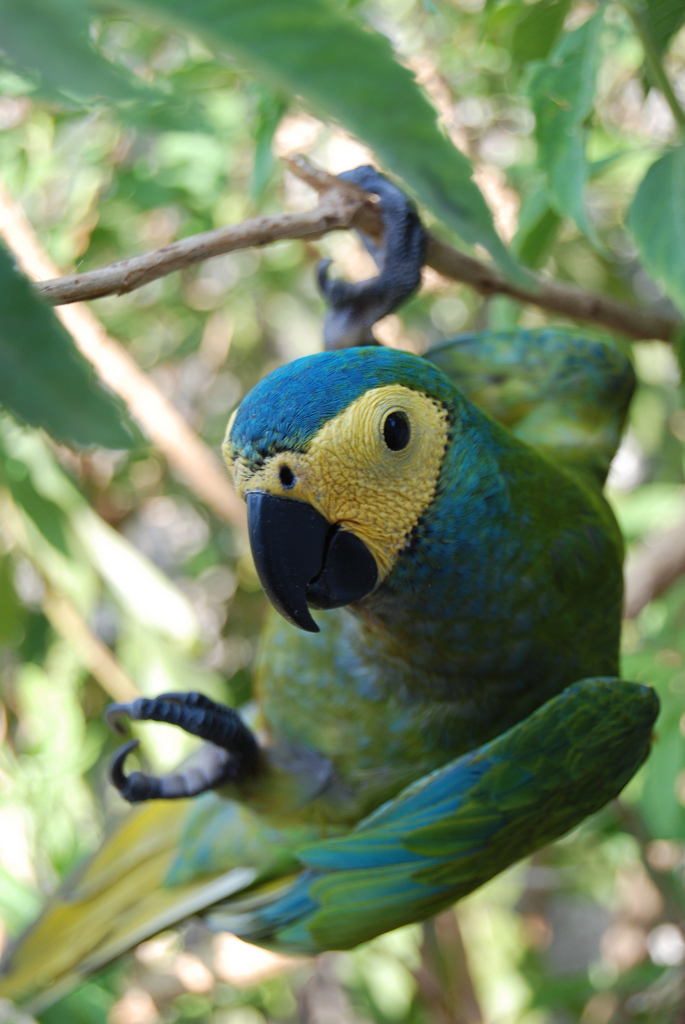
The Red-bellied Macaw is notable for its vivid green plumage, which covers most of its body, providing excellent camouflage among the lush canopies it inhabits. The bird's hallmark is its distinct red belly, a feature that becomes particularly visible during flight or when the bird is perched in a position that exposes its underside. Adult Red-bellied Macaws have a wingspan ranging from 70 to 75 centimeters, and they weigh approximately 300 grams. The bird's underwings are a contrasting yellow, visible when it takes to the air. The face of the Red-bellied Macaw is bare and pale, with a sharp, grayish-black bill ideal for cracking open hard palm nuts. Juveniles resemble adults but generally have less pronounced red on their bellies and a paler facial skin tone. There is little sexual dimorphism in this species, making it difficult to distinguish males from females in the field. In flight, the Red-bellied Macaw presents a striking silhouette, with long, pointed wings and a slightly graduated tail. When perched, its posture is upright and alert. The bird can sometimes be confused with other green macaws, such as the Blue-and-yellow Macaw. However, the unique red belly and smaller size of the Red-bellied Macaw are distinguishing characteristics.
Having trouble telling birds apart? Upload a photo to our bird identification tool for an instant species match.
Red-bellied Macaw Habitat and Range
Preferred Habitat
The Red-bellied Macaw primarily inhabits palm swamps and areas with abundant Mauritia flexuosa palms, often referred to as moriche palms. These habitats are typically found in lowland tropical regions below 500 meters in elevation, where the environment is humid and the vegetation is dense. Unlike some other macaw species, the Red-bellied Macaw is not commonly found in urban settings or highly disturbed areas. It requires large expanses of natural habitat to thrive, which restricts its presence to remote and relatively undisturbed areas. Seasonal habitat shifts may occur in response to the availability of food resources, although these movements are typically local rather than long-range migrations.
Geographic Range
The Red-bellied Macaw's range is concentrated in the northern part of South America, particularly within the Amazon Basin. It is most commonly found in countries such as Brazil, Guyana, Suriname, French Guiana, and Venezuela. The bird's range extends into parts of Colombia and eastern Peru as well. While it does not undertake long migratory journeys, the species may move locally in response to the fruiting patterns of palm trees. Population density tends to be higher in areas where Mauritia palms are abundant, as these trees constitute a critical food resource for the macaws. Conservation efforts in these regions focus on preserving the palm swamp habitats that are essential to the Red-bellied Macaw's survival.
Want to know which birds visit your area? Browse our backyard birds by location guides for region-specific species lists.
What Does the Red-bellied Macaw Eat?
The diet of the Red-bellied Macaw is specialized, with a primary focus on the fruits of the Mauritia palm. These fruits provide not only sustenance but also the fats and proteins necessary for the bird's health and reproduction. In addition to Mauritia fruits, the macaw may occasionally consume other palm species and supplement its diet with seeds. Foraging typically occurs in the early morning and late afternoon when the temperatures are cooler. The macaws use their strong beaks to crack open the hard shells of palm fruits, a task that requires significant strength and dexterity. Seasonal variations in fruit availability can lead to shifts in the bird's foraging behavior, although the reliance on palm fruits remains a constant aspect of its diet.
Red-bellied Macaw Behavior and Social Structure
The Red-bellied Macaw is a social bird, often found in groups ranging from small flocks of five to large gatherings of over 30 individuals. These flocks exhibit complex social structures and engage in various cooperative behaviors. The macaws are known for their loud and distinctive calls, which serve both to communicate within the flock and to establish territorial presence. During the breeding season, pairs engage in courtship displays that include mutual preening and synchronized movements. These displays reinforce pair bonds and are crucial for successful breeding. The species shows a degree of territorial behavior, particularly around nesting sites, although it is generally more tolerant of conspecifics than some other parrot species. The Red-bellied Macaw exhibits a daily activity pattern that peaks at dawn and dusk. During the hottest part of the day, the birds tend to rest in shaded areas.
Red-bellied Macaw Nesting and Reproduction
Red-bellied Macaws typically nest in cavities found in dead palm trees, particularly those of the Mauritia palm. These cavities provide protection against predators and harsh weather. The nest is lined with wood dust and palm fibers, materials readily available in their environment. A typical clutch consists of two to four eggs, with an incubation period of about 26 to 28 days. Both parents participate in incubating the eggs and caring for the young. After hatching, the chicks remain in the nest for approximately 10 to 12 weeks before fledging. During this time, the parents continue to provide food and protection. Red-bellied Macaws usually raise one brood per year, although in optimal conditions, they may attempt a second.
Red-bellied Macaw Sounds and Vocalizations
The vocalizations of the Red-bellied Macaw are loud and penetrating, consisting of harsh, repetitive squawks and high-pitched whistles. These calls serve various functions, including flock cohesion and territory defense. The macaw's alarm calls are particularly sharp and rapid, alerting flock members to potential dangers. During the dawn chorus, Red-bellied Macaws contribute with a cacophony of sounds that can be heard over long distances, creating an auditory spectacle that is characteristic of their habitat. The bird's vocal repertoire is less musical than some other parrot species, focusing more on volume and tone.
Interesting Facts About the Red-bellied Macaw
- 1Red-bellied Macaws are one of the few bird species that can digest the toxic compounds found in the Mauritia palm fruits.
- 2The species' preference for palm swamps makes it a key indicator of healthy wetland ecosystems in the Amazon.
- 3Red-bellied Macaws can live up to 30 years in the wild, making them one of the longer-lived parrot species.
- 4The macaw's diet is so specialized that it can be a challenge to maintain them in captivity without access to palm fruits.
- 5Flocks of Red-bellied Macaws can be spotted flying in synchronized formations, a breathtaking sight in the Amazon skies.
- 6Despite their name, the red on the belly of these macaws is often hidden, making it a surprise when they take flight.
- 7These birds have a strong bond with their mate, often staying together for life once paired.
Red-bellied Macaw Conservation Status
The Red-bellied Macaw is currently listed as Least Concern by the IUCN, but its population is considered to be decreasing. Primary threats include habitat destruction due to deforestation and the draining of palm swamps for agriculture. The illegal pet trade also poses a risk, although its impact is less severe than habitat loss. Conservation efforts focus on preserving critical habitats and enforcing regulations against illegal trapping. Organizations working in the Amazon Basin aim to protect large tracts of forest to ensure the survival of this and other species. Historical population data indicate a decline correlated with increased human encroachment and environmental changes.
Other Psittacidae Species


Birds Similar to the Red-bellied Macaw
These species are often confused with the Red-bellied Macaw due to similar appearance or overlapping range.
