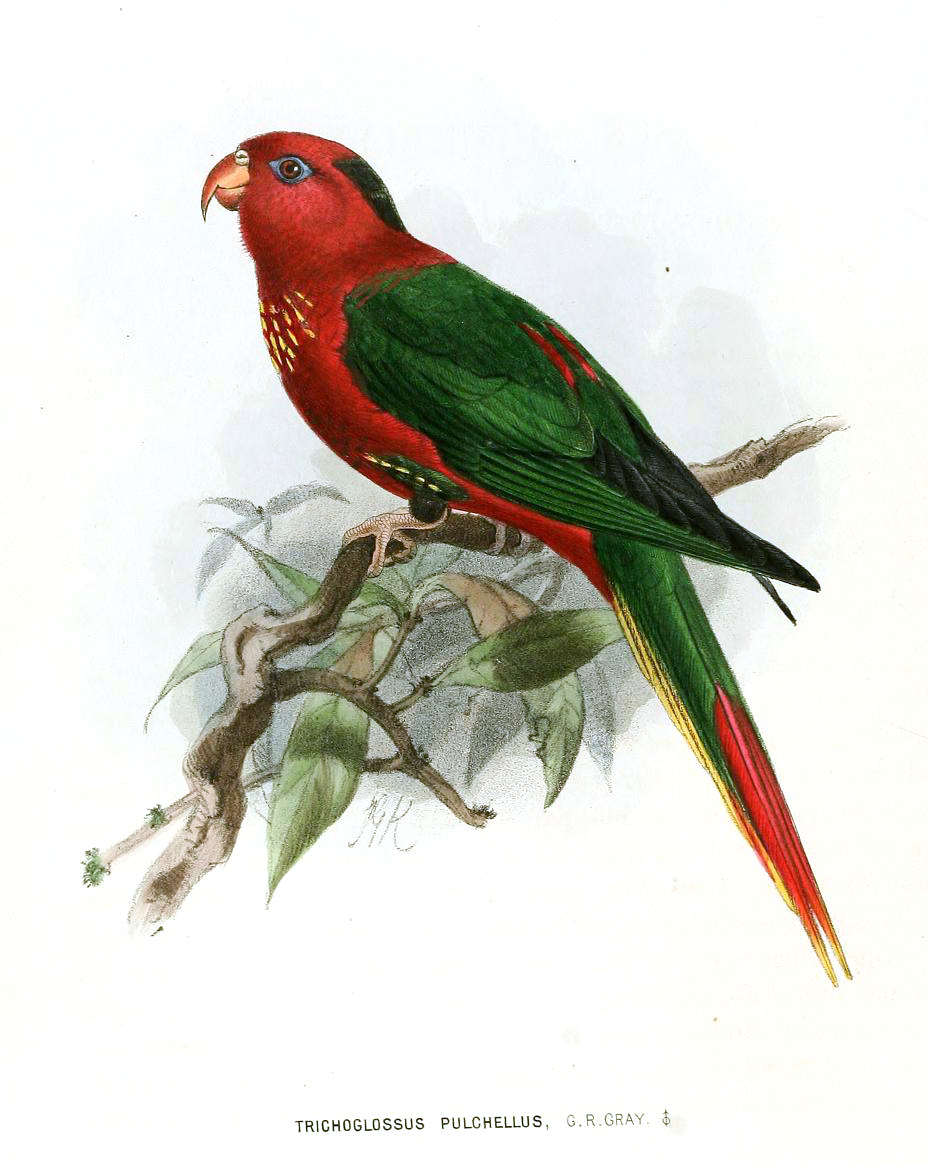
Red-flanked Lorikeet
Hypocharmosyna placentis
Order: Psittaciformes / Family: Psittaculidae

Wikimedia Commons
About the Red-flanked Lorikeet
The Red-flanked Lorikeet (Hypocharmosyna placentis) is a small, vibrantly colored parrot belonging to the family Psittaculidae. Endemic to the islands of New Guinea and nearby archipelagos, this lorikeet is most commonly found in lowland and montane forests, thriving in the lush, humid environments of these regions. Its primary habitats include Papua New Guinea and parts of Indonesia, where it plays a significant role in the pollination of native plant species due to its specialized brush-tipped tongue, adapted for feeding on nectar and pollen. The ecological role of the Red-flanked Lorikeet extends beyond its feeding habits. As a keystone species, it contributes to forest regeneration by dispersing seeds from the fruit it consumes, thus maintaining the health of its tropical ecosystem. The bird's bright plumage serves not only as a visual delight for birdwatchers but also as an important signal in its social interactions and mating rituals. Seasonally, the Red-flanked Lorikeet may exhibit slight shifts in altitude, moving to higher elevations during certain times of the year to exploit different flowering plants. This altitudinal migration ensures their continual access to food resources, showcasing their adaptability. Despite their colorful presence, Red-flanked Lorikeets can be elusive, often blending seamlessly into the dense foliage of their forest homes. Their ability to thrive in various forest types, from primary rainforests to secondary growth and even garden edges, highlights their resilience in the face of habitat modification. However, deforestation and habitat fragmentation pose significant threats to their populations. Conservation efforts focusing on habitat preservation and restoration are crucial to ensure the survival of this species. The Red-flanked Lorikeet's beauty and ecological importance underscore the need for ongoing research and protective measures, ensuring that future generations can continue to marvel at this jewel of the forest.
The Red-flanked Lorikeet belongs to the family Psittaculidae, within the order Psittaciformes. These birds typically live typically 8-12 years in the wild, with some living up to 15 years in captivity..
How to Identify a Red-flanked Lorikeet
The Red-flanked Lorikeet is easily recognized by its striking plumage. Adult males exhibit a vivid red patch on the side of their bodies, flanked by brilliant green feathers that cover most of their body, giving them their common name. The wings are predominantly green, with hints of red on the primary feathers. The face and throat are a lighter shade of green, often appearing slightly yellowish in certain lights. Females, while similarly colored, lack the red patch that characterizes the males, creating a subtle but noticeable sexual dimorphism. Juveniles resemble the adults but often display a more muted color palette, with less pronounced red markings. In flight, the Red-flanked Lorikeet presents a compact silhouette, with rapid wingbeats creating a distinctive fluttering sound. Their small size and agility allow them to navigate the dense forest canopy with ease. When perched, these lorikeets often adopt an upright posture, using their strong feet and curved beak to grip branches securely. Similar species, such as the Papuan Lorikeet, can sometimes lead to confusion. However, the Red-flanked Lorikeet's unique combination of red and green plumage serves as a reliable identifying feature. Observers should note the bird's behavior and vocalizations, which further assist in accurate identification.
Having trouble telling birds apart? Upload a photo to our bird identification tool for an instant species match.
Red-flanked Lorikeet Habitat and Range
Preferred Habitat
The Red-flanked Lorikeet inhabits a range of forested environments throughout its distribution in Oceania. Preferring lowland and montane rainforests, they are typically found at elevations from sea level up to 2,400 meters. These birds adapt well to both primary and secondary forests, often seen at forest edges and in areas undergoing regrowth. During different seasons, they may adjust their habitat preferences slightly, moving to higher elevations to follow flowering cycles of specific plants. While primarily forest dwellers, they are occasionally observed in more open woodland areas and gardens, especially where flowering trees and shrubs provide abundant food sources. Urban presence is limited, as they generally prefer the cover and resources provided by forested areas.
Geographic Range
The Red-flanked Lorikeet's range is primarily concentrated in the New Guinea region and adjacent islands, including parts of Papua New Guinea and Indonesia's Maluku and West Papua provinces. This species is non-migratory, residing year-round within its established range. However, it may engage in local altitudinal movements, particularly in response to seasonal changes in food availability. Dense populations are often found in areas with rich, diverse forest ecosystems, where flowering and fruiting plants provide ample nourishment. The lorikeet's range does not extend beyond these islands, making its conservation a region-specific concern.
Want to know which birds visit your area? Browse our backyard birds by location guides for region-specific species lists.
What Does the Red-flanked Lorikeet Eat?
Red-flanked Lorikeets primarily feed on nectar and pollen, utilizing their specialized brush-tipped tongues to extract these resources from flowers. They are particularly fond of the blossoms of eucalyptus and other native flowering trees. In addition to nectar, they consume fruits, especially soft fruits like figs and berries, which supplement their diet. During certain times of the year, when flowers and fruit are less abundant, they may also eat insects and small invertebrates, providing a necessary protein source. Their foraging behavior typically involves agile movements among the canopy, often hanging upside down to access flower clusters. Feeding occurs throughout the day, with peak activity during the early morning and late afternoon when temperatures are cooler.
Red-flanked Lorikeet Behavior and Social Structure
Red-flanked Lorikeets are social birds, often seen in small flocks ranging from a few individuals to larger groups of up to 20 birds. These flocks facilitate their foraging efficiency and provide safety in numbers against potential predators. While they are generally non-territorial, they may exhibit aggressive behavior during breeding season, defending nesting sites from intruders. Courtship involves dynamic aerial displays and mutual preening, reinforcing pair bonds. Their flight is characterized by rapid wingbeats and swift maneuvers, allowing them to navigate through dense foliage with ease. Vocal communication is vital in their social interactions, with a variety of calls used for contact, alarms, and coordination within flocks. They are most active during the daylight hours, engaging in foraging, socializing, and exploring their environment.
Red-flanked Lorikeet Nesting and Reproduction
The Red-flanked Lorikeet typically nests in tree cavities, preferring those located in tall, mature trees. Nest sites are often selected based on proximity to reliable food sources and safety from predators. The female usually lays a clutch of two to three eggs, which she incubates for about 23 days. During incubation, the male plays a crucial role in feeding the female and guarding the nest site. After hatching, both parents actively participate in feeding and caring for the chicks. The young fledge approximately six to eight weeks after hatching, although they may remain dependent on their parents for food and guidance for several weeks post-fledging. The species generally raises one brood per year, although favorable conditions may lead to occasional second broods.
Red-flanked Lorikeet Sounds and Vocalizations
The Red-flanked Lorikeet's vocalizations include a series of high-pitched, melodic whistles and chirps, often described as 'tinkling' in quality. These calls are used for communication within flocks and are most frequently heard during flight or while foraging. Alarm calls are sharper and more abrupt, serving to alert other birds of potential threats. During the dawn chorus, their calls blend harmoniously with the natural symphony of the forest, signaling the beginning of a new day. Comparatively, their calls are less raucous than those of larger parrots, maintaining a more musical tone.
Interesting Facts About the Red-flanked Lorikeet
- 1The Red-flanked Lorikeet's brush-tipped tongue is an adaptation for nectar feeding, a trait shared with only a few other parrot species.
- 2These lorikeets are capable of rapid altitudinal shifts, moving to higher elevations to follow the flowering cycles of certain plants.
- 3Despite their small size, Red-flanked Lorikeets play a crucial role in pollination, assisting in the reproduction of various native plant species.
- 4Their vibrant plumage serves not only for display but also helps in camouflage among the colorful forest flora.
- 5The Red-flanked Lorikeet's diet is highly flexible, allowing it to exploit a wide range of food resources throughout the year.
Red-flanked Lorikeet Conservation Status
The IUCN currently lists the Red-flanked Lorikeet as a species of Least Concern, though habitat destruction poses ongoing threats. Their population remains stable, but deforestation for agriculture and logging continues to reduce available habitat. Conservation efforts focus on preserving and protecting forest habitats, particularly in areas where human activities are encroaching. Establishing protected areas and promoting sustainable land-use practices are critical to their long-term survival. Historical data suggests that while populations have fluctuated, they have remained relatively resilient, adapting to changing environmental conditions.