
Red-footed Falcon
Falco vespertinus
Order: Falconiformes / Family: Falconidae
Wikimedia Commons
About the Red-footed Falcon
The Red-footed Falcon, scientifically known as Falco vespertinus, is a medium-sized raptor belonging to the Falconidae family. This species is native to eastern Europe and central Asia, where it breeds in the open grasslands and steppe habitats. Its presence is a significant indicator of environmental health, as it preys on large numbers of insects, thus playing a crucial role in controlling pest populations.
In its breeding grounds, the Red-footed Falcon is noted for its sociable nature, often forming loose colonies. These colonies can be found in areas such as Hungary's Hortobágy National Park and the expansive steppes of Kazakhstan. The species tends to prefer habitats that offer a mosaic of open landscapes interspersed with copses of trees, which provide essential perching and nesting sites.
During the migration period, the Red-footed Falcon embarks on a lengthy journey to its wintering grounds in southern Africa. This migration is notable for its long distance, with some birds traveling over 7,000 kilometers. The species utilizes a variety of stopover sites along its route, demonstrating its remarkable adaptability to different environments.
The ecological role of the Red-footed Falcon extends beyond pest control. Its presence in diverse habitats contributes to the maintenance of ecological balance by influencing prey populations and, consequently, the distribution of other predators. Furthermore, the falcon's migratory patterns provide opportunities for ornithologists to study the effects of climate change on avian species, offering insights into broader ecosystem health.
The Red-footed Falcon belongs to the family Falconidae, within the order Falconiformes. These birds typically live average 6-10 years with a max recorded of 13 years.
How to Identify a Red-footed Falcon
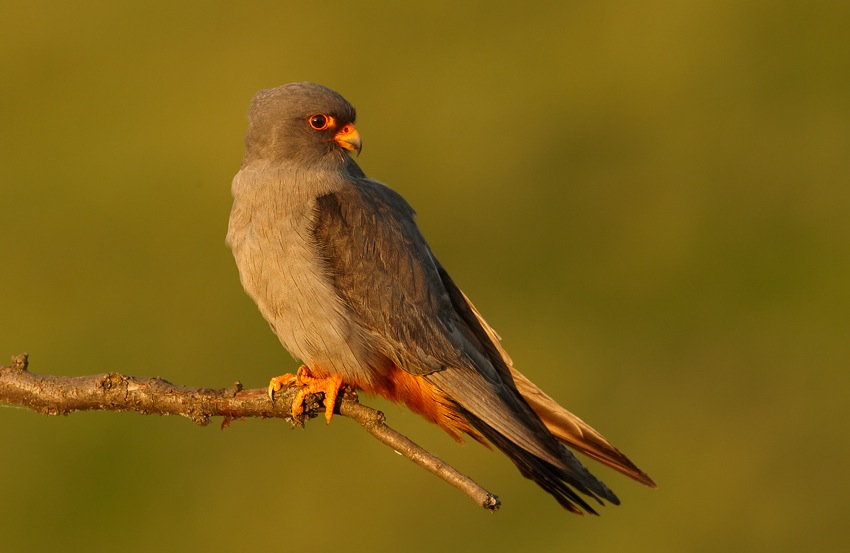
The Red-footed Falcon exhibits distinct field marks that make it recognizable. Adult males are characterized by a slate-gray plumage with striking red legs and cere. Their underwings display a contrasting pattern of lighter and darker feathers, aiding in identification during flight. Females, in contrast, have a more varied plumage with a combination of gray and rufous tones, as well as distinctive streaking on their underparts.
Juvenile Red-footed Falcons resemble females but show a more muted color palette and lack the adult male's solid gray coloration. These younger birds have a brownish hue overall with streaked underparts and a less pronounced red on their legs.
When comparing the Red-footed Falcon to similar species, such as the Eurasian Hobby or the Amur Falcon, its size and coloration are key differentiators. The Red-footed Falcon has a more robust body and shorter wings, whereas the Eurasian Hobby displays elongated wings and a sleeker body. In flight, the silhouette of the Red-footed Falcon is compact, with rapid wingbeats that create a distinctive fluttering motion. While perched, it maintains an upright posture with its red legs visible.
Having trouble telling birds apart? Upload a photo to our bird identification tool for an instant species match.
Red-footed Falcon Habitat and Range
Preferred Habitat
The Red-footed Falcon inhabits open landscapes, predominantly favoring grasslands and steppe regions in eastern Europe and central Asia. These areas, such as Russia's Volga River Basin and parts of Hungary, provide essential hunting grounds teeming with insect prey. During the breeding season, it seeks out areas with sparse tree cover or artificial structures for nesting, often adjacent to open fields.
In the non-breeding season, as it migrates to southern Africa, the falcon occupies a broader range of habitats, from savannas to agricultural lands. This adaptability allows it to exploit various ecological niches, although it shows a preference for areas offering abundant insect populations.
The Red-footed Falcon is occasionally observed in urban settings, particularly during migration. In cities, it may utilize tall buildings or other structures as perches, showcasing its ability to thrive in both rural and urban environments. Seasonal habitat shifts largely depend on prey availability, with the falcon gravitating towards regions with plentiful food resources.
Geographic Range
The breeding range of the Red-footed Falcon spans from eastern Europe to central Asia, with significant populations in countries such as Hungary, Ukraine, and Kazakhstan. Within these regions, it favors open landscapes that support its insectivorous diet. During migration, the falcon travels south through eastern Europe and the Middle East, utilizing well-established corridors that provide necessary stopover sites.
The wintering grounds of the Red-footed Falcon are located in southern Africa, where it spreads across countries like Namibia, Botswana, and South Africa. Here, it exploits the rich insect populations found in savannas and agricultural fields.
Population densities vary across its range, with the highest concentrations found in regions offering optimal breeding and foraging conditions. Conservation areas like the Kiskunság National Park in Hungary serve as important refuges during the breeding season, supporting significant numbers of these falcons.
Want to know which birds visit your area? Browse our backyard birds by location guides for region-specific species lists.
What Does the Red-footed Falcon Eat?
The diet of the Red-footed Falcon primarily consists of insects, with a preference for large, flying species such as locusts, grasshoppers, and dragonflies. This preference makes them valuable allies to agriculture by helping control pest populations. During the breeding season, the availability of these insects peaks, providing the falcon with ample food resources to sustain itself and its young.
In winter, while in southern Africa, the falcon's diet remains largely insectivorous, though it may occasionally catch small birds or rodents. The shift in prey selection corresponds to seasonal variations in prey abundance and availability.
The Red-footed Falcon employs an agile foraging technique, often hawking insects in mid-air with remarkable precision. It also hunts from perches, using its keen eyesight to spot prey before launching a swift attack. This versatile hunting strategy allows it to exploit a wide range of prey sizes, from small beetles to larger winged insects. Feeding activity peaks during the morning and late afternoon when prey is most active.
Red-footed Falcon Behavior and Social Structure
The Red-footed Falcon exhibits a complex social structure, often forming loose breeding colonies that provide mutual benefits, such as increased vigilance against predators. These colonies foster a dynamic social environment where pairs engage in cooperative behaviors.
Territorial behavior is more pronounced during the breeding season, with mated pairs defending nesting sites from intruders. Courtship displays involve aerial acrobatics and food exchanges, strengthening pair bonds and ensuring successful reproduction.
Flocking patterns vary with the season. During migration, the falcon travels in small groups, a behavior that enhances safety and navigational efficiency. In their wintering grounds, they may form larger aggregations, taking advantage of abundant food resources.
The Red-footed Falcon is diurnal, with peak activity occurring during early morning and late afternoon, aligning with prey activity. In the presence of predators, such as larger raptors, the falcon employs evasive maneuvers and alarm calls to alert conspecifics and protect its territory.
Red-footed Falcon Nesting and Reproduction
Red-footed Falcons typically utilize old nests of other bird species, particularly those of crows or rooks, rather than constructing their own. These nests are often located in trees or on artificial structures, providing elevated vantage points that enhance protection from ground-based predators.
The clutch size generally consists of 3 to 5 eggs, which the female incubates for approximately 28 to 30 days. During incubation, the male actively provides food, allowing the female to focus on maintaining optimal temperature and humidity conditions for the developing embryos.
Once the eggs hatch, both parents partake in feeding the chicks, which fledge approximately 28 to 30 days post-hatching. The cooperative nature of parental roles ensures high survival rates, with the young remaining dependent on their parents for several weeks after fledging.
Typically, the Red-footed Falcon raises one brood per year, although in conditions of high prey abundance, a second brood is possible. This adaptability underscores the species' ability to exploit favorable environmental conditions to enhance reproductive success.
Red-footed Falcon Sounds and Vocalizations
The Red-footed Falcon's call repertoire includes a series of high-pitched, rapid 'kik-kik-kik' notes, often used in communication between mates or to alert others of predators. These calls are sharp and carry well over distances.
During the breeding season, the falcon's vocalizations become more frequent and varied, with softer, more complex calls exchanged between pairs during courtship. The dawn chorus, although less pronounced than that of songbirds, features the falcon's piercing calls, signaling the start of daily activities.
Alarm calls are distinct, characterized by harsher, more urgent notes designed to convey immediate danger and prompt a swift response from nearby falcons. These vocalizations play a crucial role in maintaining colony cohesion and defense.
Interesting Facts About the Red-footed Falcon
- 1The Red-footed Falcon can travel over 7,000 kilometers during its migration from Europe to southern Africa.
- 2Despite being a raptor, the Red-footed Falcon primarily feeds on insects, making it a valuable pest controller.
- 3Red-footed Falcons often form loose colonies, a behavior that enhances protection and social interaction.
- 4Unlike many other falcons, Red-footed Falcons frequently reuse old nests of crows and rooks for breeding.
- 5Their aerial hunting skills are remarkable, with precise mid-air maneuvers to catch flying insects.
- 6The Red-footed Falcon's striking red legs are a key identifying feature, visible both in flight and while perched.
- 7This species' migratory journey spans multiple continents, showcasing its adaptability and resilience.
Red-footed Falcon Conservation Status
The Red-footed Falcon is currently classified as 'Near Threatened' on the IUCN Red List, with populations experiencing a gradual decline due to habitat loss and degradation. Agricultural intensification, particularly the removal of traditional nesting sites and pesticide use, poses significant threats. Conservation efforts include habitat protection and restoration, particularly in key breeding areas across eastern Europe. Initiatives such as nest box programs have proven effective in providing alternative nesting sites, supporting population stability. Historically, the species enjoyed more robust populations, but changes in land use and climate have contributed to its current status. Continued monitoring and targeted conservation actions are essential to reverse declining trends and ensure the Red-footed Falcon's long-term survival.
Other Falconidae Species


Birds Similar to the Red-footed Falcon
These species are often confused with the Red-footed Falcon due to similar appearance or overlapping range.

