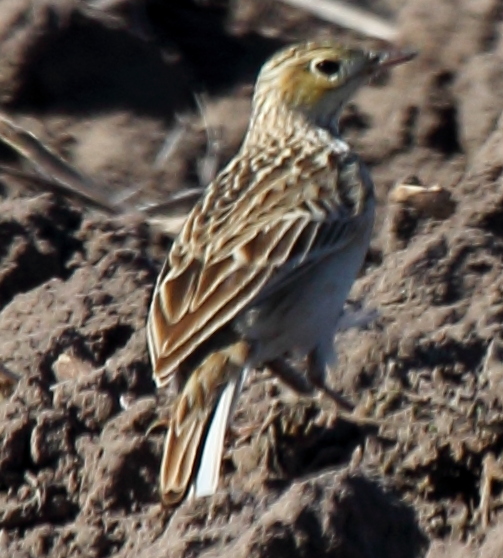
Red-throated Pipit
Anthus cervinus
Order: Passeriformes / Family: Motacillidae

Wikimedia Commons
About the Red-throated Pipit
The Red-throated Pipit (Anthus cervinus) is a small, yet captivating bird belonging to the family Motacillidae and order Passeriformes. This species is renowned for its reddish throat, a feature most prominent during the breeding season. Found across a vast range of the Northern Hemisphere, the Red-throated Pipit plays a significant ecological role in its habitats. It frequents the tundra and open grasslands of Northern Europe and Asia during the breeding season. These areas, characterized by their harsh climates, are softened by the presence of the Red-throated Pipit, whose calls and songs bring life to the landscape. In winter, the bird migrates south to warmer climates, reaching as far as Africa and Southeast Asia.
The Red-throated Pipit holds ecological significance as an insectivore, helping control insect populations in its breeding and wintering grounds. During breeding, its diet is primarily composed of insects and larvae found in the tundra and grassland ecosystems. As the seasons change, the bird adapts, shifting to seeds and other available resources, demonstrating its versatility and adaptability. This species is a part of the intricate web of life, influencing and being influenced by the flora and fauna of its habitats.
Seasonal behaviors highlight the Red-throated Pipit's adaptability. In the breeding season, males perform aerial displays, showcasing their reddish throats and singing to attract mates. As winter approaches, these birds embark on long migrations, traveling thousands of kilometers to reach their wintering grounds. They form flocks, often with other pipit species, a behavior that provides safety in numbers during their journey. The Red-throated Pipit’s presence in diverse environments and its migratory patterns make it a species of interest for ornithologists and bird enthusiasts alike.
The Red-throated Pipit belongs to the family Motacillidae, within the order Passeriformes. These birds typically live average 4 years with a maximum recorded of 7 years.
How to Identify a Red-throated Pipit
Identifying the Red-throated Pipit involves recognizing several key field marks. Adults in breeding plumage display a striking reddish throat that contrasts with their otherwise brown and heavily streaked plumage. The upperparts of the bird are predominantly brown, with darker streaks providing excellent camouflage against the ground. During the non-breeding season, the reddish throat fades, and the bird’s plumage becomes more subdued, making identification slightly more challenging.
Juvenile Red-throated Pipits resemble adults but lack the reddish throat. Instead, they have a buffier appearance with more pronounced streaking. Males and females exhibit similar plumage, though males may display slightly more vibrant colors, especially during breeding. When comparing with similar species, such as the Meadow Pipit, note the more pronounced and reddish throat of the Red-throated Pipit and its distinct call.
In flight, the Red-throated Pipit exhibits a distinctive, undulating flight pattern typical of pipits. Its perching posture is upright, often on rocks or low vegetation, providing a clear view of its environment. Observers should pay attention to its streaked appearance and listen for its call to confirm identification.
Having trouble telling birds apart? Upload a photo to our bird identification tool for an instant species match.
Red-throated Pipit Habitat and Range
Preferred Habitat
Red-throated Pipits inhabit a variety of open habitats. During the breeding season, they prefer the tundra and grasslands of Northern Europe and Asia, often found at elevations where vegetation is sparse. These habitats provide ample foraging opportunities and nesting sites. In the winter, they migrate to milder climates, inhabiting wetlands, rice fields, and agricultural lands in Africa and Southeast Asia.
They show adaptability, occupying both rural and peri-urban environments where suitable open habitats exist. The Red-throated Pipit does not typically frequent densely urban areas, as it favors wide, open spaces where it can forage and nest with minimal disturbance. Seasonal habitat shifts reflect the bird's migratory nature and its reliance on habitats that offer both food and protection.
Geographic Range
The breeding range of the Red-throated Pipit spans across the northern tundra regions of Europe and Asia, including Norway, Finland, and Siberia. In these areas, they occupy open ground during the warmer months. As winter approaches, they embark on extensive migrations to reach their wintering grounds, which extend into parts of Africa, including Egypt, Sudan, and Kenya, and across to Southeast Asia, including Thailand and the Philippines.
Migration corridors take them through Eastern Europe and the Middle East, with stopover sites crucial for refueling. Population density is highest in breeding areas where suitable habitats are abundant. Wintering populations are more dispersed, reflecting the bird's adaptability to a wide range of environments. Despite their extensive range, Red-throated Pipits are more commonly observed in areas where migratory paths concentrate.
Want to know which birds visit your area? Browse our backyard birds by location guides for region-specific species lists.
What Does the Red-throated Pipit Eat?
The Red-throated Pipit's diet mainly consists of insects, which it actively forages for in its open habitat. During the breeding season, it consumes a variety of insects and larvae, which are abundant in the tundra and grassland environments. This insectivorous diet is crucial for chick development and adult nourishment.
In winter, the bird's diet shifts to include seeds and other plant materials, reflecting the seasonal availability of food sources. The Red-throated Pipit employs a methodical foraging technique, walking on the ground and picking insects and seeds off the surface. It primarily feeds during daylight hours, with peak activity in the early morning and late afternoon. Prey size varies but typically includes small insects like beetles and flies.
Red-throated Pipit Behavior and Social Structure
The Red-throated Pipit exhibits intriguing social and behavioral patterns. During the breeding season, males engage in elaborate courtship displays, singing and performing flight displays to attract females. They often establish territories that they defend vigorously against intruders.
In non-breeding seasons, these birds are more social, forming flocks that can include hundreds of individuals. These flocks may consist of mixed pipit species, providing increased protection from predators. The Red-throated Pipit remains alert to threats, using high-pitched alarm calls to warn conspecifics of danger.
Daily activities include foraging for food, preening, and resting. The bird is mainly active during the day, with foraging peaking in the cooler hours of the morning and afternoon. Their migratory behavior is remarkable, with individuals undertaking long-distance flights to reach wintering grounds, sometimes traveling over 8,000 kilometers.
Red-throated Pipit Nesting and Reproduction
Red-throated Pipits construct nests on the ground, often hidden in dense vegetation to protect from predators. The nest is a shallow cup made from grasses and lined with finer materials such as feathers and hair.
Typical clutch size ranges from four to six eggs, which are incubated primarily by the female for about 12 to 14 days. Both parents participate in feeding the chicks once they hatch, providing a steady diet of insects to support rapid growth.
The fledging period lasts approximately 12 to 14 days, after which young pipits leave the nest but remain under parental care until they can fend for themselves. The species typically raises one brood per year, although in favorable conditions, a second brood may be attempted.
Red-throated Pipit Sounds and Vocalizations
The primary song of the Red-throated Pipit is a series of trills and high-pitched whistles, which males use during courtship displays. The song has a rhythmic, musical quality that carries well across open landscapes. Call notes are sharp and distinctive, often described as a 'spiz' or 'tsip' sound, used for communication between individuals.
Alarm calls are louder and more urgent, designed to alert other birds to predators. During the dawn chorus, the Red-throated Pipit’s song is most prominent, blending with the symphony of other birds. Its vocalizations are critical for maintaining social bonds and establishing territory.
Interesting Facts About the Red-throated Pipit
- 1Red-throated Pipits migrate over 8,000 kilometers from breeding to wintering grounds.
- 2During migration, they may form flocks with hundreds of other pipits.
- 3Their nests are cleverly hidden on the ground, camouflaged among grasses.
- 4The species is known for its striking courtship displays and distinctive songs.
- 5Red-throated Pipits adapt their diet seasonally, shifting from insects to seeds.
- 6In winter, they can be found in diverse habitats, from African wetlands to Southeast Asian fields.
- 7Despite their extensive range, Red-throated Pipits are rarely seen in urban areas.
Red-throated Pipit Conservation Status
The IUCN currently lists the Red-throated Pipit as Least Concern, with stable population trends. However, habitat loss due to agricultural expansion and climate change poses potential threats. Conservation efforts focus on habitat preservation and monitoring population trends to prevent future declines. Historically, the Red-throated Pipit has maintained a stable population, benefiting from its wide range and adaptability. Ongoing research and conservation initiatives aim to ensure that this species continues to thrive across its diverse habitats, addressing threats and promoting sustainable land-use practices.