
Ruddy Pigeon
Patagioenas subvinacea
Order: Columbiformes / Family: Columbidae
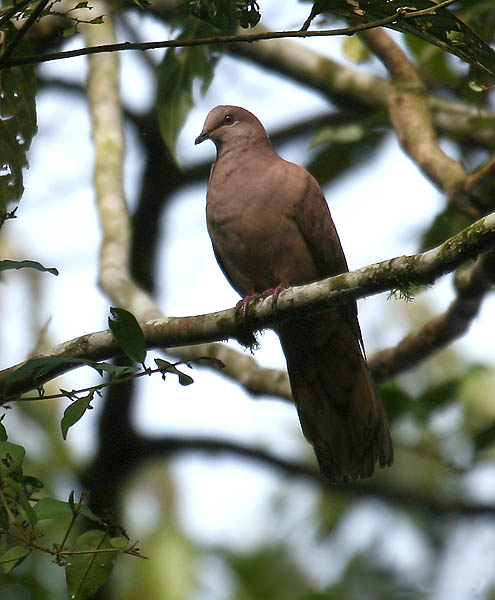
Wikimedia Commons
About the Ruddy Pigeon
The Ruddy Pigeon, scientifically known as Patagioenas subvinacea, represents a fascinating member of the Columbidae family. This medium-sized pigeon, predominantly found in the tropical regions of Central and South America, plays a significant role in its ecosystem. The Ruddy Pigeon exhibits a striking reddish-brown plumage, which serves as an excellent camouflage against the backdrop of dense forest canopies. Its presence is vital for seed dispersal, aiding in the maintenance of forest biodiversity.
Ruddy Pigeons inhabit a range stretching from southern Mexico through Central America and into the northern parts of South America, including countries such as Colombia, Ecuador, and Brazil. They prefer humid lowland forests but can also adapt to secondary forests and plantations. The dense understory provides shelter and a rich supply of food sources. These pigeons are mostly sedentary, although some populations may exhibit altitudinal migration, moving to lower elevations during colder months or in response to food availability.
Ecologically, the Ruddy Pigeon contributes significantly to its habitat. By feeding on a variety of fruits, particularly those from canopy-level trees, it facilitates seed dispersal, a crucial process for forest regeneration. This activity promotes plant diversity and supports various other species within the ecosystem. Additionally, the pigeon serves as prey for several raptors, thus playing a part in the food web's balance. Observing the Ruddy Pigeon in its natural setting offers insight into the complex interactions that sustain tropical forest ecosystems.
The Ruddy Pigeon belongs to the family Columbidae, within the order Columbiformes. These birds typically live averages 4-6 years in the wild, with some living up to 8 years..
How to Identify a Ruddy Pigeon
The Ruddy Pigeon is characterized by its medium size, measuring about 28-33 cm in length. Adults display a rich reddish-brown plumage, with the color being most intense on the head, neck, and chest. The back and wings exhibit a more subdued brown, while the underparts maintain the reddish hue. Juveniles resemble adults but often show duller colors and less defined markings. Both male and female Ruddy Pigeons appear similar, making sex differentiation in the field challenging.
In flight, the Ruddy Pigeon shows broad, rounded wings and a slightly rounded tail. This silhouette, combined with its steady, direct flight, helps differentiate it from similar species such as the Short-billed Pigeon, which tends to have a more compact appearance and slightly different coloration. When perched, the Ruddy Pigeon sits upright with a slightly puffed chest, a posture that accentuates its robust body and contributes to its distinctive profile.
Similar species may cause confusion, particularly the Short-billed Pigeon and the Band-tailed Pigeon. However, the Ruddy Pigeon can be distinguished by its consistent reddish tone and lack of contrasting white or gray bands found in the Band-tailed Pigeon. Attention to these details is essential for accurate identification in the field.
Having trouble telling birds apart? Upload a photo to our bird identification tool for an instant species match.
Ruddy Pigeon Habitat and Range
Preferred Habitat
The Ruddy Pigeon thrives in tropical and subtropical forests, particularly favoring humid lowland and montane forests. It can be found from sea level up to elevations of approximately 2,400 meters, although it tends to prefer areas below 1,500 meters. These pigeons frequently inhabit dense forest canopies and edges, where they can find abundant food and shelter.
In regions like the Amazon Basin, the Ruddy Pigeon is a common sight, blending seamlessly into the lush greenery. It also adapts to disturbed habitats, including secondary forests and coffee plantations, where it benefits from the mixed vegetation. Seasonal movements may occur, with some populations relocating to lower elevations during periods of food scarcity.
While primarily a forest species, the Ruddy Pigeon occasionally ventures into more open areas, especially when food sources are abundant. Its adaptability to different forest types ensures its wide distribution across its range.
Geographic Range
The Ruddy Pigeon boasts a broad distribution across Central and South America. Its range extends from southern Mexico through Belize, Guatemala, and Honduras, continuing southward through Costa Rica and Panama. In South America, it is found in Colombia, Venezuela, Ecuador, Peru, and Brazil, among other countries.
The pigeon primarily resides in its range year-round, showing little migratory behavior. However, in some areas, such as the Andes, altitudinal migrations occur. During colder months, pigeons may descend to lower elevations in search of food, returning to higher altitudes once conditions improve.
Population densities vary with habitat quality, with higher concentrations in regions like the Amazonian rainforests where food resources are plentiful. Despite its wide range, the Ruddy Pigeon's presence is patchy, correlating closely with forested areas.
Want to know which birds visit your area? Browse our backyard birds by location guides for region-specific species lists.
What Does the Ruddy Pigeon Eat?
The Ruddy Pigeon primarily consumes fruits, which form the bulk of its diet. It shows a preference for fruits of canopy-level trees, which it accesses with agility and precision. The pigeon also feeds on seeds and occasionally consumes small invertebrates, though these constitute a minor portion of its diet.
Seasonal variations in food availability influence dietary habits. During fruiting seasons, the pigeon takes advantage of abundant resources, gorging on a wide variety of fruits. In leaner times, it may resort to less preferred food sources, including young leaves and buds.
Foraging behavior is methodical, with individuals or small groups moving through the forest canopy in search of ripe fruits. The Ruddy Pigeon typically feeds during the day, with peak activity occurring in the early morning and late afternoon, times when fruiting trees are most attractive.
Want to attract Ruddy Pigeons to your yard? See our recommended feeders and seed types for the best results.
Ruddy Pigeon Behavior and Social Structure
The Ruddy Pigeon exhibits a solitary or small group social structure, often seen alone or in pairs. It displays territorial behavior, particularly during the breeding season when males defend their chosen nesting sites with vigor. Courtship involves males performing aerial displays and soft cooing sounds to attract females.
Flocking behavior is generally limited to foraging activities, where small groups may congregate in areas with abundant food. In response to predators, such as hawks or owls, the Ruddy Pigeon relies on its swift flight to escape, often taking refuge in dense foliage.
Daily activities follow a predictable pattern, with pigeons feeding primarily in the early morning and late afternoon. During the hottest parts of the day, they rest in shaded areas, conserving energy and avoiding predators.
Ruddy Pigeon Nesting and Reproduction
Ruddy Pigeons construct simple, yet effective nests, typically made of twigs and placed on horizontal tree branches. They prefer locations that offer concealment from predators, often choosing dense foliage or the cover of vine tangles.
The typical clutch size for the Ruddy Pigeon is one to two eggs. Both parents share incubation duties, which last approximately 14 to 16 days. After hatching, the fledglings remain in the nest for another 15 to 20 days before they are ready to make their first flights.
Parental roles are well defined, with both males and females participating in feeding and caring for the young. The species may produce multiple broods per year, depending on environmental conditions and food availability.
Ruddy Pigeon Sounds and Vocalizations
The primary song of the Ruddy Pigeon consists of a series of deep, resonant coos, delivered in a steady rhythm. This song serves as both a territorial and mating call, often heard at dawn and dusk when the bird is most vocal. The pitch remains relatively constant, giving the song a soothing quality.
In addition to its song, the Ruddy Pigeon emits a variety of call notes, including soft coos used for communication between mates. Alarm calls, sharper and more urgent in tone, signal the presence of predators.
The dawn chorus of the Ruddy Pigeon is a notable feature of its vocal behavior, with individuals contributing to the rich tapestry of forest sounds as the day begins.
Interesting Facts About the Ruddy Pigeon
- 1The Ruddy Pigeon can be found at elevations up to 2,400 meters, showcasing its adaptability to diverse altitudes.
- 2These pigeons are known for their role in seed dispersal, aiding in the regeneration of tropical forests.
- 3Despite their wide range, Ruddy Pigeons are more commonly heard than seen due to their reclusive nature.
- 4The species exhibits little sexual dimorphism, with males and females appearing almost indistinguishable.
- 5Ruddy Pigeons have been observed using their wings to produce a whistling sound during flight, a behavior seen in several pigeon species.
- 6Their deep cooing calls are a characteristic sound of tropical forests, often heard resonating through the canopy.
- 7Ruddy Pigeons can consume a wide variety of fruits, making them highly versatile foragers in their habitat.
Ruddy Pigeon Conservation Status
The Ruddy Pigeon is currently classified as Least Concern by the IUCN, with populations considered stable across most of its range. Primary threats include habitat loss due to deforestation and agricultural expansion in parts of its range. Conservation efforts focus on preserving critical habitats and promoting sustainable land-use practices. In regions like the Amazon, initiatives to curb deforestation play a crucial role in maintaining healthy pigeon populations. Historically, the Ruddy Pigeon has shown resilience in adapting to changing environments, but continued vigilance is essential to ensure its long-term survival amidst growing anthropogenic pressures.
Attracting Ruddy Pigeons to Your Feeder
The Ruddy Pigeon is a regular visitor to backyard bird feeders across its range. At the Eye On The Fly feeding station, we observe Ruddy Pigeons regularly and capture footage with our feeder cameras.


