
Rufous-breasted Leaftosser
Sclerurus scansor
Order: Passeriformes / Family: Furnariidae
Wikimedia Commons
About the Rufous-breasted Leaftosser
The Rufous-breasted Leaftosser (Sclerurus scansor) is a fascinating bird of the Furnariidae family, renowned for its specialized ground-foraging behavior in the subtropical and tropical forests of South America. This bird thrives in the dense undergrowth of the Atlantic Forest, a biodiversity hotspot in southeastern Brazil, as well as in the fragmented forest patches of Argentina and Paraguay. It plays a crucial ecological role by contributing to the health of the forest floor; as it tosses leaves, it aids in nutrient cycling and seed dispersal. Its presence indicates a well-preserved habitat, making it an important species for conservationists monitoring forest health.
This bird's ecological significance extends to its role as a predator of insects and other invertebrates, aiding in the control of pest populations. Its foraging techniques help aerate the soil, promoting plant health and growth. The Rufous-breasted Leaftosser is often observed during the early hours of the morning when it is most active, a behavior that aligns with the activity patterns of its prey. During the breeding season, typically from September to February, this bird's activity becomes more conspicuous as it engages in vocal displays and increased foraging to feed its young.
In addition to its ecological roles, the Rufous-breasted Leaftosser holds cultural significance for local communities who regard it as a symbol of the forest's vitality. Its unique calls and elusive nature have become a subject of intrigue among birdwatchers and nature enthusiasts. As forests face threats from deforestation and fragmentation, the Rufous-breasted Leaftosser's conservation becomes increasingly vital, highlighting the interconnectedness of species within these rich ecosystems.
The Rufous-breasted Leaftosser belongs to the family Furnariidae, within the order Passeriformes. These birds typically live average 5 years with a max recorded of 9 years..
How to Identify a Rufous-breasted Leaftosser
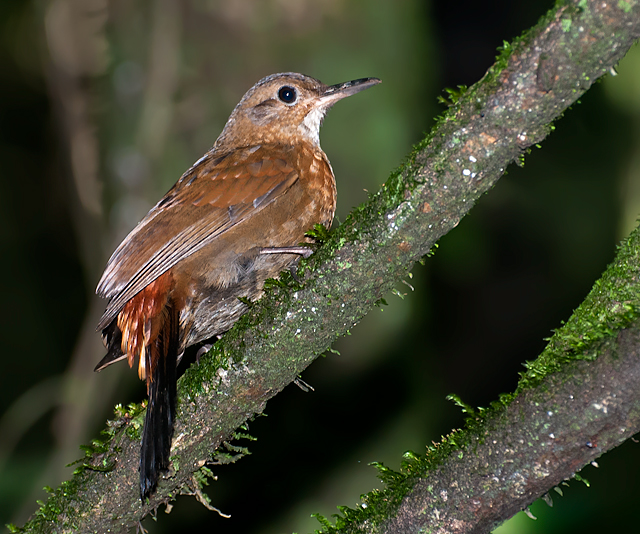
The Rufous-breasted Leaftosser is a medium-sized bird, measuring approximately 18 to 20 centimeters in length. Its most striking feature is the rich rufous coloration on its breast, which contrasts with its otherwise dark plumage. The upperparts are predominantly brown, with darker wings and tail feathers that blend seamlessly into the forest floor habitat.
Adult plumage does not vary significantly between sexes, making male and female birds appear similar. Juveniles, however, may display slightly duller breast coloration, which brightens as they mature. When compared to similar species, such as other leaftossers, the Rufous-breasted can be distinguished by its more pronounced rufous chest and its preference for denser forested areas.
In flight, the Rufous-breasted Leaftosser exhibits a rapid, direct flight pattern, with a slightly rounded tail and broad wings that facilitate maneuverability among dense foliage. Its perching posture is often horizontal, with a slight downward tilt of the tail, a behavior that aids in its leaf-tossing activities.
Having trouble telling birds apart? Upload a photo to our bird identification tool for an instant species match.
Rufous-breasted Leaftosser Habitat and Range
Preferred Habitat
The Rufous-breasted Leaftosser inhabits the humid subtropical and tropical forests of South America, particularly favoring the Atlantic Forest biome. This bird thrives in dense, evergreen forests with abundant leaf litter, where it forages for invertebrates. It is commonly found at elevations ranging from sea level up to 2,000 meters, although it is more frequently observed at mid-elevations.
Within these forests, the Rufous-breasted Leaftosser prefers areas with thick understory vegetation, which provides cover and aids its foraging strategy. While primarily a forest-dwelling species, it can sometimes be found in secondary forests and forest edges, especially in regions where primary forests have been diminished.
Seasonal habitat shifts are minimal, as the Rufous-breasted Leaftosser tends to remain within its preferred habitat year-round, though it may move locally in response to food availability. This bird is not commonly found in urban areas, as it requires dense, undisturbed forest environments to thrive.
Geographic Range
The Rufous-breasted Leaftosser's range is concentrated in the Atlantic Forest region of South America, extending through southeastern Brazil, eastern Paraguay, and northeastern Argentina. This bird is non-migratory, maintaining a year-round presence in these areas.
In Brazil, it is found primarily in the states of São Paulo, Rio de Janeiro, Minas Gerais, and Espírito Santo, where the Atlantic Forest exhibits high biodiversity. In Argentina, it inhabits the Misiones province, which hosts some of the largest remaining tracts of this forest type. In Paraguay, its range includes areas in the Paraná Department, where forest fragmentation poses a significant threat.
Population density varies, with the highest concentrations found in protected areas and well-preserved forest reserves. The Rufous-breasted Leaftosser is considered relatively common within its range, though habitat loss has led to localized declines.
Want to know which birds visit your area? Browse our backyard birds by location guides for region-specific species lists.
What Does the Rufous-breasted Leaftosser Eat?
The Rufous-breasted Leaftosser primarily feeds on invertebrates, with a diet that includes insects, spiders, and small arthropods. Its foraging technique involves a distinctive method of tossing leaves aside with its bill to uncover prey hiding beneath the forest floor debris.
During the wet season, when insect activity is highest, the Rufous-breasted Leaftosser's diet may expand to include a wider variety of prey, which provides essential protein for breeding and raising young. In drier months, it may rely more heavily on ants and beetle larvae, which are more consistently available.
Foraging typically occurs in the early morning and late afternoon, aligning with peak activity times for many invertebrate species. The bird's ability to detect and capture small prey in low-light conditions speaks to its adaptability and specialized feeding behavior.
Rufous-breasted Leaftosser Behavior and Social Structure
The Rufous-breasted Leaftosser exhibits a solitary and secretive lifestyle, often seen alone or in pairs. Territorial behavior is pronounced during the breeding season, with males actively defending their chosen area through vocalizations and displays.
Courtship displays involve a series of rapid flights and calls, with both males and females participating in establishing and maintaining pair bonds. These displays often take place in the early morning or late afternoon, coinciding with peak activity periods.
While not typically a flocking species, the Rufous-breasted Leaftosser may join mixed-species foraging flocks outside the breeding season, which can enhance foraging success and predator detection. When threatened, this bird relies on its cryptic plumage and quick movements to evade predators, often retreating to dense undergrowth for cover.
Rufous-breasted Leaftosser Nesting and Reproduction
The nesting habits of the Rufous-breasted Leaftosser are as specialized as its foraging behavior. This bird constructs nest sites in natural cavities or burrows, often in earthen banks or among the roots of large trees. The nest is composed of leaves, twigs, and other forest detritus, providing camouflage and insulation.
Clutch sizes typically range from two to three eggs, with both parents sharing incubation duties. The incubation period lasts approximately 17 to 19 days, with both parents also contributing to feeding and caring for the hatchlings.
Fledging occurs about 20 to 22 days after hatching, though young birds may remain dependent on parental care for several weeks thereafter. The Rufous-breasted Leaftosser is known to raise one or occasionally two broods per year, depending on environmental conditions and food availability.
Rufous-breasted Leaftosser Sounds and Vocalizations
The Rufous-breasted Leaftosser's primary song consists of a series of short, sharp whistles, often delivered in rapid succession. These whistles have a clear, penetrating quality that carries well through dense forest environments.
Call notes are typically shorter and softer, used for communication between pairs or as alarm calls when potential threats are detected. During the dawn chorus, the Rufous-breasted Leaftosser often joins other forest birds in a symphony of calls that mark the start of the day.
The bird's vocalizations, while not as melodious as some songbirds, serve essential functions in territory defense and mate attraction, highlighting its role in the forest soundscape.
Interesting Facts About the Rufous-breasted Leaftosser
- 1The Rufous-breasted Leaftosser is named for its unique foraging habit, using its bill to toss leaves aside in search of prey.
- 2This bird's ability to thrive in dense forests makes it an indicator species for forest health and biodiversity.
- 3Despite its secretive nature, the Rufous-breasted Leaftosser's distinctive call is often heard long before the bird is seen.
- 4The Rufous-breasted Leaftosser is one of approximately six species within the Sclerurus genus, all known for their ground-foraging behavior.
- 5During the breeding season, Rufous-breasted Leaftossers become more vocal, with males singing to establish territory and attract mates.
- 6This bird's reliance on forest floor invertebrates makes it sensitive to changes in forest composition and health.
- 7Field biologists often use playback of its calls to survey and study populations in dense forest habitats.
Rufous-breasted Leaftosser Conservation Status
The Rufous-breasted Leaftosser is currently listed as Least Concern by the IUCN, though its population trend shows signs of decline due to habitat loss. Deforestation and fragmentation of the Atlantic Forest pose significant threats, as the bird relies on dense, undisturbed forest environments. Conservation efforts focus on protecting and restoring forest habitats, with initiatives aimed at expanding protected areas and promoting sustainable land use practices. Historical population changes have been influenced by extensive deforestation, underscoring the importance of ongoing conservation measures. Community involvement and education play crucial roles in these efforts, fostering a greater understanding of the Rufous-breasted Leaftosser's ecological significance and the need for habitat preservation.
Other Furnariidae Species


Birds Similar to the Rufous-breasted Leaftosser
These species are often confused with the Rufous-breasted Leaftosser due to similar appearance or overlapping range.