
Rufous-tailed Xenops
Xenops milleri
Order: Passeriformes / Family: Furnariidae
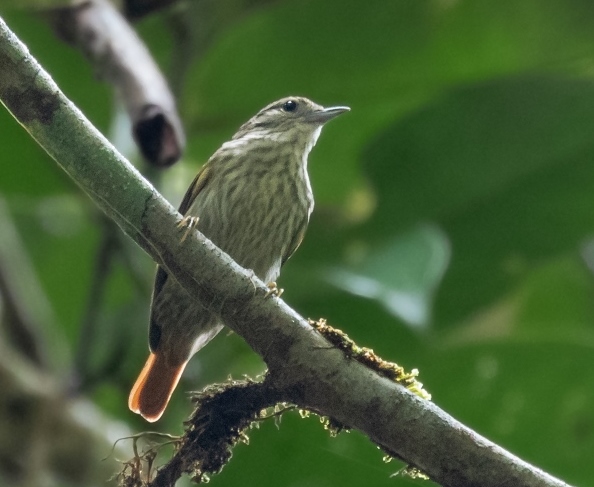
Wikimedia Commons
About the Rufous-tailed Xenops
The Rufous-tailed Xenops (Xenops milleri) is a small bird belonging to the family Furnariidae, renowned for its distinctive rufous tail and unique ecological niche. This species inhabits the tropical and subtropical forests of South America, primarily in the Amazon Basin. It thrives in the dense undergrowth and mid-level canopies of these biodiverse forests, where it plays a crucial role as an insectivore. Its presence in the ecosystem helps control insect populations, contributing to the health and balance of its habitat. The Rufous-tailed Xenops is particularly significant in the Amazonian rainforests of Brazil, Peru, and Colombia, regions rich in biodiversity and ecological complexity. Throughout the year, this species engages in various behaviors linked to its survival and reproduction, such as foraging in mixed-species flocks and participating in breeding activities during the drier months. The bird's adaptability to different forest types, including secondary growth and edge habitats, underscores its ecological importance. Seasonal behaviors of the Rufous-tailed Xenops include shifts in foraging strategies in response to food availability. During the wet season, when insect abundance peaks, the Xenops increases its feeding activity, capitalizing on the plentiful food resources. As a year-round resident of its range, it does not undertake significant migrations, but local movements may occur in search of optimal feeding conditions. This bird's ecological role extends beyond mere insect control; its interactions with other species, such as participation in mixed-species flocks, facilitate information exchange and enhance foraging efficiency. Understanding the significance of the Rufous-tailed Xenops within its ecosystem provides insight into the complex interdependencies that characterize tropical forest environments.
The Rufous-tailed Xenops belongs to the family Furnariidae, within the order Passeriformes. These birds typically live average 5-7 years..
How to Identify a Rufous-tailed Xenops
Identifying the Rufous-tailed Xenops involves noting several key field marks. Adult birds exhibit a predominantly brown plumage with a streaked appearance on the back and wings, complemented by a characteristic rufous tail that gives the species its name. The head features a short, slightly decurved bill and a pale supercilium that contrasts with the darker crown. Juvenile Xenops resemble adults but may show less distinct streaking and a duller overall coloration. Sexual dimorphism is minimal, with males and females appearing similar in the field. Confusion with other small brown birds, such as the Woodcreepers, can occur, but the Rufous-tailed Xenops' unique tail color and foraging behavior help differentiate it. Its flight silhouette is compact, with rapid wingbeats and a distinctive tail flicking motion. When perched, the Xenops often adopts a horizontal posture, clinging to branches and tree trunks with its strong legs. This posture, combined with its active foraging, makes it a lively and engaging bird to observe. The Rufous-tailed Xenops' behavior and appearance in the field offer reliable clues for identification, even among the diverse avifauna of its forest home.
Having trouble telling birds apart? Upload a photo to our bird identification tool for an instant species match.
Rufous-tailed Xenops Habitat and Range
Preferred Habitat
The Rufous-tailed Xenops primarily inhabits tropical and subtropical forests, favoring areas with dense undergrowth and mid-canopy levels. It is commonly found in the Amazon Basin, thriving in primary rainforest habitats as well as secondary growth and edge environments. These birds prefer humid, evergreen forests that provide abundant insect prey. They are typically encountered at elevations ranging from lowland areas up to 1,200 meters, although they are most abundant in lowland forest interiors. Seasonal habitat shifts are minimal, as the species is non-migratory and resident year-round. While the Rufous-tailed Xenops is generally absent from urban areas, it may occasionally be found in rural settings where forest cover remains intact. Its adaptability to different forest types, including disturbed areas, highlights its resilience in the face of habitat changes. The Rufous-tailed Xenops' preference for dense forest habitats underscores the importance of preserving these environments for its continued survival.
Geographic Range
The Rufous-tailed Xenops is primarily distributed across the Amazon Basin, with its range extending through several South American countries. Breeding and resident populations can be found in Brazil, Peru, Colombia, and Bolivia, where dense tropical forests provide optimal habitat. The species does not undertake long-distance migrations, remaining within its extensive range throughout the year. However, it may exhibit local movements in search of food or suitable nesting sites. Within this range, population density tends to be higher in undisturbed forest interiors, though the Rufous-tailed Xenops can also be found in secondary forest and along forest edges. The bird's presence in these regions contributes to the rich biodiversity for which the Amazon is renowned. While the Rufous-tailed Xenops is not considered migratory, its ability to inhabit a variety of forest types allows it to maintain stable populations across its range.
Want to know which birds visit your area? Browse our backyard birds by location guides for region-specific species lists.
What Does the Rufous-tailed Xenops Eat?
The Rufous-tailed Xenops primarily feeds on insects, which it gleans from the bark and foliage of trees. Its diet consists mainly of small arthropods such as beetles, ants, and spiders. During the wet season, when insect populations peak, the Xenops intensifies its foraging efforts, taking advantage of the increased food availability. The bird employs a unique foraging technique, using its short, decurved bill to probe crevices in bark and beneath leaves. This method allows it to access prey that other birds might overlook. The Rufous-tailed Xenops typically forages alone or in pairs, although it frequently joins mixed-species flocks, benefiting from the collective vigilance and foraging success of the group. Its foraging activity occurs mostly during the daylight hours, with peak feeding times in the early morning and late afternoon. The bird's diet and foraging behavior play a significant role in controlling insect populations, underscoring its ecological importance in its habitat.
Rufous-tailed Xenops Behavior and Social Structure
The Rufous-tailed Xenops exhibits a range of behaviors that reflect its adaptation to life in dense forest environments. Socially, it is often seen foraging in mixed-species flocks, a behavior that enhances its foraging efficiency and reduces predation risk. Within these flocks, the Xenops maintains a degree of territoriality, defending feeding sites against other birds. Courtship displays involve vocalizations and mutual preening, strengthening pair bonds. The Rufous-tailed Xenops is generally monogamous, with pairs forming long-term bonds. Despite its small size, the bird is an active and agile forager, moving rapidly among branches and tree trunks in search of food. It is predominantly diurnal, with peak activity periods in the early morning and late afternoon. In response to predators, the Xenops may freeze or adopt a cryptic posture, relying on its camouflaged plumage to avoid detection. The bird's behaviors are finely tuned to its forest habitat, enabling it to exploit available resources efficiently.
Rufous-tailed Xenops Nesting and Reproduction
The Rufous-tailed Xenops constructs its nest in natural cavities found in tree trunks or branches, occasionally using abandoned woodpecker holes. Nests are lined with soft materials such as feathers, plant fibers, and leaves, providing a secure environment for eggs and chicks. Clutch size typically ranges from two to three eggs, which are incubated by both parents. The incubation period lasts approximately 15-18 days, with both sexes sharing the responsibility. Once hatched, the chicks are altricial, requiring constant care and feeding from both parents. Fledging occurs about 20-22 days after hatching, with young birds remaining close to the nest site as they learn to forage independently. The Rufous-tailed Xenops may raise one or two broods per year, depending on food availability and environmental conditions. Parental care is extensive, with both parents involved in feeding and protecting the young until they are fully independent. The bird's nesting habits highlight its adaptability and resourcefulness in utilizing available resources within its forest habitat.
Rufous-tailed Xenops Sounds and Vocalizations
The Rufous-tailed Xenops' primary song consists of a series of sharp, high-pitched notes delivered in rapid succession. These notes have a rhythmic, almost mechanical quality, resembling the sound of a distant typewriter or a series of quick taps. Call notes are typically short and sharp, often used to maintain contact between individuals in a flock. Alarm calls are more strident, serving to alert conspecifics to the presence of predators. During the dawn chorus, the Rufous-tailed Xenops contributes with its distinctive song, adding to the rich tapestry of sounds that characterize tropical forests. Its vocalizations are a key component of its communication repertoire, facilitating interactions with other birds and enhancing its survival in a complex acoustic environment.
Interesting Facts About the Rufous-tailed Xenops
- 1The Rufous-tailed Xenops is one of the few bird species that uses its tail for balance while foraging on vertical surfaces.
- 2Despite their small size, Rufous-tailed Xenops are known to be highly territorial, often defending feeding areas aggressively.
- 3The Rufous-tailed Xenops participates in mixed-species flocks, often forming associations with antbirds and woodcreepers.
- 4These birds are named after the Greek word 'xenos,' meaning strange, due to their unique foraging behavior and appearance.
- 5Rufous-tailed Xenops have a wide range of vocalizations, each serving different communicative purposes within their social groups.
- 6Their distinctive rufous tail is not only an identifying feature but also aids in camouflage among the reddish-brown forest debris.
- 7The Rufous-tailed Xenops uses its short, stout bill to expertly extract insects from tree bark, a skill honed over millennia of evolution.
Rufous-tailed Xenops Conservation Status
The Rufous-tailed Xenops is currently listed as Least Concern on the IUCN Red List, with stable population trends across its range. However, the primary threats to its habitat include deforestation and habitat fragmentation due to agricultural expansion and logging activities. Conservation efforts focus on preserving large tracts of intact forest, particularly in the Amazon Basin, to ensure the survival of this and other forest-dependent species. Protected areas and sustainable land-use practices are critical to mitigating habitat loss. Historically, the Rufous-tailed Xenops has maintained stable populations, but ongoing threats necessitate continued monitoring and conservation action to safeguard its future.
Other Furnariidae Species


Birds Similar to the Rufous-tailed Xenops
These species are often confused with the Rufous-tailed Xenops due to similar appearance or overlapping range.

