
Rustic Bunting
Emberiza rustica
Order: Passeriformes / Family: Emberizidae
Wikimedia Commons
About the Rustic Bunting
The Rustic Bunting (Emberiza rustica) is a small passerine bird belonging to the Emberizidae family. This species captivates bird enthusiasts with its distinctive seasonal plumage and complex migration patterns. Found predominantly across the Palearctic region, the Rustic Bunting is a quintessential example of avian adaptation to varying environments. During the breeding season, it inhabits the dense, mixed forests of northern Europe and Asia, favoring areas with rich underbrush that provide ample cover and nesting sites. The bird's ecological role as both a seed disperser and an insect predator underscores its importance within these ecosystems.
In winter, the Rustic Bunting migrates to more temperate regions, reaching as far south as Japan, Korea, and parts of eastern China. This seasonal shift allows the bird to exploit different food sources, primarily seeds and small insects, depending on availability. The bird's adaptability is evident in its ability to thrive in a range of habitats, from the lush taiga to the more open, agricultural landscapes encountered during migration.
The Rustic Bunting's population dynamics are closely tied to the health of its breeding and wintering habitats. Deforestation and agricultural expansion pose significant threats by reducing available nesting sites and food sources. However, conservation efforts and protected areas in key regions offer some hope for maintaining stable populations. As an indicator species, the Rustic Bunting helps scientists assess the impact of environmental changes on broader ecosystems. Its presence, or absence, can signal shifts in habitat quality and biodiversity.
The Rustic Bunting belongs to the family Emberizidae, within the order Passeriformes. These birds typically live average 3-5 years, max recorded 8 years.
How to Identify a Rustic Bunting
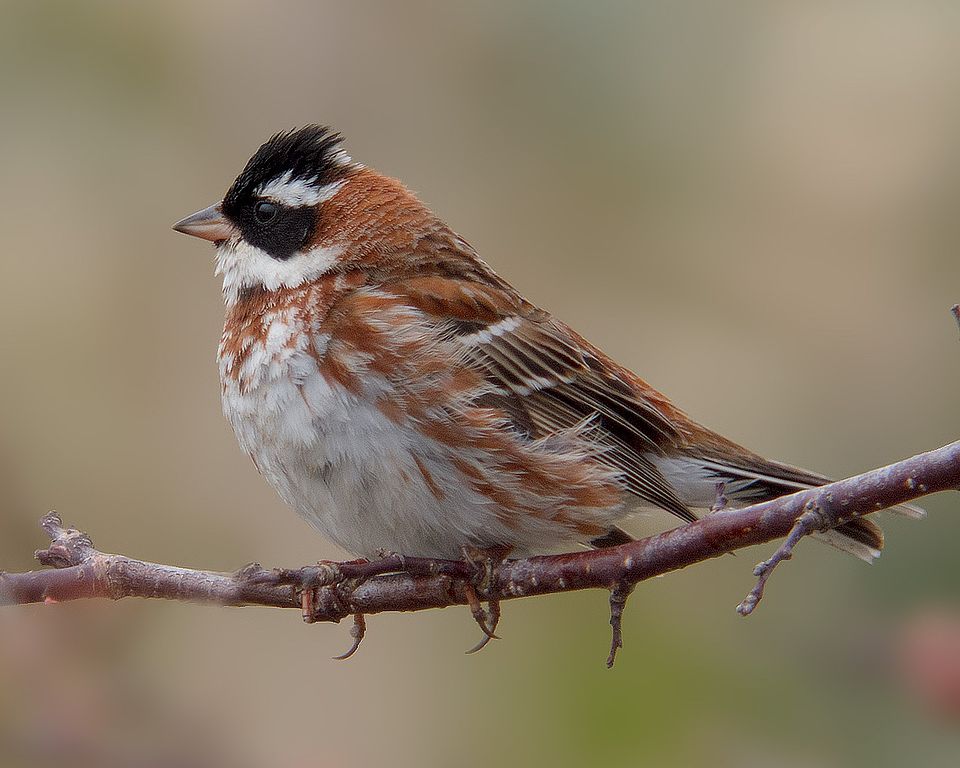
Adult Rustic Buntings exhibit a striking contrast of colors that make them relatively easy to identify in the field. Males in breeding plumage boast a black crown and face, sharply delineated by prominent white supercilium and malar stripes. The bird's underparts are predominantly white, with a distinctive chestnut hue on the flanks. Females and juveniles, while less vivid, display a similar pattern but with more muted tones and a brownish wash replacing the black.
Both sexes have brownish upperparts, streaked with darker shades, providing effective camouflage in their natural habitat. The distinction between males and females becomes less pronounced outside the breeding season, as the males' plumage fades. Juveniles resemble females, although they can be identified by their fresher feathering and more uniformly brown appearance.
In flight, the Rustic Bunting reveals a slender silhouette with a slightly forked tail, aiding identification even from a distance. When perched, the bird often adopts an upright posture, making its facial markings more visible. This posture, combined with its characteristic tail flicking, provides additional clues for field identification. Although similar in some respects to other members of the Emberizidae family, the Rustic Bunting's unique facial pattern and chestnut flanks distinguish it from closely related species.
Having trouble telling birds apart? Upload a photo to our bird identification tool for an instant species match.
Rustic Bunting Habitat and Range
Preferred Habitat
The Rustic Bunting primarily inhabits dense, mixed forests during the breeding season, favoring areas with substantial underbrush. These forests, located in northern Europe and Asia, offer the bird ample cover and nesting sites. It prefers moist environments, often near rivers or wetlands, which support a diverse insect population crucial for feeding young. In winter, the bird migrates to more temperate regions, including southern Japan, Korea, and parts of eastern China, where it can be found in open fields, agricultural lands, and shrubby areas.
Elevation ranges for the Rustic Bunting vary depending on the region, typically spanning from sea level up to about 1,500 meters. This adaptability allows the species to exploit a range of environments, from lowland forests to hilly terrains. During migration, the bird may also be seen in urban parks and gardens, where it takes advantage of available food sources. While generally more common in rural settings, its presence in urban areas has been increasing, likely due to habitat changes in its traditional wintering grounds.
Geographic Range
The breeding range of the Rustic Bunting extends across northern Europe and Asia, from Scandinavia through Siberia to the Kamchatka Peninsula. This vast expanse includes countries such as Finland, Sweden, and Russia, where the bird makes use of the extensive boreal forests. In winter, the Rustic Bunting migrates southward to milder climates, with significant populations wintering in Japan, South Korea, and eastern China. These regions provide the bird with suitable habitats and abundant food resources.
Migration corridors for the Rustic Bunting are extensive, often following the east Asian flyway. During migration, the bird can be seen in various regions, including Mongolia and parts of northern China. Population density hotspots during the winter months include the coastal plains of Japan and the river valleys of Korea, where the bird gathers in flocks to forage.
While the Rustic Bunting is generally considered a migratory species, small populations may remain year-round in some southern parts of its range, particularly where mild winters allow. This flexibility in range underscores the species' adaptability to changing environmental conditions.
Want to know which birds visit your area? Browse our backyard birds by location guides for region-specific species lists.
What Does the Rustic Bunting Eat?
The Rustic Bunting's diet consists primarily of seeds and insects, with distinct seasonal variations. During the breeding season, the bird predominantly consumes insects, which provide the necessary protein for raising young. It feeds on a variety of insects, including grasshoppers, beetles, and caterpillars, which it captures by foraging through the undergrowth.
In winter, the Rustic Bunting's diet shifts to seeds, which are more abundant and accessible. It favors seeds from grasses and weeds, supplementing its diet with small berries when available. The bird's foraging technique involves hopping along the ground, using its beak to probe through leaf litter and soil for hidden morsels. This methodical approach allows it to exploit a range of food sources in different habitats.
The bird generally feeds during daylight hours, with peak activity in the early morning and late afternoon. Its feeding schedule is influenced by weather conditions and food availability, adapting to ensure maximum energy intake. The Rustic Bunting's role as both a seed disperser and insect predator highlights its ecological significance in maintaining balanced ecosystems.
Rustic Bunting Behavior and Social Structure
The Rustic Bunting exhibits a range of behaviors that reflect its adaptability and social nature. During the breeding season, it is often solitary or found in pairs, exhibiting territorial behavior to protect nesting sites. Males perform courtship displays that include singing and fluttering flights to attract females. These displays serve as both a mating ritual and a territorial proclamation.
Outside the breeding season, the Rustic Bunting becomes more gregarious, forming flocks that can number in the hundreds. These flocks provide safety in numbers, particularly during migration and when foraging in open fields. The bird's response to predators includes a mix of alarm calls and evasive flights, often seeking cover in dense vegetation.
Daily activity patterns of the Rustic Bunting revolve around feeding and resting. It is most active during the cooler parts of the day, retreating to shaded or sheltered areas when temperatures rise. This behavior ensures efficient energy use and minimizes exposure to potential threats. The bird's adaptability to different social structures and environmental conditions underscores its resilience in the face of changing habitats.
Rustic Bunting Nesting and Reproduction
The Rustic Bunting builds its nest low to the ground, often in dense underbrush or at the base of a shrub. This preference provides both concealment and protection from predators. The nest itself is a cup-shaped structure, crafted from grasses, leaves, and moss, lined with finer materials such as hair and feathers to ensure comfort for the young.
Clutch size typically ranges from 3 to 5 eggs, with the female assuming the primary role in incubation, which lasts about 12 to 14 days. During this period, the male remains nearby, providing food and protection. Once hatched, the chicks are altricial, requiring intensive care and feeding by both parents. Fledging occurs after approximately 10 to 12 days, with the young remaining dependent on their parents for a short period thereafter.
The Rustic Bunting typically raises one brood per year, although favorable conditions may allow for a second. This breeding strategy, coupled with its choice of nesting sites, reflects the bird's adaptation to its environment and ensures the continuation of the species amidst various challenges.
Rustic Bunting Sounds and Vocalizations
The primary song of the Rustic Bunting is a series of clear, melodious notes, often described as a sweet, whistling tune. These notes are delivered in a slow, deliberate rhythm, making the song both distinctive and pleasing to the ear. The bird's call notes are simpler and more abrupt, often serving as contact calls within a flock.
Alarm calls are sharper and more urgent, designed to alert other birds to potential threats. During the dawn chorus, the Rustic Bunting's song contributes to the rich tapestry of sounds, although it is not the dominant voice. The song's quality and rhythm can be compared to the harmonious notes of a European Robin, offering a familiar point of reference for birdwatchers.
The vocal repertoire of the Rustic Bunting plays a crucial role in communication and social interactions, facilitating mate attraction and territory defense during the breeding season.
Interesting Facts About the Rustic Bunting
- 1The Rustic Bunting migrates over 3,000 kilometers annually, showcasing its remarkable endurance.
- 2Historically, the Rustic Bunting's name has been used in traditional Chinese poetry to symbolize resilience.
- 3Rustic Buntings can form flocks of over 200 individuals during winter, highlighting their social nature.
- 4The bird's distinctive black and white facial markings help camouflage it among the shadows of dense forests.
- 5Despite their small size, Rustic Buntings play a significant role in controlling insect populations in their habitats.
- 6The Rustic Bunting's nesting success depends heavily on the density of underbrush in its breeding territories.
- 7In some cultures, the Rustic Bunting is considered a harbinger of spring, with its song marking the season's arrival.
Rustic Bunting Conservation Status
The Rustic Bunting is currently listed as Vulnerable on the IUCN Red List, with populations experiencing a decline due to habitat loss and degradation. Primary threats include deforestation, agricultural expansion, and climate change, which reduce available breeding and wintering habitats. Conservation efforts focus on habitat protection and restoration, particularly in key breeding areas. Historical population changes have seen fluctuations, with periods of decline linked to environmental pressures. Recent conservation measures aim to stabilize populations by creating protected areas and promoting sustainable land use practices. Continued monitoring and research are essential to understanding the impacts of ongoing threats and to develop effective conservation strategies.


