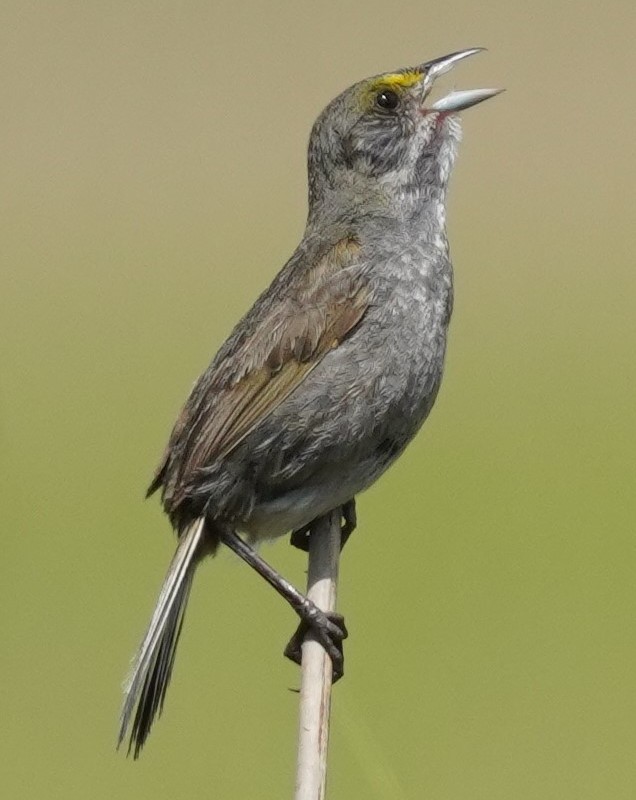
Saltmarsh Sparrow
Ammospiza caudacuta
Order: Passeriformes / Family: Passerellidae

Wikimedia Commons
About the Saltmarsh Sparrow
The Saltmarsh Sparrow (Ammospiza caudacuta) is a small bird endemic to the coastal salt marshes of the Atlantic seaboard of North America. Its presence is a key indicator of healthy, functioning salt marsh ecosystems. Saltmarsh Sparrows play a critical ecological role as both predator and prey within these habitats. They primarily reside in areas stretching from the coastal marshes of Maine down to Virginia, utilizing the dense grasses and tidal zones as both breeding and feeding grounds. The bird's distribution is notably limited to these highly specialized environments, making it particularly vulnerable to habitat loss and climate change. During the breeding season, which spans from late spring to early summer, Saltmarsh Sparrows are ground-nesters, building their nests in dense vegetation to avoid tidal flooding. They exhibit a unique breeding system where males do not defend territories or form pair bonds, a rare trait among songbirds. Instead, males sing to attract multiple females, while females solely take on the responsibility of nest building and chick rearing. In winter, these birds move slightly southward, inhabiting marshes from the Carolinas to Florida. As migratory patterns shift due to environmental pressures, their winter range might extend or contract. Saltmarsh Sparrows are also known for their slightly nomadic tendencies outside the breeding season, likely in response to food availability and habitat conditions.
The Saltmarsh Sparrow belongs to the family Passerellidae, within the order Passeriformes. These birds typically live average lifespan is 3-5 years, with a maximum recorded lifespan of 8 years..
How to Identify a Saltmarsh Sparrow
Saltmarsh Sparrows are small songbirds, measuring approximately 12-14 cm in length with a wingspan of 18-21 cm. Their plumage is a blend of browns and grays, providing effective camouflage among the reeds and grasses of their habitat. Key identifying features include a streaked brown back, a pale gray belly, and a distinct yellowish-orange patch above the eye. This patch, along with a gray crown and white throat, helps differentiate them from similar species like the Nelson's Sparrow. Juveniles appear similar to adults but with more muted tones and less distinct facial markings. There is little sexual dimorphism, with males and females sharing similar plumage. In flight, Saltmarsh Sparrows exhibit a low, undulating flight pattern, often staying close to the ground. Their perching posture is typically upright, often seen clinging to vertical stalks of grass or reeds. This posture, along with their constant movement through marsh vegetation, aids in their identification during field observations.
Having trouble telling birds apart? Upload a photo to our bird identification tool for an instant species match.
Saltmarsh Sparrow Habitat and Range
Preferred Habitat
Saltmarsh Sparrows are specialists of tidal salt marshes, where they inhabit areas dominated by Spartina grasses and high marsh zones. These environments offer both protection and resources they need for survival. They are commonly found at elevations just above sea level, where tidal flooding can still impact nest success. During the nesting season, they prefer areas with dense vegetation that provides concealment and minimizes predation risk. In the winter, Saltmarsh Sparrows may shift to more southern marshes, maintaining their fidelity to coastal habitats. Unlike many birds, they are rarely found in urban or heavily forested areas. Instead, they thrive in rural, undeveloped coastal regions where marsh integrity remains intact.
Geographic Range
Saltmarsh Sparrows breed primarily along the northeastern coast of the United States, from Maine to Virginia. Their breeding range is limited to these coastal areas due to their specific habitat requirements. In winter, they migrate to marshes further south, from the Carolinas to Florida, though their movements can be somewhat erratic. Migration corridors typically follow the Atlantic flyway, hugging the coastlines where suitable habitat persists. Population density is highest in well-preserved marshes, with significant numbers found in regions like the Great Bay in New Hampshire and the Connecticut River Estuary. Hotspots for wintering populations include the salt marshes of coastal South Carolina and Georgia.
Want to know which birds visit your area? Browse our backyard birds by location guides for region-specific species lists.
What Does the Saltmarsh Sparrow Eat?
The diet of the Saltmarsh Sparrow is primarily insectivorous, with a preference for small invertebrates such as insects, spiders, and crustaceans. During the breeding season, they forage predominantly on the ground or within low vegetation, capitalizing on the abundance of prey brought in by tidal actions. As food availability shifts with the seasons, they may also consume seeds and plant matter, especially in winter. Foraging typically occurs during daylight hours, with peak activity in early morning and late afternoon. Their feeding behavior involves probing and gleaning techniques, effectively capturing prey hidden in mud or among grasses. Prey size generally ranges from small insects to larger beetles and grasshoppers, depending on availability.
Saltmarsh Sparrow Behavior and Social Structure
Saltmarsh Sparrows exhibit a solitary nature outside of the breeding season, often found alone or in loose groups. During the breeding season, their behavior shifts as males seek to attract females through song. Unlike many other songbirds, these sparrows do not defend territories nor do males assist in raising young. Instead, the species follows a promiscuous breeding system, where females mate with multiple males. Territorial disputes are rare, though females may exhibit aggressive behavior towards intruders near their nests. In terms of activity patterns, Saltmarsh Sparrows are primarily diurnal, engaging in foraging and song during daylight hours. At high tide, when marshes flood, they often retreat to higher ground or perch above water level to avoid danger. Predators like raptors and marsh mammals pose threats, but the sparrows rely on their cryptic plumage and agile flight to escape. Flocking occurs more frequently in winter months, when larger groups form to exploit food resources and provide protection against predators.
Saltmarsh Sparrow Nesting and Reproduction
Nesting for the Saltmarsh Sparrow is a solitary endeavor undertaken by females. Nests are constructed close to the ground within dense vegetation, often built on a platform of woven grasses to mitigate tidal flooding. The cup-shaped nests are composed of fine grasses and lined with softer materials like feathers or animal hair. A typical clutch consists of 3-5 eggs, which are pale greenish with brown speckling. The incubation period lasts approximately 11-13 days, with females solely responsible for warming the eggs. After hatching, chicks fledge in about 9-11 days, though they remain dependent on the female for food and protection during this vulnerable period. Saltmarsh Sparrows typically raise one brood per season, although in optimal conditions, a second brood may be attempted. Parental care is exclusively the role of the female, as males do not participate in chick-rearing.
Saltmarsh Sparrow Sounds and Vocalizations
The primary song of the Saltmarsh Sparrow is an unassuming series of soft, buzz-like notes, delivered in a rapid sequence. The song lacks the musicality found in many other songbirds, instead resembling the sound of a distant cicada. Males sing from elevated perches within their marshy territory to attract females. Call notes are sharp and metallic, used for communication between individuals. Alarm calls are more insistent, serving as a warning to nearby sparrows of potential danger. During the dawn chorus, Saltmarsh Sparrows contribute with subdued, repetitive phrases that blend seamlessly into the ambient sounds of the marsh.
Interesting Facts About the Saltmarsh Sparrow
- 1Saltmarsh Sparrows have one of the most restricted breeding ranges of any North American bird, confined solely to the Atlantic coast.
- 2Unlike most songbirds, male Saltmarsh Sparrows do not establish territories, preferring instead a more promiscuous breeding strategy.
- 3The species is highly specialized, relying almost entirely on tidal salt marshes for all aspects of its life cycle.
- 4Saltmarsh Sparrows face unique challenges due to their habitat, including the risk of nest flooding due to high tides.
- 5These sparrows often build nests on raised platforms of grass to reduce the risk of tidal flooding.
- 6The Saltmarsh Sparrow's song is less melodic than most, often described as a series of insect-like buzzes.
- 7During high tides, Saltmarsh Sparrows can be observed perching above water levels to avoid being swept away.
Saltmarsh Sparrow Conservation Status
The Saltmarsh Sparrow is currently listed as vulnerable by the IUCN, with populations experiencing a significant decline due to habitat loss and climate change. Primary threats include rising sea levels, which lead to increased nest flooding, and habitat degradation from human development. Conservation efforts focus on habitat restoration and protection, with initiatives to preserve existing marshlands and enhance resilience against tidal impacts. Historically, the population has fluctuated with changes in land use and climate, but recent trends show a concerning decrease in numbers. Conservation organizations are actively engaged in monitoring efforts to better understand and mitigate these threats.
Other Passerellidae Species


Birds Similar to the Saltmarsh Sparrow
These species are often confused with the Saltmarsh Sparrow due to similar appearance or overlapping range.