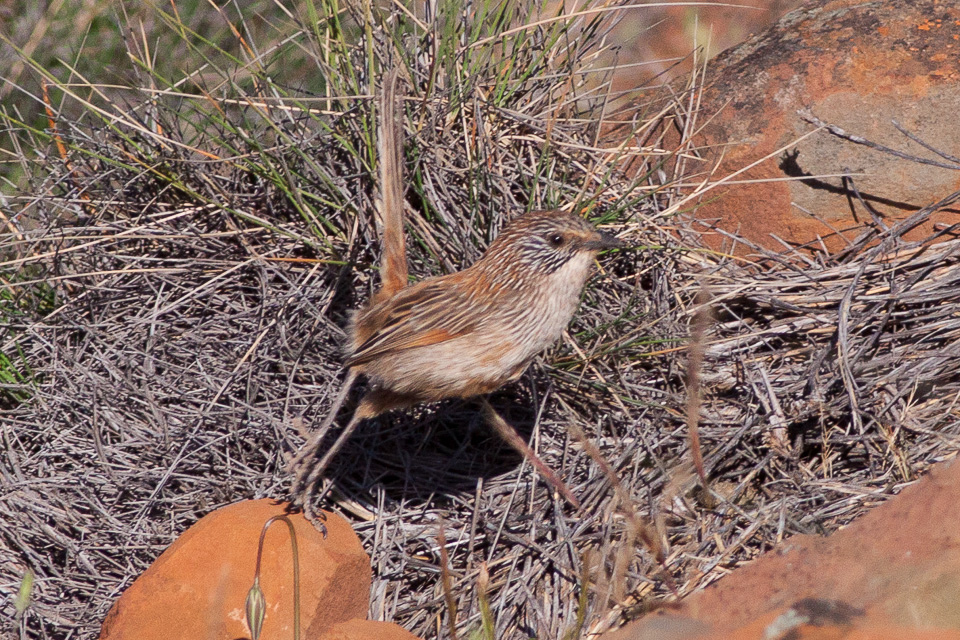
Sandhill Grasswren
Amytornis oweni
Order: Passeriformes / Family: Maluridae

Wikimedia Commons
About the Sandhill Grasswren
The Sandhill Grasswren, scientifically known as Amytornis oweni, inhabits the arid and semi-arid regions of central Australia, primarily within the sand dunes and spinifex grasslands. This elusive bird plays a significant role in its ecosystem as an insectivore, contributing to the control of insect populations. Unlike many other grasswrens, the Sandhill Grasswren is adapted specifically to its sandy environment, which influences both its behavior and physical adaptations. It prefers areas dominated by dense spinifex, a type of tough, spiky grass that provides both camouflage and protection from predators. The Sandhill Grasswren has evolved to thrive in these challenging conditions, often found in the Simpson Desert, Great Victoria Desert, and adjacent areas, where temperatures can be extreme and water sources scarce.
Ecologically, the Sandhill Grasswren is a key species in maintaining the balance of insect populations within its habitat. Its presence indicates a healthy ecosystem, as it requires specific environmental conditions to survive. During the breeding season, which typically occurs in the austral spring from September to November, the Sandhill Grasswren becomes more vocal and active. This period coincides with increased insect activity, providing ample food for raising young. Outside the breeding season, the bird is more secretive, relying on its cryptic plumage to blend into the environment, thus avoiding predators.
The Sandhill Grasswren's significance extends beyond its role as an insect predator. It is a species of interest for ornithologists and birdwatchers, who are drawn to its specialized adaptations and the challenges of observing it in its natural habitat. Conservationists monitor its populations closely, as changes in its numbers can signal shifts in the health of its ecosystem. However, its preference for remote and harsh environments means it is less studied than more accessible species. As a result, ongoing research efforts aim to better understand its ecological needs and how to protect its habitat from potential threats such as climate change and habitat destruction.
The Sandhill Grasswren belongs to the family Maluridae, within the order Passeriformes. These birds typically live average 4 years with max recorded 7 years.
How to Identify a Sandhill Grasswren
The Sandhill Grasswren is a small, cryptically colored bird that blends seamlessly into its sandy surroundings. Adult plumage is predominantly brown with intricate patterns of black and white streaks across the back and wings, providing effective camouflage against predators. The underparts are a lighter buff color, with subtle streaking that varies in intensity. Males and females are similar in appearance, although males may exhibit slightly bolder markings during the breeding season. Juveniles resemble adults but tend to have softer and less defined streaking, making them appear duller overall.
In the field, the Sandhill Grasswren can be challenging to spot due to its secretive nature and effective camouflage. Observers can distinguish it from similar species by its distinctive tail, which is long and often held upright, revealing intricate patterns. The tail feathers have pale tips, contributing to its characteristic appearance. When in flight, the Sandhill Grasswren's silhouette is compact, with rapid wingbeats and a tendency to stay low to the ground, rarely venturing far from cover.
Comparison with other grasswrens can be difficult, but the Sandhill Grasswren's preference for sandy, spinifex-dominated habitats is a useful clue. Its call is another distinguishing feature, often heard before the bird is seen. Observers should look for subtle behavioral cues, such as its habit of skulking through dense grasses and its tendency to remain motionless when threatened, which further complicates detection.
Having trouble telling birds apart? Upload a photo to our bird identification tool for an instant species match.
Sandhill Grasswren Habitat and Range
Preferred Habitat
The Sandhill Grasswren inhabits arid and semi-arid regions characterized by sand dunes and spinifex grasslands. These environments are primarily located in central Australia, within the Simpson Desert, Great Victoria Desert, and similar areas. The bird favors dense spinifex clumps for shelter and foraging, relying on these grasses for protection from predators and harsh environmental conditions. Elevations range from flat desert plains to low dune systems, where the grasswren's effective camouflage and behavioral adaptations allow it to thrive.
Seasonally, the Sandhill Grasswren does not migrate but may adjust its range slightly in response to changes in food availability and environmental conditions. It remains largely absent from urban areas, as its habitat preferences are specific to undisturbed, natural environments. Its presence in rural regions is limited to those locations that maintain the necessary vegetation structure and composition. Conservation of these habitats is crucial for the species' continued survival, as habitat degradation poses a significant threat.
Geographic Range
The Sandhill Grasswren's range is confined to central Australia, with populations spread across the Simpson Desert, Great Victoria Desert, and surrounding arid areas. Its distribution is patchy, dictated by the availability of suitable spinifex habitats. Within these regions, the grasswren occupies territories where dense grass cover provides ample foraging opportunities and shelter. The bird is non-migratory, maintaining a year-round presence within its established range.
Breeding territories are typically established in the austral spring when conditions are optimal for raising young. During this period, the birds may be more widely dispersed as they seek out the best nesting sites. However, changes in climate and habitat conditions can lead to fluctuations in population density, with some areas experiencing temporary declines or increases based on resource availability.
Conservation efforts are focused on protecting these critical habitats from threats such as land clearing, invasive species, and climate change, which can alter the delicate balance of the grasswren's environment. Monitoring population trends across its range provides valuable insights into the health of these ecosystems and the effectiveness of conservation strategies.
Want to know which birds visit your area? Browse our backyard birds by location guides for region-specific species lists.
What Does the Sandhill Grasswren Eat?
The Sandhill Grasswren primarily feeds on insects, which make up the bulk of its diet. It forages on the ground, often within dense spinifex clumps, where it uses its bill to probe for insects hidden in the sand and leaf litter. Ants, beetles, and various larvae are common prey items, providing the necessary protein and energy for survival in harsh environments.
Seasonal variations in diet occur, with the grasswren consuming more seeds and plant material during periods when insect availability is low. This adaptability in diet helps sustain populations through fluctuating environmental conditions. Prey size varies, but the bird typically selects small to medium-sized insects that are abundant and easy to capture.
Foraging activity peaks during the cooler parts of the day, such as early morning and late afternoon, when the heat is less intense. This pattern minimizes energy expenditure and reduces exposure to predators. The Sandhill Grasswren's feeding strategy is opportunistic, allowing it to exploit various food sources as they become available, ensuring a stable diet even in variable conditions.
Sandhill Grasswren Behavior and Social Structure
The Sandhill Grasswren is a highly territorial bird, often found in pairs or small family groups. It exhibits strong site fidelity, with individuals defending their territories against intruders throughout the year. These territories are centered around dense spinifex clumps, which provide essential resources such as food and nesting sites.
During the breeding season, males perform complex courtship displays to attract mates, involving vocalizations and physical displays that showcase their plumage. These displays play a crucial role in mate selection, as females assess the fitness of potential partners based on their performance. The grasswren's vocalizations are an integral part of its behavior, used not only in courtship but also to communicate with family members and signal alarm in the presence of predators.
Daily activity patterns are influenced by environmental conditions, with the Sandhill Grasswren most active during cooler periods. It spends much of the day foraging and resting in shaded areas to avoid the intense heat. When threatened, the bird employs its cryptic plumage to remain undetected, often freezing in place or seeking cover in dense vegetation. This behavior reduces predation risk and enhances its survival in open, exposed habitats.
Sandhill Grasswren Nesting and Reproduction
The Sandhill Grasswren constructs its nest within dense spinifex clumps, utilizing the shelter and protection these grasses provide. The nest is a small, cup-shaped structure made from grass stems, leaves, and other plant materials. It is carefully lined with softer materials such as feathers and fine grasses to create a comfortable environment for the eggs and chicks.
The typical clutch size is two to three eggs, which the female incubates for approximately 12 to 14 days. During incubation, the male assists by providing food and defending the territory from potential threats. Once hatched, the chicks remain in the nest for about 10 to 12 days before fledging. Both parents participate in feeding and caring for the young, ensuring their rapid development and survival.
The Sandhill Grasswren may produce one to two broods per year, depending on environmental conditions and resource availability. Successful breeding is closely tied to the abundance of insects, which provide the necessary nourishment for growing chicks. Parental care continues for several weeks after fledging, with juveniles often remaining in close proximity to their parents as they learn essential survival skills.
Sandhill Grasswren Sounds and Vocalizations
The Sandhill Grasswren's song is a complex series of trills and chirps, delivered in a rapid, melodic sequence. The rhythm is lively, with varying pitch and intricate patterns that are unique to each individual. These vocalizations serve multiple purposes, including courtship, territorial defense, and communication with family members.
Call notes are softer and less elaborate than the primary song, often used in close-range communication between mates or between parents and chicks. Alarm calls are sharp and abrupt, designed to alert family members to the presence of predators. During the dawn chorus, the Sandhill Grasswren is particularly vocal, its song contributing to the cacophony of sounds that characterize the early morning in its habitat.
Comparatively, the bird's vocalizations are less continuous than those of some other grasswren species, with intervals of silence as it listens for responses or evaluates its surroundings. This pattern reflects its cautious nature and reliance on acoustic communication within dense habitats where visual contact is limited.
Interesting Facts About the Sandhill Grasswren
- 1The Sandhill Grasswren is named for its preference for sandy habitats, a unique trait among grasswrens.
- 2Unlike many birds, the Sandhill Grasswren relies on camouflage rather than speed to evade predators.
- 3The species' song is a key identifier, with each male possessing a slightly different sequence of notes.
- 4Sandhill Grasswrens build their nests almost exclusively within spinifex, showcasing their specialization.
- 5Despite its remote habitat, the Sandhill Grasswren attracts birdwatchers due to its elusive nature.
- 6The bird's long tail, often held upright, is a distinctive feature that aids in identification.
- 7During hot days, the Sandhill Grasswren limits activity to conserve energy and avoid overheating.
Sandhill Grasswren Conservation Status
The IUCN currently lists the Sandhill Grasswren as a species of Least Concern, although its population trends are not well-documented due to its remote and inaccessible habitat. Primary threats to the species include habitat degradation from invasive plant species, altered fire regimes, and climate change, which affect the availability of suitable spinifex habitats. Conservation efforts focus on maintaining and restoring these critical habitats through controlled burning practices and the management of invasive species. Protecting large tracts of undisturbed habitat is essential for the grasswren's survival, as fragmentation can lead to population declines and increased vulnerability to threats. Historical population changes are difficult to assess, but ongoing monitoring and research are crucial for understanding the species' status and informing conservation strategies. Collaboration between government agencies, conservation organizations, and local communities is vital for effective conservation. Education and awareness programs help highlight the importance of preserving the unique ecosystems that support the Sandhill Grasswren and other specialized species.
Other Maluridae Species


Birds Similar to the Sandhill Grasswren
These species are often confused with the Sandhill Grasswren due to similar appearance or overlapping range.