
Sayaca Tanager
Thraupis sayaca
Order: Passeriformes / Family: Thraupidae
Wikimedia Commons
About the Sayaca Tanager
The Sayaca Tanager, scientifically known as Thraupis sayaca, is a vibrant member of the family Thraupidae. Commonly observed across much of South America, this bird exhibits a remarkable adaptability to diverse habitats. It thrives in a variety of environments, from urban gardens to rural woodlands, making it a familiar presence in areas like Brazil, Paraguay, and northern Argentina. The Sayaca Tanager plays a significant ecological role as both a consumer of fruit and a potential seed disperser, impacting the dynamics of flora in its habitats. In urban settings, these tanagers often visit bird feeders, adding a splash of color and activity to residential areas. Their adaptability also extends to seasonal behavior. During the breeding season, which typically spans from September to March, Sayaca Tanagers become more territorial, establishing and defending nesting sites. Outside of the breeding season, they exhibit more social behavior, often seen in small groups as they forage for food. The Sayaca Tanager's adaptability and vibrant presence underscore its importance in ecological communities across South America, serving as both an indicator of environmental health and a beloved component of local biodiversity.
The Sayaca Tanager belongs to the family Thraupidae, within the order Passeriformes. These birds typically live average 4-6 years, with a maximum recorded of 8 years..
How to Identify a Sayaca Tanager
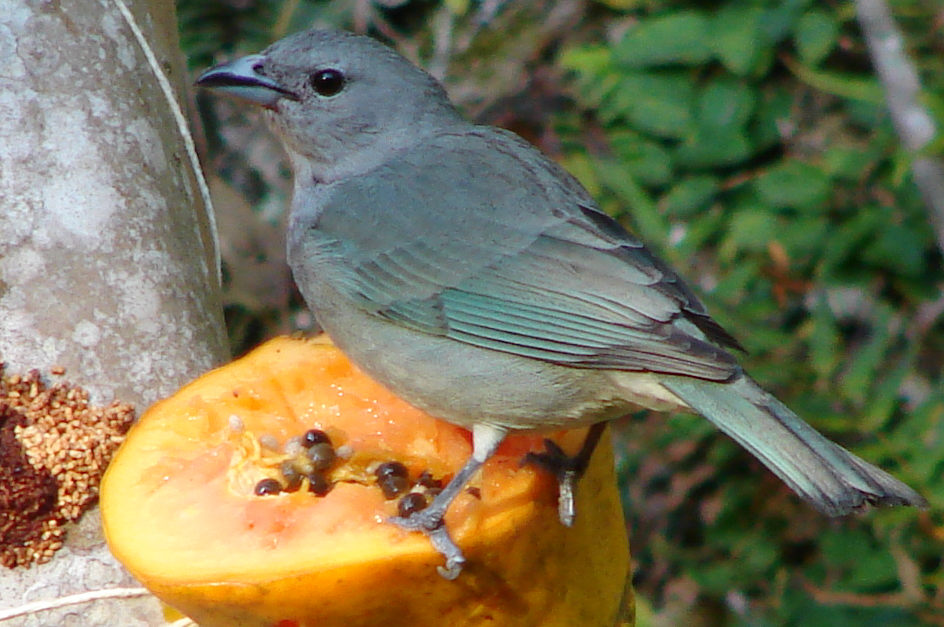
Sayaca Tanagers are medium-sized birds, averaging around 18 cm in length. Adults display a predominantly pale blue plumage with a subtle greenish tint on their wings and back. The underparts are lighter, often appearing almost gray. Males and females share similar plumage, making them difficult to distinguish by sex. Juvenile birds, however, can be identified by their duller, more muted coloration compared to adults. In terms of similar species, the Sayaca Tanager can be confused with the Blue-gray Tanager (Thraupis episcopus). A key distinguishing feature is the Sayaca's more uniform blue coloration without the white wing patch characteristic of the Blue-gray Tanager. In flight, Sayaca Tanagers exhibit a direct, slightly undulating flight pattern, typical for tanagers, with short bursts of speed. When perched, they maintain an upright posture, often seen in trees or shrubs as they scan for food or potential threats.
Having trouble telling birds apart? Upload a photo to our bird identification tool for an instant species match.
Sayaca Tanager Habitat and Range
Preferred Habitat
The Sayaca Tanager is highly adaptable, occupying a range of habitats. It thrives in lowland and montane forests, preferring open areas with scattered trees, gardens, and parks. In urban environments, it frequents backyards, particularly those with abundant fruit-bearing plants. Elevation-wise, it is commonly found from sea level up to about 2,000 meters in regions like the Brazilian Atlantic Forest and the Pantanal. Seasonal shifts in habitat are minimal, as the Sayaca Tanager is largely sedentary, though it may move locally in response to food availability. Unlike some birds that avoid urban areas, the Sayaca Tanager has embraced these environments, often nesting in artificial structures.
Geographic Range
The Sayaca Tanager's range is extensive, covering much of eastern and southern South America. It is a year-round resident in countries such as Brazil, Paraguay, Uruguay, and northern Argentina, as well as eastern Bolivia. Unlike migratory species, the Sayaca Tanager does not undergo long-distance migrations but may engage in short-range movements. Population densities are particularly high in southeastern Brazil, where urban expansion has coincided with increased sightings. These birds are absent from the cooler, southernmost regions of South America, preferring the warmer climates of the continent's central and northern portions.
Want to know which birds visit your area? Browse our backyard birds by location guides for region-specific species lists.
What Does the Sayaca Tanager Eat?
The Sayaca Tanager has a primarily frugivorous diet, favoring a variety of fruits such as papayas, bananas, and berries. It also consumes nectar and insects, particularly during the breeding season when protein demands are higher. The tanager's foraging behavior is active and opportunistic, often seen hopping between branches in search of ripe fruits. Insects are gleaned from foliage or caught in flight, though less frequently. Feeding occurs throughout the day, peaking during the early morning and late afternoon. The bird's diverse diet allows it to adapt to seasonal changes in food availability, shifting its focus between fruit and insects as necessary.
Sayaca Tanager Behavior and Social Structure
Sayaca Tanagers exhibit fascinating social behavior. Outside of the breeding season, they often form small, loose flocks, which can include other tanager species. Their territorial behavior intensifies during the breeding season, as pairs establish and defend their nesting sites. Courtship involves mutual preening and the presentation of food by males to females. In terms of predator avoidance, Sayaca Tanagers rely on their keen eyesight and quick reflexes to detect and evade threats. They typically begin their day at dawn, engaging in vocalizations that serve to strengthen pair bonds and establish territory. During the day, they are active foragers, resting intermittently in shaded areas during the midday heat.
Sayaca Tanager Nesting and Reproduction
Sayaca Tanagers construct cup-shaped nests made of twigs, roots, and grasses, often lined with softer materials like feathers or fur. They prefer to nest in trees or shrubs, choosing sites that offer some cover from predators. Clutch sizes typically range from 2 to 3 eggs, which are incubated mainly by the female for about 13 to 15 days. Both parents participate in feeding and caring for the chicks, which fledge approximately 15 to 18 days after hatching. The Sayaca Tanager generally raises one to two broods per year, depending on food availability and environmental conditions.
Sayaca Tanager Sounds and Vocalizations
The vocalizations of the Sayaca Tanager are a key aspect of its behavior. Their primary song is a melodious series of high-pitched notes, often described as a sweet, repetitive 'chip-chip-chip' that varies in pitch. This song is most commonly heard at dawn and is used to establish territory. Calls include a sharper, more abrupt 'tsip' sound, used in communication between individuals and as an alarm call to warn of predators. The dawn chorus of the Sayaca Tanager is a delightful experience for bird enthusiasts, often serving as a natural soundtrack in the habitats they frequent.
Interesting Facts About the Sayaca Tanager
- 1Sayaca Tanagers are known to occasionally visit bird feeders, especially those offering fruit, making them popular among birdwatchers.
- 2Despite their vibrant appearance, Sayaca Tanagers can be surprisingly elusive, often blending into their surroundings due to their subtle blue-gray plumage.
- 3The name 'Sayaca' is derived from a local term used in parts of Brazil to describe the bird's distinctive call.
- 4Their nests, though often well-hidden in foliage, are sometimes located in surprising places such as building ledges or garden structures.
- 5Sayaca Tanagers contribute to seed dispersal, playing an important ecological role in the maintenance of plant diversity in their habitats.
- 6These birds are not considered migratory, instead opting for short-distance movements that suit their omnivorous diet and flexible habitat needs.
Sayaca Tanager Conservation Status
According to the IUCN, the Sayaca Tanager is classified as a species of Least Concern, with a stable population trend. Its adaptability to a range of habitats, including human-altered environments, contributes to its widespread presence. However, habitat destruction, particularly in regions like the Amazon, poses a potential threat. Conservation efforts focus on habitat preservation and the protection of biodiversity corridors. Historically, the Sayaca Tanager's range has remained fairly stable, with urban expansion in some regions even benefiting its numbers by providing new feeding and nesting opportunities.


