
Seychelles Paradise-Flycatcher
Terpsiphone corvina
Order: Passeriformes / Family: Monarchidae
Wikimedia Commons
About the Seychelles Paradise-Flycatcher
The Seychelles Paradise-Flycatcher (Terpsiphone corvina) is a bird species of exceptional ecological and conservation significance, primarily known for its striking appearance and limited distribution. Endemic to the Seychelles archipelago, this bird plays a crucial role in its native ecosystem. Historically, it was found across multiple islands, but now its primary stronghold is La Digue Island. Here, it inhabits woodland areas, particularly those with dense undergrowth and mature canopy trees. This flycatcher is integral in controlling insect populations, as it predominantly feeds on small insects, which it skillfully catches in flight. Its presence is a testament to the health of the forest ecosystems on these islands. The Seychelles Paradise-Flycatcher exhibits notable seasonal behavior. During the breeding season, which aligns with the island's wetter months, males become particularly conspicuous, displaying their long tail feathers and engaging in elaborate courtship displays. These displays not only attract mates but also deter rival males from encroaching on their territories. Outside of the breeding season, the flycatcher is somewhat less visible, as it tends to stay in the lower forest strata, foraging quietly. Conservationists pay close attention to this species, as it serves as a flagship for broader biodiversity conservation efforts in the Seychelles. The bird's restricted range and declining habitat quality due to human development and invasive species make it a subject of concern among ecologists. Efforts are underway to expand its habitat through reforestation and to control invasive species that threaten its existence. The presence of the Seychelles Paradise-Flycatcher in conservation discussions highlights the delicate balance needed to maintain island biodiversity and underscores the importance of preserving endemic species in isolated ecosystems.
The Seychelles Paradise-Flycatcher belongs to the family Monarchidae, within the order Passeriformes. These birds typically live average 5-7 years, with a maximum recorded lifespan of 10 years..
How to Identify a Seychelles Paradise-Flycatcher
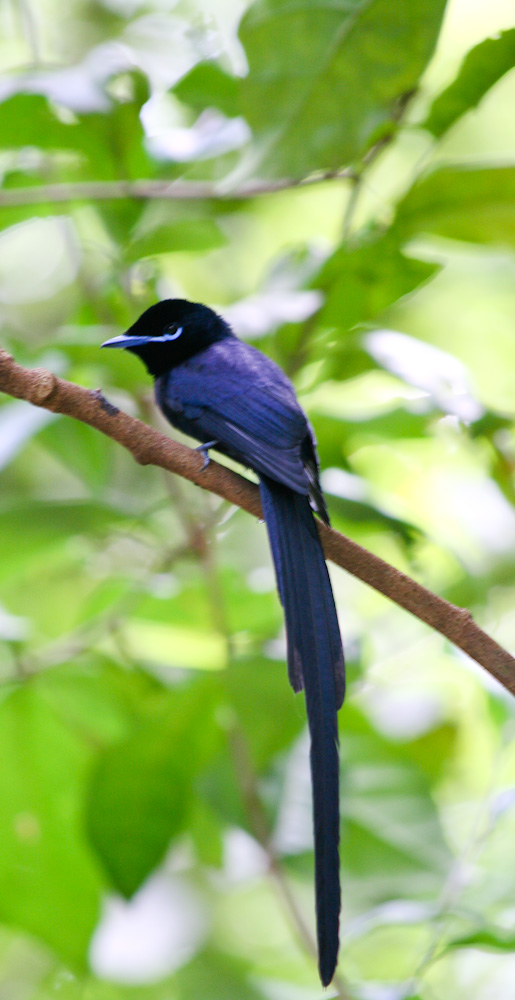
The Seychelles Paradise-Flycatcher is a visually stunning bird, easily identifiable by its unique plumage and elongated tail. Adult males are particularly striking, featuring a glossy black plumage with iridescent blue highlights, which glisten under the tropical sun. Their most distinguishing feature is their long, trailing tail feathers, which can measure up to 30 centimeters, adding a dramatic flair to their appearance. Females, while less flamboyant, are equally distinctive. They possess a combination of rufous and white plumage, with a shorter tail compared to males. Juveniles resemble females but often have duller colors. When comparing the Seychelles Paradise-Flycatcher to similar species, one must consider its overall size and tail length. The Madagascar Paradise-Flycatcher, another member of the same family, might cause confusion. However, the Seychelles bird is generally darker and lacks the vivid white morph found in its Madagascar counterpart. In flight, the Seychelles Paradise-Flycatcher presents a silhouette characterized by its elongated tail and rounded wings. Perched, it often assumes an upright posture, with its long tail flowing gracefully behind. This bird's unique color and structure make it a captivating subject for birdwatchers and ornithologists alike.
Having trouble telling birds apart? Upload a photo to our bird identification tool for an instant species match.
Seychelles Paradise-Flycatcher Habitat and Range
Preferred Habitat
The Seychelles Paradise-Flycatcher primarily resides in dense, mature woodlands, where it finds ample food and nesting sites. Its preferred habitat includes areas with a rich undergrowth and tall trees, which provide both cover and a plethora of insects for feeding. On La Digue, the bird's main habitat includes the Veuve Reserve, a protected area specially designated for its conservation. This flycatcher thrives at low elevations, typically below 300 meters, where the forest is thickest and biodiversity is richest. Unlike some bird species, the Seychelles Paradise-Flycatcher does not migrate, maintaining a year-round presence in its chosen habitat. While it is primarily found in forested areas, it occasionally ventures into adjacent gardens and plantations, particularly those that border its natural habitat. This adaptability to slightly altered environments is important for its survival, given the ongoing changes in land use on the islands.
Geographic Range
The range of the Seychelles Paradise-Flycatcher is extremely limited, confined to the Seychelles archipelago in the Indian Ocean. Historically, it was found on several islands, but today its population is primarily concentrated on La Digue Island. This restriction in range highlights its vulnerability and the importance of local conservation efforts. The species does not migrate, making its survival heavily reliant on the health of its current habitat. While small populations have been reintroduced to other islands within the Seychelles, including Denis and Curieuse, La Digue remains the primary stronghold for this bird. Within its range, the flycatcher occupies select forested areas, often in reserves or protected regions, where conservation measures help sustain its population. The limited range of the Seychelles Paradise-Flycatcher emphasizes the need for ongoing habitat protection and restoration efforts to ensure the species' future.
Want to know which birds visit your area? Browse our backyard birds by location guides for region-specific species lists.
What Does the Seychelles Paradise-Flycatcher Eat?
The diet of the Seychelles Paradise-Flycatcher consists primarily of insects, which it catches with impressive agility. Its feeding strategy involves a combination of aerial hawking and gleaning from foliage, demonstrating both versatility and skill. The bird targets a range of insects, including beetles, flies, and caterpillars, which are abundant in its woodland habitat. During the wetter months, when insect populations peak, the flycatcher can be seen actively foraging throughout the day. In contrast, during drier periods, it may spend more time searching for prey, venturing into different forest strata to locate food. This adaptability in feeding behavior is crucial for its survival, given the seasonal fluctuations in insect availability. The bird's role as an insectivore is vital, contributing to the control of insect populations and maintaining ecological balance within its habitat.
Seychelles Paradise-Flycatcher Behavior and Social Structure
The Seychelles Paradise-Flycatcher exhibits fascinating behaviors that highlight its role in the ecosystem and its adaptive strategies. It is primarily solitary or found in pairs, particularly during the breeding season. Territorial behavior is prominent among males, who establish and defend their territories through song and physical displays. Courtship involves elaborate displays, where the male showcases his long tail feathers and engages in aerial acrobatics to attract a mate. These displays serve not only to entice females but also to ward off rival males. Outside the breeding season, the bird remains relatively quiet, focusing on foraging and maintaining its territory. When threatened by predators, the flycatcher employs alarm calls and evasive maneuvers to protect itself and its young. Its daily activity pattern includes active foraging from dawn to dusk, with peak activity occurring in the early morning and late afternoon when insect prey is most accessible.
Seychelles Paradise-Flycatcher Nesting and Reproduction
Nesting for the Seychelles Paradise-Flycatcher involves intricate construction and careful selection of location. The nests are cup-shaped, often placed in the fork of a tree branch, which provides stability and protection from predators. The birds use a variety of natural materials, including twigs, moss, and spider silk, to build their nests, ensuring a secure and camouflaged site. The typical clutch size ranges from one to two eggs, with both parents sharing incubation duties. The incubation period lasts about 14 to 16 days, after which the chicks hatch and are fed by both parents. Fledging occurs approximately 18 to 20 days after hatching, with continued parental care until the young are fully independent. The species typically raises one brood per year, but favorable conditions can lead to occasional second broods. The commitment of both parents to rearing their young is a key factor in the survival of this endangered species.
Seychelles Paradise-Flycatcher Sounds and Vocalizations
The sounds of the Seychelles Paradise-Flycatcher are distinctive and play an essential role in communication. The primary song is a melodious series of whistles, varying in pitch and rhythm, often delivered from a concealed perch within the forest canopy. This song is most prominent during the breeding season, serving to establish territory and attract mates. Call notes include sharp, short chirps used for communication between mates and to signal alarm. When alarmed, the bird may emit a harsher, more urgent call to alert others of potential danger. The dawn chorus of the Seychelles Paradise-Flycatcher is a lively affair, with males actively singing to assert their presence and deter rivals. These vocalizations, though not as loud as those of some larger birds, carry well through the dense vegetation of their habitat.
Interesting Facts About the Seychelles Paradise-Flycatcher
- 1The male Seychelles Paradise-Flycatcher's tail feathers can measure up to 30 cm, making them one of the longest among flycatchers.
- 2Despite being critically endangered, the Seychelles Paradise-Flycatcher was once more widespread, with populations on multiple islands in the archipelago.
- 3The bird's name reflects its striking beauty and the island paradise it inhabits, embodying the unique biodiversity of the Seychelles.
- 4The Seychelles Paradise-Flycatcher plays a crucial role in controlling insect populations, feeding mainly on insects caught in flight.
- 5Conservation efforts have led to the reintroduction of the Seychelles Paradise-Flycatcher to other islands, expanding its range beyond La Digue.
- 6Both male and female flycatchers participate in building the nest, using materials like twigs and spider silk to create a secure structure.
- 7The Seychelles Paradise-Flycatcher's melodious song contributes to the rich soundscape of the island's forests, especially during the breeding season.
Seychelles Paradise-Flycatcher Conservation Status
The Seychelles Paradise-Flycatcher is classified as critically endangered by the IUCN, with its population trend currently considered stable due to concerted conservation efforts. Primary threats to the species include habitat loss from human development, predation by invasive species such as rats and cats, and competition from other birds introduced to the islands. Conservation efforts focus on habitat restoration, predator control, and public education to raise awareness about the species' plight. The establishment of the Veuve Reserve on La Digue has been pivotal in providing a controlled environment for the flycatcher to thrive. Historical population declines due to deforestation and habitat fragmentation have been somewhat mitigated by these ongoing initiatives. The species' status as a conservation flagship has helped garner international support, highlighting the importance of protecting island biodiversity.


