
Sharp-billed Treehunter
Heliobletus contaminatus
Order: Passeriformes / Family: Furnariidae
Wikimedia Commons
About the Sharp-billed Treehunter
The Sharp-billed Treehunter, scientifically named Heliobletus contaminatus, is a unique member of the family Furnariidae. This bird is predominantly found in the Atlantic Forests of southeastern Brazil and eastern Paraguay, extending into northeastern Argentina. These forests, characterized by their high biodiversity, provide a rich habitat for the Sharp-billed Treehunter. This species plays a crucial ecological role as an insectivore, helping to control insect populations within these ecosystems. The Sharp-billed Treehunter exhibits a preference for subtropical and tropical moist lowland forests and montane forests, where it is often seen foraging energetically on tree trunks and branches. Its presence is significant, as it contributes to the intricate food web of these biodiverse regions. The bird is highly adapted to its environment, utilizing its sharp bill to extract insects and larvae from crevices in the bark, a behavior that underscores its role as a natural pest control agent. Seasonally, the Sharp-billed Treehunter remains relatively sedentary, with no significant migratory patterns, although it may undertake altitudinal movements in response to food availability. During the breeding season, which occurs in the austral spring and summer, these birds become more vocal and active, with increased foraging to support their young. The Sharp-billed Treehunter's reliable presence in its native habitat underscores its importance in maintaining the ecological balance of the forest ecosystems.
The Sharp-billed Treehunter belongs to the family Furnariidae, within the order Passeriformes. These birds typically live average 5-7 years, with a max recorded of 10 years.
How to Identify a Sharp-billed Treehunter
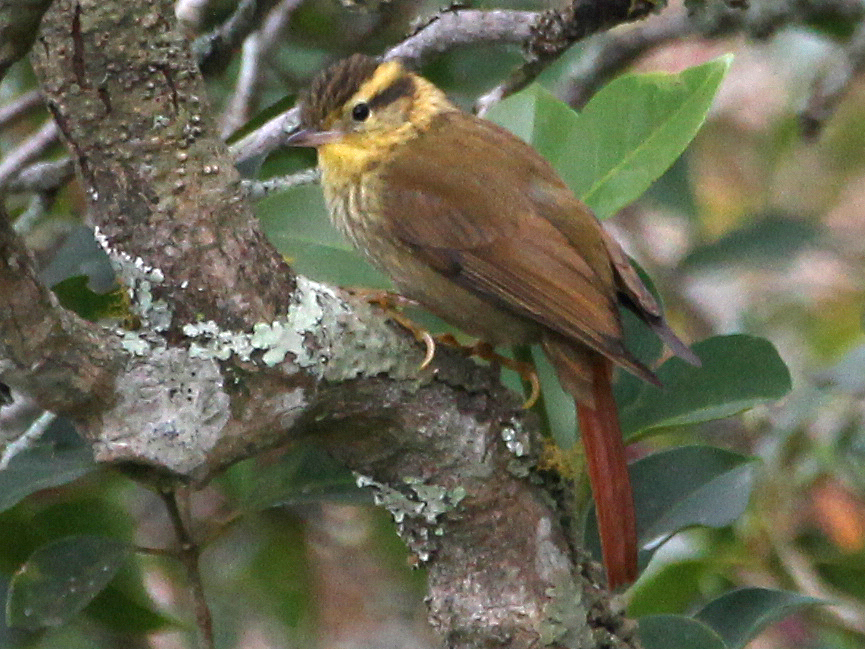
The Sharp-billed Treehunter is a small bird, measuring approximately 14 to 15 cm in length. Its most distinguishing feature is its slender, pointed bill, adapted for probing into bark crevices. The plumage is predominantly olive-brown, with a slightly rufous tint on the wings and tail. The underparts are lighter, with a buffy hue, providing some contrast. Juveniles resemble adults but may have slightly duller plumage. There is little sexual dimorphism, making it difficult to distinguish males from females in the field. However, both genders exhibit similar vocalizations and foraging behaviors. In flight, the Sharp-billed Treehunter displays a rapid wingbeat and a slightly undulating flight pattern. When perched, it often adopts an upright posture, clinging to vertical surfaces of tree trunks and branches. It resembles other treecreepers and woodcreepers, but its distinctive bill and foraging style help differentiate it. Observing its behavior and habitat preference aids in correct identification.
Having trouble telling birds apart? Upload a photo to our bird identification tool for an instant species match.
Sharp-billed Treehunter Habitat and Range
Preferred Habitat
The Sharp-billed Treehunter primarily inhabits subtropical and tropical moist lowland and montane forests. It thrives in dense, humid forest environments, often at elevations ranging from sea level up to 2000 meters. Within these forests, it prefers areas with ample tree cover and a rich supply of insects, essential for its diet. Seasonal habitat shifts are minimal, though local movements may occur in response to food availability. The Sharp-billed Treehunter is rarely found in urban settings and shows a strong preference for undisturbed forest areas. Its survival is closely tied to the health and preservation of its native forest habitats.
Geographic Range
The Sharp-billed Treehunter's range is largely centered in South America, specifically in the Atlantic Forest biome. It is primarily found in southeastern Brazil, including the states of São Paulo, Rio de Janeiro, and Minas Gerais, as well as in eastern Paraguay and northeastern Argentina. This bird is non-migratory, residing year-round within its range. Although it does not undertake long-distance migrations, it may exhibit altitudinal movements within its range, especially when local food resources fluctuate. Populations are densest in regions with intact forest cover, where they can find optimal foraging conditions.
Want to know which birds visit your area? Browse our backyard birds by location guides for region-specific species lists.
What Does the Sharp-billed Treehunter Eat?
The diet of the Sharp-billed Treehunter is predominantly insectivorous. It feeds extensively on insects and their larvae, which it expertly extracts from bark crevices using its specialized bill. The bird's foraging technique involves probing and pecking at tree surfaces while moving along trunks and branches. During the wet season, a time of insect abundance, its diet may expand to include a greater variety of arthropods. The Sharp-billed Treehunter forages throughout daylight hours, with peak activity in the early morning and late afternoon. Its feeding schedule aligns closely with the availability of prey within the forest ecosystem.
Sharp-billed Treehunter Behavior and Social Structure
The Sharp-billed Treehunter is typically solitary or found in pairs, displaying a strong territorial instinct, especially during the breeding season. It establishes territories that it defends vigorously against intruders. Courtship behavior includes vocal displays and mutual foraging between mates. The bird's response to predators involves remaining motionless or quickly retreating to dense foliage. Its daily activity pattern centers around foraging, with periods of rest during the hottest part of the day. Although not highly social, the Sharp-billed Treehunter may join mixed-species foraging flocks, benefiting from the increased vigilance such groups provide.
Sharp-billed Treehunter Nesting and Reproduction
Sharp-billed Treehunter nests are typically located within tree cavities or on protected ledges. The nest itself is a simple structure composed of leaves, moss, and other plant materials. Clutch size generally consists of two to three eggs, which are incubated by both parents. The incubation period lasts approximately 15 to 18 days, followed by a fledging period of about 20 days. Both parents participate in feeding the young, ensuring a steady supply of insects to support rapid growth. The Sharp-billed Treehunter usually raises one brood per year, though in optimal conditions, a second brood is possible.
Sharp-billed Treehunter Sounds and Vocalizations
The primary song of the Sharp-billed Treehunter is a series of sharp, high-pitched notes delivered in rapid succession, often described as a 'tsee-tsee-tsee' sound. These vocalizations serve to establish territory and communicate with mates. Call notes vary but typically include short, sharp 'chip' sounds. Alarm calls are more urgent and staccato, designed to alert other birds to potential threats. During the dawn chorus, the Sharp-billed Treehunter's song is more frequent, contributing to the vibrant auditory landscape of the forest.
Interesting Facts About the Sharp-billed Treehunter
- 1The Sharp-billed Treehunter uses its specialized bill to pry insects from the bark, showcasing a unique adaptation among Furnariidae.
- 2Despite being a small bird, the Sharp-billed Treehunter plays a significant role in controlling insect populations in its habitat.
- 3The species name 'contaminatus' reflects the bird’s historical classification challenges due to its complex taxonomic relationships.
- 4The Sharp-billed Treehunter is often heard more than seen, as its camouflaged plumage blends well with the forest environment.
- 5This bird exhibits a remarkable ability to cling to vertical tree trunks, similar to the behavior of woodpeckers.
- 6The Atlantic Forest, home to the Sharp-billed Treehunter, is one of the most diverse ecosystems in the world, hosting many endemic species.
- 7The Sharp-billed Treehunter's reliance on forest habitats highlights the critical importance of forest conservation in South America.
Sharp-billed Treehunter Conservation Status
The IUCN classifies the Sharp-billed Treehunter as Near Threatened, primarily due to habitat loss from deforestation and agricultural expansion. While the population is currently stable, ongoing destruction of the Atlantic Forest poses a significant threat. Conservation efforts focus on protecting existing forest habitats and promoting reforestation. Historical population changes reflect the broader patterns of forest degradation in its range, emphasizing the need for continued conservation action.


