
Shining Honeycreeper
Cyanerpes lucidus
Order: Passeriformes / Family: Thraupidae
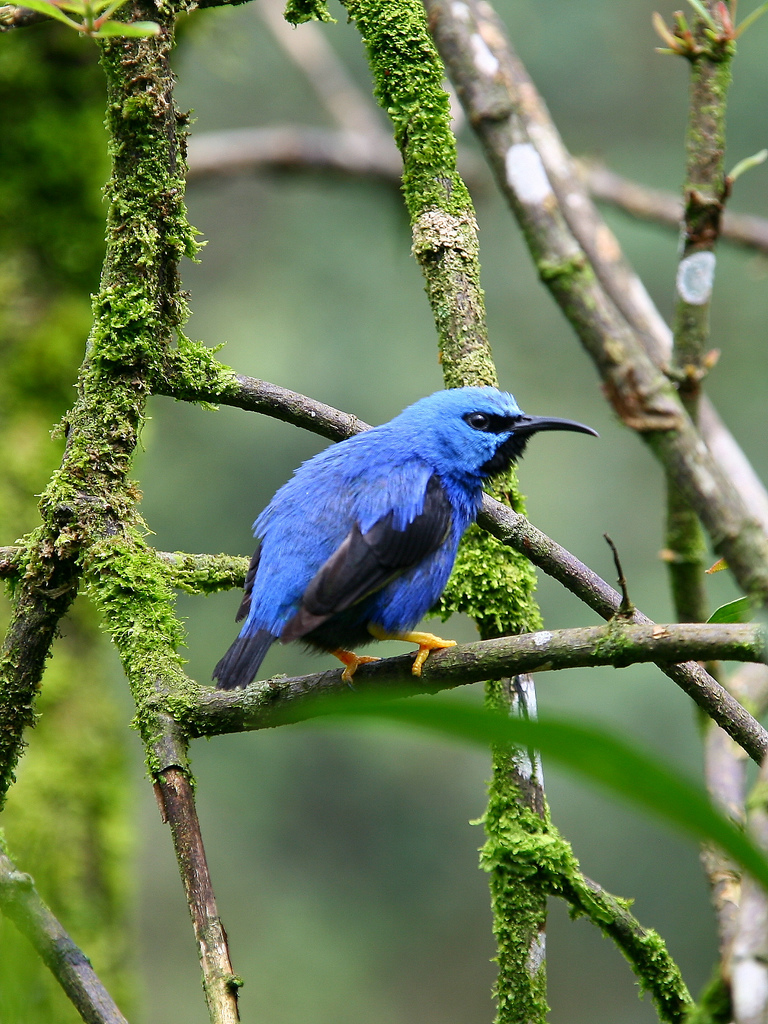
Wikimedia Commons
About the Shining Honeycreeper
The Shining Honeycreeper, scientifically known as Cyanerpes lucidus, belongs to the family Thraupidae and is a fascinating small bird found primarily in the tropical regions of Central America. This species is recognized for its vivid coloration and plays a significant ecological role in its habitat. Typically inhabiting lowland and foothill forests, the Shining Honeycreeper is often seen in countries such as Costa Rica and Panama. These birds are essential pollinators, contributing to the health of their ecosystems by transferring pollen as they feed on nectar from various flowering plants. Outside of the breeding season, they often join mixed-species feeding flocks, an activity that enhances their foraging success and offers some protection from predators. The Shining Honeycreeper adapts to different environments, including secondary forests and plantations, demonstrating its ecological versatility. Seasonal behaviors are also noteworthy, as they become more vocal and active during the breeding season, which coincides with the rainy months when food resources are abundant. The bird's presence in these areas is a key indicator of the health of the ecosystem, as their need for flowering plants ties them closely to the environment's overall floral diversity. During the breeding season, males exhibit more vibrant plumage and increased singing to attract mates and defend territories. This bird's adaptability to various habitats and its role in pollination underscore its ecological importance in the tropical landscapes it inhabits.
The Shining Honeycreeper belongs to the family Thraupidae, within the order Passeriformes. These birds typically live typically 3-5 years in the wild..
How to Identify a Shining Honeycreeper
The Shining Honeycreeper exhibits striking sexual dimorphism. Adult males display a vibrant blue plumage with a black mask and throat, while females have a more subdued olive-green coloration with faint streaks. Juveniles resemble females but are generally duller. A distinctive feature of the species is its slender, downward-curved bill, ideal for nectar feeding. The bird's flight appears swift and direct, with rapid wingbeats that create a blur of color as the male's blue plumage contrasts against the forest backdrop. When perched, the Shining Honeycreeper often holds its tail slightly cocked and is usually seen in the mid to upper canopy, where it forages. Confusion may arise with the Red-legged Honeycreeper, but differences in leg color and the extent of black on the head help distinguish them. The male Shining Honeycreeper's almost uniform blue body and black head are key identifiers, while the female's olive tones blend well with the forest foliage, providing excellent camouflage.
Having trouble telling birds apart? Upload a photo to our bird identification tool for an instant species match.
Shining Honeycreeper Habitat and Range
Preferred Habitat
The Shining Honeycreeper thrives in tropical lowland and foothill forests, favoring areas with abundant flowering plants. In countries like Costa Rica, it can be found at elevations up to 1,200 meters, although it is more common below 900 meters. These birds show adaptability to both pristine and disturbed habitats, including secondary forests and plantations, where flowering trees are present. While primarily a forest dweller, the Shining Honeycreeper occasionally ventures into gardens and urban areas where suitable flora exists. Seasonal shifts in habitat use are influenced by flowering cycles, with the birds moving locally to track food availability. Despite its presence in modified landscapes, the species remains closely tied to regions with high plant diversity, underscoring its dependence on forest ecosystems.
Geographic Range
The Shining Honeycreeper's range extends across the tropical regions of Central America, from southern Mexico through Honduras, Nicaragua, Costa Rica, and into western Panama. It exhibits a resident, non-migratory lifestyle, maintaining territories year-round within this range. Population densities are highest in areas with abundant flowering plants, where these birds can be seen in significant numbers. The species tends to be more common in lowland forests, but it can also be found in foothills, adapting to different elevations depending on local conditions. Although it does not undertake long-distance migrations, the bird may engage in local movements driven by the seasonal availability of nectar and fruit sources.
Want to know which birds visit your area? Browse our backyard birds by location guides for region-specific species lists.
What Does the Shining Honeycreeper Eat?
The Shining Honeycreeper primarily feeds on nectar, favoring flowers of various tropical plant species. It employs a specialized feeding technique, using its slender, curved bill to probe deep into blossoms, extracting nectar with its brush-tipped tongue. In addition to nectar, the bird supplements its diet with fruits and small insects, which provide essential proteins and nutrients. Seasonal changes in diet are evident, with a greater reliance on insects during the breeding season to support the increased energy demands of raising young. Foraging occurs throughout the day, with peaks in activity during the cooler morning and late afternoon hours. The Shining Honeycreeper's preference for diverse flowering plants underscores its role as a critical pollinator in its ecosystem.
Want to attract Shining Honeycreepers to your yard? See our recommended feeders and seed types for the best results.
Shining Honeycreeper Behavior and Social Structure
The Shining Honeycreeper displays a social structure that is generally non-territorial outside of the breeding season, often joining mixed-species flocks to forage. During the breeding period, males become more territorial, exhibiting displays that include singing and posturing to ward off rivals and attract females. Courtship displays involve the male showcasing his vibrant plumage through fluttering flights and perched displays. While generally solitary or in pairs during breeding, these birds exhibit flocking behavior at other times, gathering in groups to exploit rich food sources. Their response to predators includes swift, evasive flights and the use of dense foliage for cover. Daily activities are primarily diurnal, with peak activity levels occurring in the cooler hours of the day.
Shining Honeycreeper Nesting and Reproduction
The Shining Honeycreeper builds small, cup-shaped nests approximately 3-6 meters above ground, often in the fork of a tree branch. The nest consists of fine plant materials, including grasses and rootlets, woven together to create a sturdy structure. Typically, the female lays two to three eggs per clutch, with an incubation period of about 12-14 days. Both parents participate in feeding the chicks, which fledge approximately 15-20 days after hatching. The species can produce up to two broods per year, depending on food availability and environmental conditions. Parental roles are shared, although the female primarily handles incubation, while the male assists in feeding the young post-hatching.
Shining Honeycreeper Sounds and Vocalizations
The Shining Honeycreeper's song is a series of high-pitched, melodious notes that are both rapid and rhythmic. The typical song consists of a repetitive sequence of whistled phrases, often delivered from a concealed perch. Call notes are sharp and distinctive, often used as contact calls between individuals or to signal alarm in the presence of predators. During the dawn chorus, males are particularly vocal, using their songs to establish territories and attract mates. The tonal quality of their vocalizations is clear and musical, akin to a series of delicate whistles.
Interesting Facts About the Shining Honeycreeper
- 1The Shining Honeycreeper's tongue is uniquely adapted with a brush-like tip, ideal for nectar feeding.
- 2Males molt into their striking blue plumage at about one year of age, while females maintain a more subdued look.
- 3Despite their small size, Shining Honeycreepers are effective pollinators for a variety of tropical plants.
- 4These birds are often found in mixed-species flocks, which can include up to 20 different bird species.
- 5Shining Honeycreepers' nests are often reused in subsequent breeding seasons, built upon and reinforced each year.
- 6Their primary habitat, tropical lowland forests, supports an incredible diversity of life, making conservation critical.
- 7Shining Honeycreepers can hover briefly like hummingbirds when feeding, though they mostly perch while foraging.
Shining Honeycreeper Conservation Status
The Shining Honeycreeper currently holds a status of Least Concern according to the IUCN. Its population trend appears stable, supported by its adaptability to a range of habitats, including secondary forests and plantations. However, ongoing threats include habitat loss due to deforestation and agricultural expansion. Conservation efforts focus on preserving tropical forest habitats and promoting sustainable land use practices. The bird's ability to thrive in modified environments offers some resilience, but long-term conservation success depends on maintaining core forest areas and plant diversity.
Attracting Shining Honeycreepers to Your Feeder
The Shining Honeycreeper is a regular visitor to backyard bird feeders across its range. At the Eye On The Fly feeding station, we observe Shining Honeycreepers regularly and capture footage with our feeder cameras.


