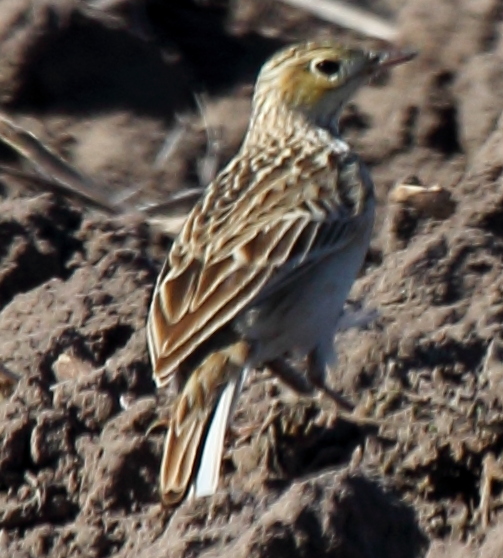
Short-tailed Pipit
Anthus brachyurus
Order: Passeriformes / Family: Motacillidae

Wikimedia Commons
About the Short-tailed Pipit
The Short-tailed Pipit, scientifically known as Anthus brachyurus, inhabits a niche within the vast grasslands and open savannas of sub-Saharan Africa. This small, inconspicuous bird plays a significant ecological role as both a predator and prey within its environment. As a ground-dwelling insectivore, it helps control insect populations, thus maintaining ecological balance.
Widespread across specific African regions, the Short-tailed Pipit is particularly prevalent in southern and eastern Africa, thriving in countries such as South Africa, Zimbabwe, Kenya, and Tanzania. Its preference for short grass plains and open fields, often with scattered shrubs, makes it a quintessential species of open habitats. While not as vocal or conspicuous as some other pipit species, its presence is marked by subtle behaviors and a distinctive high-pitched song.
During the breeding season, the Short-tailed Pipit becomes more territorial. This period is characterized by increased vocal activity and elaborate courtship displays. While it is known to be somewhat elusive, its breeding activities provide vital opportunities for observation. The bird's role as a key insectivore means it is an integral part of the food chain, serving as prey for larger birds of prey and mammals. Its seasonal behaviors align with the availability of food resources, demonstrating its adaptability to changing environments.
The Short-tailed Pipit is also an indicator species for healthy grassland ecosystems. As grassland habitats face threats from human activities such as agriculture and urbanization, the conservation of this species becomes increasingly important. By understanding its ecological role and behavior, conservationists can better devise strategies to preserve both the bird and its habitat.
The Short-tailed Pipit belongs to the family Motacillidae, within the order Passeriformes. These birds typically live average 3-5 years with a max recorded of 6 years..
How to Identify a Short-tailed Pipit
Identifying the Short-tailed Pipit involves noting several key field marks. Adults typically exhibit brown upperparts with streaked patterns, allowing them to blend seamlessly into their grassy environments. Underparts are paler, with subtle streaking on the breast. The hallmark feature of the Short-tailed Pipit is its notably short tail, which distinguishes it from other pipit species.
Males and females appear similar, with no significant sexual dimorphism, although subtle variations in plumage intensity may occur. Juveniles resemble adults but generally have more pronounced streaking and a fresher appearance. In flight, the Short-tailed Pipit displays a characteristic fluttering pattern, and its short tail is easily noticeable.
When perched, the Short-tailed Pipit maintains an upright posture, often observed on low shrubs or rocks. Confusion with other pipit species is possible, particularly with the African Pipit, but the shorter tail and unique song of Anthus brachyurus are reliable identification cues.
Having trouble telling birds apart? Upload a photo to our bird identification tool for an instant species match.
Short-tailed Pipit Habitat and Range
Preferred Habitat
The Short-tailed Pipit thrives predominantly in open grasslands and savannas, favoring regions with short grasses and minimal tree cover. It is frequently found in the high-altitude grasslands of the Drakensberg mountains in South Africa, as well as the open plains of the Serengeti in Tanzania.
This species prefers habitats that provide both adequate cover and open spaces for foraging. While generally absent from densely forested or heavily urbanized areas, it can sometimes be spotted in rural agricultural fields, particularly where traditional farming practices maintain natural grassland edges.
Seasonal shifts in habitat preference are often driven by rainfall patterns, which affect insect abundance. During dry spells, the Short-tailed Pipit may move to areas where grass remains lush and insects plentiful, although it generally does not undertake long-distance migrations.
Geographic Range
The Short-tailed Pipit is a resident species across much of sub-Saharan Africa. Its core range includes southern Africa, extending northwards to Ethiopia and Somalia. This pipit is particularly common in South Africa, Botswana, and Namibia, where grassland habitats are extensive.
Although not known for long migrations, the Short-tailed Pipit exhibits some local movement in response to seasonal changes in food availability. During the breeding season, it remains within its established territories, which are often characterized by optimal grassland conditions.
Population densities are highest in regions where grasslands are maintained either naturally or through sustainable agricultural practices. In countries like Kenya and Tanzania, the Short-tailed Pipit is frequently observed in national parks and reserves that protect its preferred habitat.
Want to know which birds visit your area? Browse our backyard birds by location guides for region-specific species lists.
What Does the Short-tailed Pipit Eat?
The diet of the Short-tailed Pipit primarily consists of insects and other small invertebrates. It favors beetles, ants, and spiders, which it gleans from the ground while foraging. This bird's short bill is well-adapted for picking insects off grass stems and the soil surface.
During the breeding season, the abundance of insects provides ample food for both adults and their chicks. In the cooler, drier months, the Short-tailed Pipit may supplement its diet with seeds, although this forms a minor part of its overall intake.
Foraging typically occurs during the early morning and late afternoon when insects are most active. The pipit uses a mix of walking and hopping to cover ground, often pausing to peck at the soil or vegetation. This methodical foraging technique maximizes its success in capturing prey.
Short-tailed Pipit Behavior and Social Structure
The Short-tailed Pipit exhibits solitary or pair-based social structures, especially during the breeding season when pairs establish territories. Territorial displays include singing from elevated perches and engaging in aerial chases to deter intruders.
Courtship involves males performing flight displays with distinctive fluttering and gliding, accompanied by song. These displays serve to attract females and establish pair bonds. Once paired, both sexes contribute to territory defense, though males are typically more vocal.
The species displays a diurnal activity pattern, focusing on foraging and territorial maintenance during daylight hours. At night, it roosts on the ground, often in sheltered grassy areas. When threatened by predators, the Short-tailed Pipit relies on its cryptic plumage and prefers to run and hide rather than fly, although it will take to the air if necessary.
Short-tailed Pipit Nesting and Reproduction
The Short-tailed Pipit constructs a cup-shaped nest on the ground, typically hidden among tufts of grass. The nest is built using dried grasses and rootlets, providing excellent camouflage against predators.
A typical clutch consists of 2-4 eggs, which are pale and speckled, blending well with the surroundings. Both parents participate in incubation, which lasts approximately 12-14 days. After hatching, the chicks remain in the nest for about 11-13 days before fledging.
Parental roles are shared, with both male and female feeding the chicks and maintaining the nest. The Short-tailed Pipit may produce two broods per year if conditions are favorable, particularly in regions with extended rainy seasons that promote insect abundance.
Short-tailed Pipit Sounds and Vocalizations
The primary song of the Short-tailed Pipit is a series of high-pitched, melodic trills, often delivered from a low perch or in flight. The song rhythmically repeats and is characterized by a rapid tempo with a sweet, musical quality.
Call notes are shorter and serve various communication purposes, such as maintaining contact with a mate or issuing warning signals. Alarm calls are sharper and more urgent, alerting other birds to potential dangers.
During the dawn chorus, the Short-tailed Pipit's song contributes to the vibrant acoustic landscape of the grasslands. Compared to other pipits, its song is more delicate and less assertive, yet distinctly recognizable to experienced birdwatchers.
Interesting Facts About the Short-tailed Pipit
- 1The Short-tailed Pipit is one of the few pipit species that builds its nest entirely on the ground, leveraging its camouflage for protection.
- 2Despite its small size, the Short-tailed Pipit covers extensive ground when foraging, often walking several hundred meters in a single session.
- 3Short-tailed Pipits exhibit localized movements, but unlike many pipits, they are not long-distance migrants, remaining largely within their home range.
- 4The species' song is often used as a key identification feature, especially during the breeding season when it becomes more vocal.
- 5Short-tailed Pipits play a vital role in controlling insect populations, thereby contributing to the ecological health of grassland habitats.
- 6They are adaptable to various grassland conditions, thriving in both natural savannas and modified agricultural landscapes.
- 7The Short-tailed Pipit's cryptic plumage not only provides camouflage but also assists in its stealthy hunting techniques.
Short-tailed Pipit Conservation Status
The Short-tailed Pipit currently holds a status of Least Concern according to the IUCN Red List, with a stable population trend overall. While not immediately threatened, habitat loss due to agricultural expansion and urban development poses long-term risks. Conservation efforts focus on preserving grassland habitats through sustainable land management practices. Protected areas such as national parks and wildlife reserves play a crucial role in maintaining suitable environments for the Short-tailed Pipit. Historically, the population has remained relatively stable, but ongoing monitoring is essential to detect any shifts that may indicate emerging threats. Collaborative conservation initiatives aim to balance agricultural productivity with biodiversity conservation.