
Slate-colored Hawk
Leucopternis schistaceus
Order: Accipitriformes / Family: Accipitridae
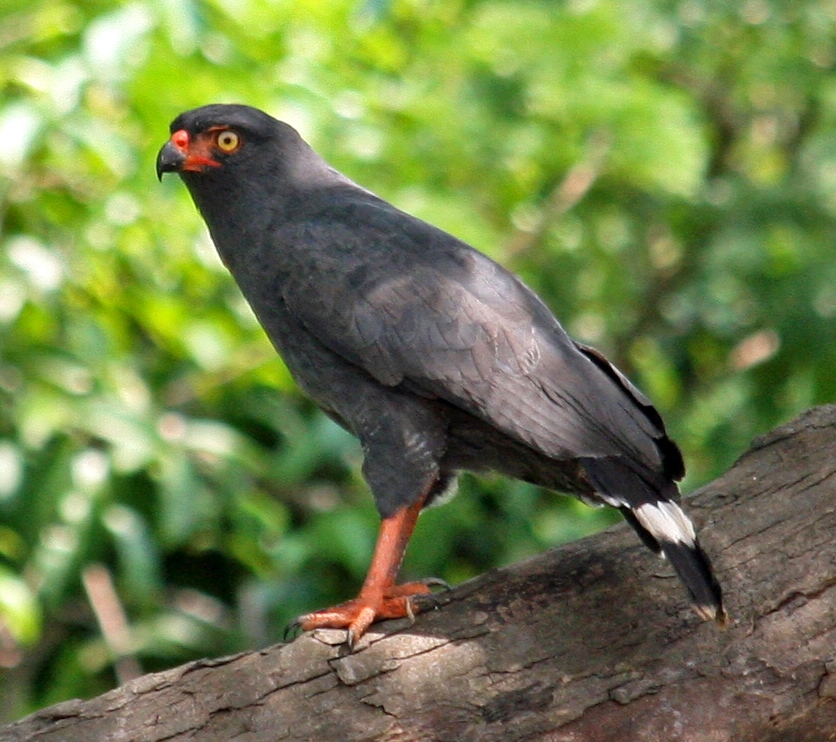
Wikimedia Commons
About the Slate-colored Hawk
The Slate-colored Hawk (Leucopternis schistaceus) is a medium-sized raptor found predominantly in the neotropical regions of South America. This bird plays a significant role in the forest ecosystem as both a predator and a scavenger, helping regulate populations of smaller birds and mammals. It occupies the Amazon basin, spanning countries such as Brazil, Peru, Ecuador, and Colombia. These regions host the dense lowland tropical rainforests that are ideal for the Slate-colored Hawk's hunting and nesting activities. The hawk's preference for undisturbed habitats makes it a valuable indicator of forest health.
The Slate-colored Hawk remains relatively reclusive, favoring the thick canopy where it can hunt in solitude. Despite its elusive nature, the bird is critical to the ecological balance, preying on a variety of small mammals, birds, and reptiles. This predatory role helps maintain the balance of species within its habitat, preventing overpopulation of particular prey species. The hawk's presence is a testament to the untouched beauty of the Amazon, as it thrives best in mature forests that have not been altered by human activity.
Seasonal behaviors of the Slate-colored Hawk are largely influenced by the wet and dry cycles of the Amazon. During the wet season, when food is abundant, they are more active and visible, often seen soaring above the canopy or perched silently on a branch. In the dry season, their activity decreases slightly as they adapt to the changes in prey availability. However, their adaptability allows them to remain in the same territories year-round, showcasing their resilience and specialized adaptation to their environment.
The Slate-colored Hawk belongs to the family Accipitridae, within the order Accipitriformes. These birds typically live average 12-15 years, with a maximum recorded of 18 years..
How to Identify a Slate-colored Hawk
The Slate-colored Hawk is characterized by its uniform slate-gray plumage, which provides excellent camouflage in the dense forest canopy. Adult birds display a subtle yet striking contrast between their lighter gray chest and darker back, while their underparts are uniformly gray. Juvenile hawks differ slightly, exhibiting a brownish tint to their feathers, which gradually transitions to the adult gray as they mature.
Males and females are similar in appearance, although females tend to be slightly larger, a common trait among raptors. Their robust build, broad wings, and short tail enable them to maneuver adeptly through the dense forest. In flight, the hawk's silhouette is distinctive, with broad, rounded wings and a short, squared-off tail, allowing birders to distinguish it from similar species such as the Gray Hawk (Buteo plagiatus), which has a longer tail and more pronounced barring on its underparts.
When perched, the Slate-colored Hawk maintains a stoic posture, often remaining motionless for extended periods. This behavior, combined with their coloring, can make them challenging to spot among the shadows and foliage. Observers should take note of their bright yellow legs and cere, which contrast with the otherwise monochrome appearance and can be key identifiers.
Having trouble telling birds apart? Upload a photo to our bird identification tool for an instant species match.
Slate-colored Hawk Habitat and Range
Preferred Habitat
The Slate-colored Hawk thrives in the lowland tropical rainforests of the Amazon basin. It is most commonly found in pristine, primary forests where the dense canopy provides ample cover and hunting opportunities. Typically, they inhabit areas at elevations below 1000 meters, favoring environments that offer extensive tree cover and minimal human disturbance.
In these forests, the hawk utilizes the upper canopy and mid-levels for hunting and nesting, rarely venturing into open spaces or secondary growth areas. Unlike some raptors that adapt to urban settings, the Slate-colored Hawk remains firmly rooted in its forested domain, relying on the biodiversity and complexity of these ecosystems to support its dietary and reproductive needs.
While the bird is non-migratory and generally sedentary, slight habitat shifts can occur in response to seasonal changes in prey availability. However, these shifts are minor, as the hawk's primary habitat remains the untouched, mature forests of its range.
Geographic Range
The Slate-colored Hawk's range is concentrated in the Amazon basin, extending across several South American countries. It is primarily found in Brazil, Peru, Ecuador, Colombia, and parts of Venezuela. This distribution places the hawk in one of the most biodiverse regions on Earth, where it thrives in the extensive forest cover provided by the Amazon.
The bird does not exhibit long-distance migration, instead remaining within its established territories throughout the year. This sedentary nature is supported by the consistent climate and resource availability in the tropical rainforest. Within its range, population densities vary, with higher concentrations often found in areas of greater prey abundance and minimal habitat disturbance.
While the Slate-colored Hawk's range is relatively stable, any changes in forest cover due to deforestation or climate change could significantly impact its distribution. The bird's reliance on undisturbed habitats underscores the importance of conservation efforts focused on preserving the Amazon's vast forests.
Want to know which birds visit your area? Browse our backyard birds by location guides for region-specific species lists.
What Does the Slate-colored Hawk Eat?
The diet of the Slate-colored Hawk consists primarily of small mammals, birds, and reptiles, highlighting its role as an adaptable predator within the forest ecosystem. This bird of prey employs a sit-and-wait strategy, perching silently until potential prey comes into view, then striking with speed and precision.
During the wet season, when prey is more abundant, the hawk may expand its diet to include insects and amphibians, taking advantage of the seasonal increase in biodiversity. Conversely, in the dry season, when prey becomes less accessible, the Slate-colored Hawk demonstrates remarkable adaptability, focusing on more readily available food sources.
Prey size varies from small rodents and lizards to larger birds, with the hawk capable of adjusting its hunting technique based on the target. This opportunistic feeding behavior ensures its survival across different seasons and environmental conditions, showcasing its adaptability and skill as a forager.
Slate-colored Hawk Behavior and Social Structure
The Slate-colored Hawk exhibits solitary behavior, preferring to hunt and live alone or in pairs, especially during the breeding season. Its territorial nature is evident through its vocalizations and occasional aerial displays, which serve to mark and defend its domain against intruders.
Courtship displays for this species involve mutual soaring and calling between pairs, strengthening pair bonds and establishing territories for nesting. Once paired, the hawks maintain monogamous relationships, often returning to the same nesting sites each year.
The bird's daily activity peaks during the early morning and late afternoon, coinciding with the movement of prey. During midday, when temperatures rise, the hawk may retreat to shaded perches, minimizing activity until temperatures cool. The Slate-colored Hawk's response to predators involves a mix of vocal alarms and evasive maneuvers, ensuring its safety and that of its offspring.
Despite its solitary nature, the Slate-colored Hawk occasionally participates in mixed-species flocks, particularly during food shortages. In these instances, the hawk adapts its hunting technique and social behavior to capitalize on the opportunities presented by the presence of other bird species.
Slate-colored Hawk Nesting and Reproduction
The Slate-colored Hawk constructs its nest high in the forest canopy, favoring large trees that provide both support and concealment. Nests are typically made from sticks and lined with leaves, creating a sturdy platform for the eggs and chicks.
Preferred nesting sites are often located near water sources, offering easy access to food and additional security from ground-based predators. The hawk's clutch size usually consists of one to two eggs, with both parents participating in incubation, which lasts approximately 35 days.
Once hatched, the young hawks remain in the nest for 6 to 8 weeks under the care of both parents. The fledging period involves gradual increases in flight practice and hunting skills, with the parents providing food and guidance throughout this development stage.
The Slate-colored Hawk typically raises one brood per year, aligning with the abundance of resources during the wet season. This strategic reproductive timing enhances the survival rates of the chicks, ensuring the continuation of the species in its dense forest habitat.
Slate-colored Hawk Sounds and Vocalizations
The Slate-colored Hawk's vocalizations are relatively simple, consisting of a series of sharp, high-pitched whistles that serve as territorial calls and communication between mates. These calls, often described as 'kee-kee-kee,' resonate through the forest, especially during the breeding season when marking territory and attracting a mate becomes a priority.
In addition to these primary whistles, the hawk emits harsher, more urgent calls when alarmed or threatened by potential predators. These alarm calls are louder and more rapid, designed to warn other hawks and deter intruders. Unlike songbirds, the Slate-colored Hawk does not participate in elaborate dawn choruses, instead opting for sporadic calls throughout the day.
The hawk's vocalizations are less varied than many other bird species, reflecting its solitary, territorial nature. However, these sounds play a crucial role in maintaining its presence within its domain, ensuring its continued success in the dense forest habitat.
Interesting Facts About the Slate-colored Hawk
- 1The Slate-colored Hawk can cover vast distances while hunting, sometimes traveling up to 20 kilometers a day in search of food.
- 2Despite its reclusive nature, the Slate-colored Hawk is one of the most vocal raptors in its range, often heard before it is seen.
- 3Slate-colored Hawks have been observed engaging in cooperative hunting, a rare behavior for solitary raptors.
- 4The Slate-colored Hawk's nest is often reused for several years, with new layers of sticks and leaves added each breeding season.
- 5Young Slate-colored Hawks depend on their parents for up to two months after fledging, a lengthy juvenile dependency for a raptor.
- 6The species' preferred nest sites in large trees make it vulnerable to logging activities that target these same trees for timber.
- 7Despite its reliance on undisturbed forests, the Slate-colored Hawk's adaptability allows it to thrive in a variety of tropical forest types.
Slate-colored Hawk Conservation Status
The Slate-colored Hawk is currently classified as Least Concern by the IUCN, with a relatively stable population trend. While the species is not immediately threatened, ongoing deforestation and habitat destruction in the Amazon pose significant risks to its long-term survival. Primary threats include logging, agriculture, and infrastructure development, all of which contribute to habitat fragmentation. Conservation efforts focus on preserving large tracts of contiguous forest and establishing protected areas to mitigate these impacts. Historically, the Slate-colored Hawk has maintained stable populations due to the expansive and remote nature of its habitat. However, as human activities continue to encroach upon the Amazon, the need for effective conservation strategies becomes increasingly urgent to ensure the survival of this and other forest-dependent species.


