
Slender-billed Miner
Geositta tenuirostris
Order: Passeriformes / Family: Furnariidae
Wikimedia Commons
About the Slender-billed Miner
The Slender-billed Miner, Geositta tenuirostris, belongs to the family Furnariidae and is a fascinating representative of the avian life inhabiting South America's arid and semi-arid regions. This bird is particularly adapted to the high-altitude environments of the Andes, where its unique physical and behavioral traits ensure its survival. Found predominantly in Peru, Bolivia, and Chile, the Slender-billed Miner thrives in puna grasslands and rocky terrains, which provide both shelter and abundant foraging opportunities. Its ecological role is significant, as it aids in the aeration of soil and the control of insect populations, contributing to the balance of these ecosystems.
In the Andean puna, this species is a year-round resident, enduring harsh climatic conditions that include cold temperatures and strong winds. Geositta tenuirostris has evolved to exploit niches that few other birds can, relying on its long, slender bill to probe for insects beneath the ground or within crevices. This adaptation is crucial during the dry season when food becomes scarce on the surface, forcing the Miner to dig deeper into the earth.
The Slender-billed Miner's presence in these remote areas also makes it an indicator species for environmental changes. Its population trends can offer insights into the health of high-altitude ecosystems. As climate change and human activities increasingly impact these regions, monitoring the Slender-billed Miner's status could provide valuable data for conservation efforts. Moreover, the bird's ability to thrive in challenging conditions makes it a subject of interest for studies on adaptation and resilience in avian species.
The Slender-billed Miner belongs to the family Furnariidae, within the order Passeriformes. These birds typically live average 5-7 years, with a max recorded of 10 years.
How to Identify a Slender-billed Miner
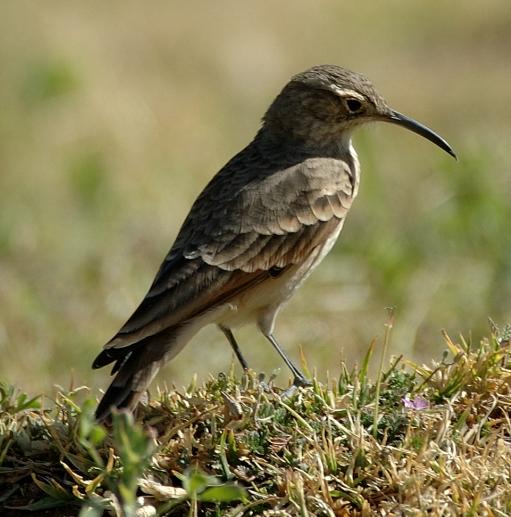
The Slender-billed Miner is a small bird, approximately 14-15 cm in length, with a slender, down-curved bill that distinguishes it from other species in its range. Its plumage is predominantly gray-brown, offering excellent camouflage against the rocky and dusty backgrounds of its natural habitat. The underparts are paler, often showing a subtle buffy wash across the chest and belly. Adults of both sexes appear similar, lacking any significant sexual dimorphism.
Juvenile Slender-billed Miners resemble adults but tend to have slightly duller plumage and less distinct markings, which may lead to confusion with other ground-dwelling species such as the Lesser Canastero. However, the distinctive bill shape and foraging behavior typically aid in identification.
In flight, the Slender-billed Miner displays a rapid, undulating flight pattern, with short bursts of flapping followed by brief glides. When perched, it often adopts a low, horizontal posture, blending seamlessly with its surroundings. Observers should note its tendency to stay close to the ground, frequently bobbing its tail as it moves.
Having trouble telling birds apart? Upload a photo to our bird identification tool for an instant species match.
Slender-billed Miner Habitat and Range
Preferred Habitat
The Slender-billed Miner primarily inhabits the puna grasslands and rocky areas of the Andes, thriving at elevations ranging from 3,000 to 5,000 meters. These high-altitude landscapes, characterized by sparse vegetation and rugged terrain, provide the ideal environment for the Miner's specialized feeding habits. During the dry season, the bird may venture to slightly lower elevations, but it remains closely tied to its preferred open habitats.
While largely absent from urban areas, the Miner's presence can be noted in rural settings where human activity does not significantly alter the landscape. This bird's preference for undisturbed grasslands and rocky slopes highlights the importance of conserving these habitats, which are increasingly threatened by agricultural expansion and mining.
Geographic Range
The Slender-billed Miner's range is confined to the central Andes of South America, predominantly in Peru, Bolivia, and northern Chile. It is considered a resident species, with little to no long-distance migration observed. Instead, it may exhibit altitudinal movements in response to seasonal changes, descending to lower elevations during particularly harsh winters.
The Miner's distribution is patchy, often concentrated in areas where suitable habitat is available. In Peru, the bird is found from the departments of Ancash south to Puno, while in Bolivia, its range extends through the altiplano regions. In Chile, sightings are more sporadic, primarily in the northern parts of the country. Despite its limited range, the species is not currently considered threatened, though localized populations may experience pressure from habitat degradation.
Want to know which birds visit your area? Browse our backyard birds by location guides for region-specific species lists.
What Does the Slender-billed Miner Eat?
The diet of the Slender-billed Miner is primarily composed of insects and other small invertebrates, which it meticulously extracts from the soil and crevices using its specialized bill. Ants, beetles, and larvae form the bulk of its food intake, although the Miner will also consume seeds and plant material when animal prey is scarce. During the dry season, when surface food is limited, the bird's foraging strategy involves probing deeper into the ground to access hidden insect populations.
The Miner's feeding schedule is largely dictated by the availability of prey, with peak activity occurring in the early morning and late afternoon when insects are most active. This opportunistic foraging behavior allows the Miner to maintain its energy requirements in the challenging high-altitude environment.
Slender-billed Miner Behavior and Social Structure
The Slender-billed Miner exhibits a solitary lifestyle, often seen alone or in pairs rather than in large flocks. Its territorial behavior becomes particularly pronounced during the breeding season, when individuals vigorously defend their chosen nesting sites from intruders. The Miner employs a combination of vocalizations and posturing to assert its dominance over a territory.
Courtship displays are subtle but involve mutual preening and gentle calls exchanged between mates. The pair bond is strong, with both partners participating in nest building and chick rearing. Outside the breeding season, the Miner remains somewhat inconspicuous, focusing on foraging and maintaining its territory.
The species shows a degree of resilience to predators, often relying on its cryptic plumage to avoid detection. When threatened, the Miner may freeze or engage in distraction displays to protect its nest or young. Daily activity peaks at dawn and dusk, aligning with the cooler temperatures and increased prey availability at these times.
Slender-billed Miner Nesting and Reproduction
The Slender-billed Miner constructs its nest in burrows excavated in the ground or within rock crevices, utilizing the natural protection offered by these sites. The nest itself consists of a simple cup made of grasses and soft plant fibers, providing a secure environment for the eggs. Clutch size typically ranges from two to three eggs, which are pale and unmarked.
Both parents share responsibilities in incubation, which lasts approximately 14 to 16 days. After hatching, the chicks remain in the nest for an additional two to three weeks, during which time they are fed and cared for by both adults. The parents take turns in foraging and guarding the nest, ensuring that the young are well protected from predators. The species generally raises one brood per year, although favorable conditions may occasionally allow for a second.
Slender-billed Miner Sounds and Vocalizations
The primary song of the Slender-billed Miner is a series of clear, high-pitched notes delivered in rapid succession. The rhythm is consistent, with each note evenly spaced, creating a mechanical yet melodic quality. Calls are softer, often involving a series of short 'chip' notes used for communication between mates or to signal alarm.
Alarm calls are more urgent and harsher, serving to alert both the mate and nearby conspecifics of potential danger. During the dawn chorus, the Slender-billed Miner is an active participant, contributing its distinctive song to the symphony of sounds that characterize Andean mornings. Its vocalizations are somewhat reminiscent of a metal rod being tapped, providing a unique auditory marker in its habitat.
Interesting Facts About the Slender-billed Miner
- 1The Slender-billed Miner is one of the few birds that can survive at altitudes exceeding 4,500 meters, showcasing remarkable physiological adaptations.
- 2Its name, Geositta tenuirostris, reflects its most distinctive feature: 'tenuirostris' translates to 'slender-billed,' highlighting its specialized feeding adaptation.
- 3Despite its small size, the Slender-billed Miner plays a vital role in soil aeration, similar to earthworms, aiding nutrient cycling in its habitat.
- 4The bird's cryptic plumage allows it to blend seamlessly with its rocky environment, providing effective camouflage against predators.
- 5Unlike many other bird species, the Slender-billed Miner maintains a stable pair bond, with mated pairs often observed feeding and moving together.
- 6The Slender-billed Miner's song can be heard echoing across the Andes at dawn, a testament to its territorial nature and vocal prowess.
- 7Although primarily insectivorous, the Slender-billed Miner will occasionally consume seeds, showcasing its adaptability to fluctuating food resources.
Slender-billed Miner Conservation Status
Currently, the Slender-billed Miner is classified as a species of Least Concern by the IUCN, indicating a stable population trend across its range. However, its habitat faces pressure from agricultural development, mining activities, and climate change, all of which could impact future population stability. Conservation efforts focus on preserving the high-altitude grasslands and rocky areas that the Miner depends on. Protected areas and national parks in the Andes play a crucial role in maintaining these ecosystems. Historical population data suggest that the species has remained relatively stable over the past decades, but continued monitoring is essential to ensure that this remains the case.


