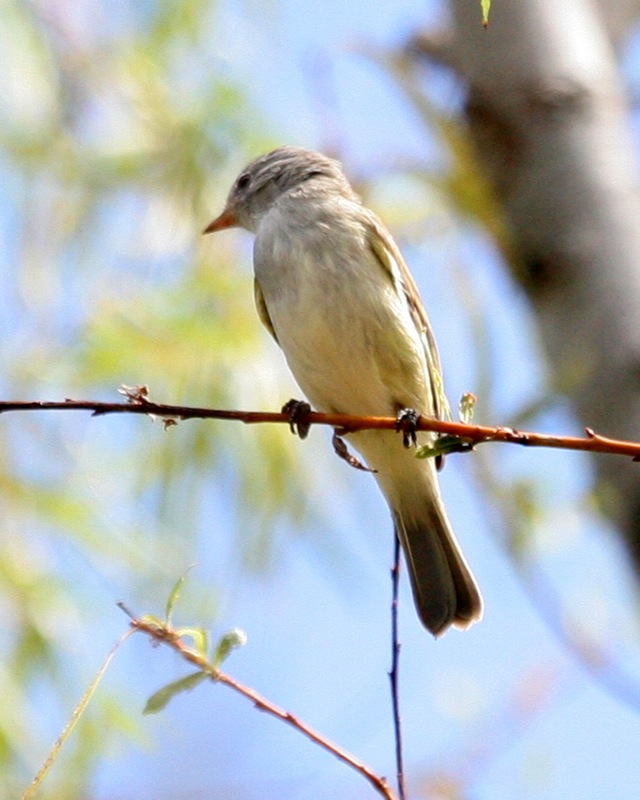
Slender-billed Tyrannulet
Inezia tenuirostris
Order: Passeriformes / Family: Tyrannidae

Wikimedia Commons
About the Slender-billed Tyrannulet
The Slender-billed Tyrannulet (Inezia tenuirostris) is a small passerine bird that belongs to the Tyrannidae family. This species is primarily found in the lowland and foothill forests of northern South America, including regions in Venezuela and Guyana. The bird's name is derived from its notably slender bill, an adaptation that aids in its insectivorous diet. Occupying a niche within the understory layers of subtropical and tropical moist forests, the Slender-billed Tyrannulet plays a crucial role in controlling insect populations. It is often spotted flitting through the foliage in search of food. As a member of the diverse Neotropical avifauna, this tyrannulet exhibits a range of seasonal behaviors that reflect the dynamic ecosystem it inhabits.
The importance of the Slender-billed Tyrannulet extends beyond its ecological role. It acts as an indicator species for the health of its native habitat. Conservationists monitor its population trends to gauge the impact of deforestation and habitat fragmentation in the region. The bird's survival is intrinsically linked to the preservation of its forest environment, making it a focal point for conservation efforts. The Slender-billed Tyrannulet's presence in undisturbed forest tracts signifies a well-balanced ecosystem that supports a variety of flora and fauna.
During the breeding season, the Slender-billed Tyrannulet's behavior becomes more conspicuous. The bird establishes territories, often marked by vocal displays that serve both as a mate attraction and a deterrent to potential rivals. Outside of the breeding season, the tyrannulet may join mixed-species flocks, benefiting from the protective vigilance and foraging efficiency of these groups. This adaptability in social structure demonstrates its resilience in the face of environmental pressures, yet underscores the need for intact habitats to support its life cycle.
The Slender-billed Tyrannulet belongs to the family Tyrannidae, within the order Passeriformes. These birds typically live average 4 years with a maximum recorded of 6 years..
How to Identify a Slender-billed Tyrannulet
The Slender-billed Tyrannulet presents a distinct appearance that assists birders in its identification. Adult plumage primarily consists of olive-green upperparts with slightly lighter underparts, giving it a subtle yet elegant look. The bird's most distinguishing feature is its slender, pointed bill, which contrasts with the typically broader bills of other tyrant flycatchers. Juvenile Slender-billed Tyrannulets resemble adults but tend to show fresher plumage with more pronounced buffy edges on the feathers, which gradually wear off as they age.
Sexual dimorphism in this species is minimal, with males and females exhibiting similar coloration and size, making visual differentiation in the field challenging. However, observing behavior during the breeding season may provide clues to an individual's sex, as males are generally more vocal and active in territorial displays.
In flight, the Slender-billed Tyrannulet displays a silhouette typical of small flycatchers, with rapid, fluttering wingbeats interspersed with glides. When perched, it maintains an upright posture, often flicking its wings and tail, which is a common behavior among tyrant flycatchers. Birders might confuse the Slender-billed Tyrannulet with other small, greenish flycatchers, such as the Beardless Tyrannulet, but the thin bill and specific vocalizations help in making a correct identification.
Having trouble telling birds apart? Upload a photo to our bird identification tool for an instant species match.
Slender-billed Tyrannulet Habitat and Range
Preferred Habitat
The Slender-billed Tyrannulet inhabits the humid lowland and foothill forests of northern South America, with a preference for subtropical and tropical moist broadleaf forests. It thrives in regions where the canopy is dense, and the understory provides ample cover and foraging opportunities. Elevations range from sea level up to approximately 1,200 meters, although it is most commonly observed in lower elevations.
While primarily a forest-dwelling species, this tyrannulet shows some adaptability by occasionally venturing into secondary forests and forest edges, especially where old-growth forests are disturbed. Seasonal habitat shifts are minimal, as the Slender-billed Tyrannulet is a year-round resident of its preferred habitat. The bird's presence in urban areas is rare, as it relies heavily on the structural complexity and rich insect life of natural forest environments.
Geographic Range
The Slender-billed Tyrannulet is endemic to the northern regions of South America, particularly prevalent in Venezuela and Guyana. Its range primarily covers the Amazon basin's periphery, where it thrives in the rich, humid forests that characterize this biodiversity hotspot.
Unlike some migratory tyrants, the Slender-billed Tyrannulet is non-migratory, residing year-round within its established range. This sedentary nature means that its distribution closely ties to the availability of suitable habitat. Regions such as Venezuela's Orinoco River basin and Guyana's Iwokrama Forest are known hotspots for observing this species.
Population density is highest in areas where forest tracts remain undisturbed, though local populations can vary based on habitat quality and availability. The bird's range does not extend into countries like Brazil or Colombia, where similar habitats exist, largely due to the presence of competing flycatcher species occupying similar ecological niches.
Want to know which birds visit your area? Browse our backyard birds by location guides for region-specific species lists.
What Does the Slender-billed Tyrannulet Eat?
The Slender-billed Tyrannulet primarily consumes small insects, which it captures through a combination of sallying and gleaning techniques. Its slender bill is well-suited for picking off insect prey from foliage and bark. During the wet season, when insect abundance peaks, the bird's diet becomes almost exclusively insectivorous, with a preference for soft-bodied insects like caterpillars and small beetles.
In the dry season, the Slender-billed Tyrannulet may supplement its diet with small fruits and berries, although insects remain the staple. This opportunistic feeding behavior ensures that the bird can sustain itself even when insect prey is less abundant.
The tyrannulet forages actively throughout the day, often participating in mixed-species flocks. This social foraging strategy not only increases feeding efficiency but also offers protection from predators. The bird's foraging activity is highest in the early morning and late afternoon, coinciding with increased insect activity during these cooler periods.
Slender-billed Tyrannulet Behavior and Social Structure
The Slender-billed Tyrannulet exhibits a range of interesting behaviors that reflect its adaptability to the forest environment. Socially, the bird tends to be solitary or found in pairs during the breeding season, becoming more gregarious outside this period. It often joins mixed-species flocks, which include various insectivorous birds that benefit from mutual vigilance and increased foraging success.
Territorial behavior is prominent during the breeding season. Males establish and defend territories through vocalizations and display flights, using song to both attract mates and deter rivals. These vocal displays occur primarily in the early morning and late afternoon, times of heightened avian activity.
Courtship involves a series of displays where the male exhibits its agility and vigor, sometimes offering food to the female as part of the bonding process. Once paired, both male and female participate in nest construction and feeding of the young, demonstrating a strong cooperative breeding strategy.
The Slender-billed Tyrannulet exhibits a diurnal activity pattern, being most active during the cooler parts of the day. This pattern not only aligns with its foraging needs but also minimizes exposure to predators such as raptors, which are more active during midday.
Slender-billed Tyrannulet Nesting and Reproduction
The Slender-billed Tyrannulet constructs an open cup nest, typically placed on the horizontal fork of a tree branch, well-hidden among dense foliage. Nest materials include fine twigs, grass, and spider silk, which provide a sturdy yet camouflaged structure. Preferentially, nests are situated at varying heights above the ground, usually between 3 to 10 meters, depending on the availability of suitable nesting sites.
Clutch size generally consists of two to three eggs, which are incubated primarily by the female. The incubation period lasts approximately 14 to 16 days, during which the male remains vigilant and helps in gathering food.
After hatching, both parents participate in feeding the chicks, which fledge about 16 to 18 days post-hatching. The fledging timeline is crucial, as it coincides with periods of high insect availability, ensuring the nestlings receive adequate nutrition. In favorable conditions, the Slender-billed Tyrannulet may raise two broods per year, though this is dependent on environmental factors such as food supply and predation pressure.
Slender-billed Tyrannulet Sounds and Vocalizations
The primary song of the Slender-billed Tyrannulet is a series of quick, high-pitched notes that create a melodious yet irregular rhythm. Each note is crisp and clear, often likened to the sound of tinkling glass. These vocalizations serve as both territorial signals and mating calls.
Call notes are short and sharp, frequently used in communication between individuals within a territory or while foraging in flocks. Alarm calls, on the other hand, are more harsh and repetitive, serving to alert fellow birds of potential threats such as predators.
During the dawn chorus, the Slender-billed Tyrannulet's song becomes more pronounced, contributing to the rich acoustic landscape of the forest. These vocalizations are less frequent during the heat of midday, resuming in the cooler late afternoon.
Interesting Facts About the Slender-billed Tyrannulet
- 1The Slender-billed Tyrannulet's bill is specifically adapted for capturing small insects, making it an efficient insectivore.
- 2Despite its small size, the Slender-billed Tyrannulet plays a key role in pest control by consuming large numbers of insects.
- 3The species' non-migratory behavior ensures it remains in northern South America throughout the year, unlike some flycatchers.
- 4The Slender-billed Tyrannulet often participates in mixed-species foraging flocks, benefiting from collective vigilance against predators.
- 5Its vocalizations are often described as melodious, adding to the vibrant soundscape of its tropical forest habitat.
- 6The bird's olive-green plumage provides excellent camouflage among the dense foliage of its forest environment.
- 7Despite habitat pressures, the Slender-billed Tyrannulet has historically maintained a stable population, reflecting its adaptability.
Slender-billed Tyrannulet Conservation Status
The IUCN currently lists the Slender-billed Tyrannulet as Least Concern, indicating a stable population trend across its range. However, ongoing deforestation and habitat degradation pose significant threats to its long-term survival. Conservation efforts focus on preserving the bird's natural habitat through protected areas and sustainable land management practices. In regions such as the Iwokrama Forest in Guyana, conservation programs aim to balance ecological preservation with community development, ensuring that both the local human and avian populations can thrive. Historically, the Slender-billed Tyrannulet has maintained a stable population, thanks in part to its adaptability and the relatively undisturbed nature of its primary habitats. Nevertheless, continuous monitoring is essential to detect any changes in population dynamics that could signal emerging threats.
Other Tyrannidae Species


Birds Similar to the Slender-billed Tyrannulet
These species are often confused with the Slender-billed Tyrannulet due to similar appearance or overlapping range.