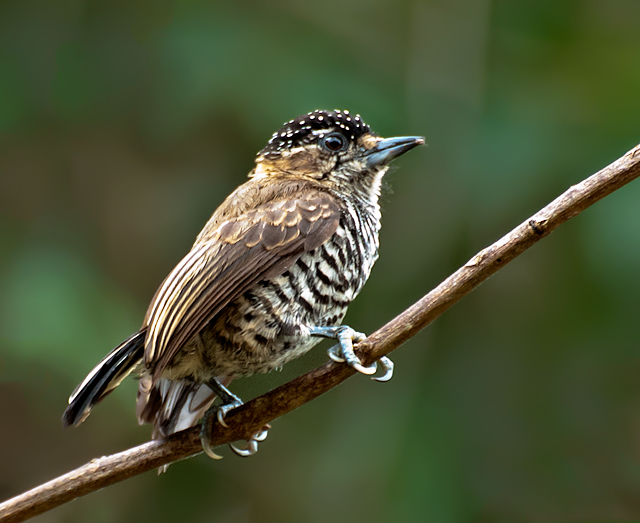
Smoky-brown Woodpecker
Picoides fumigatus
Order: Piciformes / Family: Picidae
Wikimedia Commons
About the Smoky-brown Woodpecker
The Smoky-brown Woodpecker (Picoides fumigatus) inhabits the lush tropical and subtropical forests of Central and South America. This species plays a crucial role in maintaining the health of its forested ecosystem by controlling insect populations and aiding in nutrient cycling through its wood-pecking activities. Typically found in countries such as Brazil, Colombia, and Venezuela, the Smoky-brown Woodpecker prefers dense, humid forests but can also be spotted in secondary growth and occasionally in plantations. Its presence in these varied habitats underscores its adaptability, though it remains closely tied to forested regions.
This woodpecker is an important indicator of forest health. By feeding on insects that can become pests if left unchecked, it helps to protect trees from infestations. The Smoky-brown Woodpecker also contributes to the ecological dynamics by creating cavities in trees for nesting, which subsequently provide shelter for various other species. This bird is also known for its distinct seasonal behaviors. During the breeding season, it becomes noticeably more territorial, with males frequently engaging in drumming displays to establish dominance and attract mates. Outside the breeding season, the Smoky-brown Woodpecker is less territorial and may be observed foraging at varying heights within the forest, from the understory to the canopy, depending on food availability.
The significance of the Smoky-brown Woodpecker extends beyond its ecological roles. It serves as a valuable subject for ornithologists studying the impacts of habitat fragmentation and climate change on tropical bird species. Its adaptability to different forest conditions makes it an excellent model organism for understanding how birds might respond to environmental changes. Despite its adaptability, the Smoky-brown Woodpecker still faces threats from deforestation and habitat loss, which are prevalent in many regions of its range. Conservation efforts aimed at preserving tropical forests are critical for the continued survival of this species.
The Smoky-brown Woodpecker belongs to the family Picidae, within the order Piciformes. These birds typically live about 5-7 years..
How to Identify a Smoky-brown Woodpecker
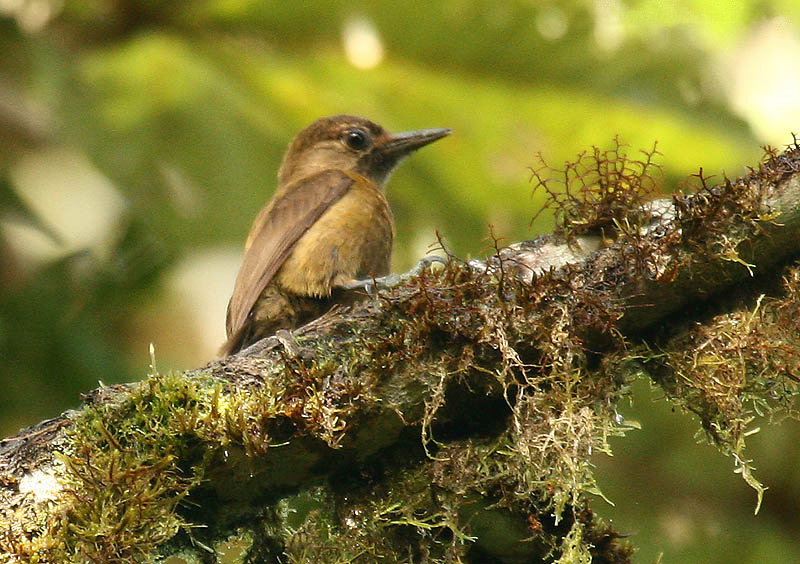
The Smoky-brown Woodpecker is medium-sized, with adults typically measuring around 18-20 cm in length. Its plumage is predominantly a rich, smoky-brown color, which provides excellent camouflage against the bark of trees. The wings and tail are barred with black, creating a distinctive pattern that can be observed when the bird is in flight or perched with its wings slightly spread. The crown of the male Smoky-brown Woodpecker is usually marked with a subtle red patch, a feature that is absent or less pronounced in females, aiding in gender differentiation.
Juvenile Smoky-brown Woodpeckers resemble adults but may display slightly duller plumage and lack the distinctiveness of the adult male's crown patch. Compared to other woodpecker species, the Smoky-brown Woodpecker's bill is relatively short and straight, well-suited for its insectivorous diet. In flight, this woodpecker exhibits a characteristic undulating pattern, typical of many woodpecker species, with rapid wingbeats followed by a short glide.
Confusion with similar species, such as the Little Woodpecker (Veniliornis passerinus), is possible. However, the Smoky-brown Woodpecker's larger size and the absence of pale barring on the underparts help differentiate it. When perched, it often adopts a vertical stance on tree trunks, using its stiff tail feathers for support, a common behavior among woodpeckers.
Having trouble telling birds apart? Upload a photo to our bird identification tool for an instant species match.
Smoky-brown Woodpecker Habitat and Range
Preferred Habitat
The Smoky-brown Woodpecker primarily inhabits tropical and subtropical forests, including both primary and secondary growth. Its range extends from lowland rainforests to montane forests, usually found at elevations ranging from sea level up to about 2,500 meters. In places like the Andes, the woodpecker is commonly observed in cloud forests, where it exploits the rich insect life associated with these humid environments.
While the Smoky-brown Woodpecker is predominantly a forest bird, it shows some flexibility in habitat preference, occasionally venturing into forest edges and degraded areas, provided there is sufficient tree coverage. This adaptability makes it somewhat resilient to habitat changes, though it is still vulnerable to extensive deforestation. Unlike some woodpecker species that adapt well to urban environments, the Smoky-brown Woodpecker is less commonly found in heavily urbanized areas, preferring instead rural and semi-rural settings where trees are abundant.
Geographic Range
The Smoky-brown Woodpecker's range spans a significant portion of Central and South America. It breeds across a wide geographic area, from southern Mexico down through Central America, including countries like Costa Rica and Panama, and extends into South America, covering regions in Colombia, Venezuela, Ecuador, Peru, and Brazil. In the Amazon Basin, the woodpecker is particularly widespread, benefiting from the vast expanses of undisturbed forest.
Unlike some migratory bird species, the Smoky-brown Woodpecker is generally considered non-migratory, maintaining year-round residence within its range. However, there may be minor local movements in response to food availability or environmental conditions, particularly in areas where seasonal changes in rainfall affect forest dynamics. Population density tends to be highest in regions where forest cover remains largely intact, highlighting the impact of habitat quality on the species' distribution.
Despite being non-migratory, the Smoky-brown Woodpecker exhibits some variability in local presence, with occasional reports of it appearing in areas where it is not typically abundant. These occurrences are often linked to temporary environmental changes, such as increased insect infestations that attract the birds.
Want to know which birds visit your area? Browse our backyard birds by location guides for region-specific species lists.
What Does the Smoky-brown Woodpecker Eat?
The diet of the Smoky-brown Woodpecker primarily consists of insects, which it skillfully extracts from tree bark using its specialized bill. Beetles, ants, and their larvae form the bulk of its diet, though it also consumes other invertebrates, such as spiders, when available. During the breeding season, the woodpecker's need for high-protein food sources increases, leading it to intensify its foraging activities.
In addition to insects, the Smoky-brown Woodpecker occasionally supplements its diet with plant material, such as fruits and seeds, particularly during periods when insect prey is less abundant. This dietary flexibility allows it to exploit a range of food resources, which aids its survival in varying environmental conditions.
The woodpecker's foraging technique involves a combination of pecking and gleaning. It often forages at various heights within the forest, from the understory to the canopy, depending on where prey is most plentiful. The bird employs a methodical approach, moving systematically along tree trunks and branches, tapping lightly to detect hollow areas where insects might be hiding.
Smoky-brown Woodpecker Behavior and Social Structure
The Smoky-brown Woodpecker exhibits solitary behavior outside of the breeding season, although pairs may often remain in close proximity. During the breeding season, however, it becomes highly territorial, with males engaging in vigorous drumming displays to establish and defend territories. These drumming sequences, produced by rapid bill strikes on resonant tree surfaces, serve both to repel rivals and attract potential mates.
Courtship behavior involves a variety of displays, including mutual tapping and ritualized feeding, where the male offers food to the female. Once a pair bond is formed, both members participate in nest excavation and subsequent care of the young. The woodpecker's daily activity pattern is diurnal, with most foraging and social interactions occurring during daylight hours. At night, it roosts in tree cavities or dense foliage for protection.
When faced with predators, the Smoky-brown Woodpecker relies on its cryptic plumage for concealment. If directly threatened, it may employ distraction displays or flee to safety by flying to an alternate tree. Unlike some woodpecker species that exhibit communal roosting or flocking behavior, the Smoky-brown Woodpecker generally remains solitary or in pairs, a trait that reflects its territorial nature.
Smoky-brown Woodpecker Nesting and Reproduction
The Smoky-brown Woodpecker nests in cavities, which it excavates in dead or decaying trees. These cavities provide safe and insulated environments for eggs and chicks. Nest site selection is a joint effort, with both male and female participating in the excavation process, which can take several days to complete.
A typical clutch consists of 2-4 white eggs, which are incubated by both parents for approximately 12-14 days. The incubation period involves alternating shifts, ensuring that one parent is always present to protect the eggs from potential predators. Once the eggs hatch, the chicks are altricial, requiring extensive care and feeding from both parents.
Fledging occurs about 24-28 days after hatching, at which point the young woodpeckers begin to explore their surroundings while still relying on parental support for food. The number of broods per year can vary, but in optimal conditions, the Smoky-brown Woodpecker may produce two broods. This reproductive strategy allows for rapid recovery of population numbers in favorable habitats.
Smoky-brown Woodpecker Sounds and Vocalizations
The primary song of the Smoky-brown Woodpecker is a series of rapid, rhythmic drumming sounds, produced by striking its bill against resonant surfaces. This drumming serves multiple purposes, including territory establishment and mate attraction. The rhythm is consistent, with a rapid tempo that distinguishes it from the drumming patterns of other woodpecker species.
In addition to drumming, the woodpecker produces various vocalizations, including sharp, high-pitched calls that serve as alarm signals or communication between mates. These calls are often described as a "peek" or "pit" sound, sharp and penetrating, ensuring they travel through dense forest foliage. During the dawn chorus, the Smoky-brown Woodpecker may be heard producing a series of more melodic notes, often in conjunction with drumming, creating a distinctive presence in the early morning soundscape.
While its vocal repertoire is not as complex as that of some songbird species, the woodpecker's sounds are integral to its social interactions and survival strategies, providing essential cues for territory maintenance and predator awareness.
Interesting Facts About the Smoky-brown Woodpecker
- 1The Smoky-brown Woodpecker is known to drum at a frequency of up to 19 beats per second, making it one of the faster drummers among woodpeckers.
- 2Unlike many woodpeckers, the Smoky-brown does not rely heavily on sap as a food source, focusing instead on a diet rich in insects.
- 3The Smoky-brown Woodpecker's call can be heard over great distances, often serving as a reliable indicator of its presence within dense forests.
- 4This species of woodpecker can excavate a new nesting cavity in as little as a week, demonstrating remarkable efficiency in its nesting habits.
- 5The Smoky-brown Woodpecker's ability to adapt to secondary forests highlights its resilience in the face of moderate habitat changes.
- 6During the breeding season, Smoky-brown Woodpeckers often engage in synchronized drumming duets, strengthening pair bonds.
- 7The bird's brown and black plumage provides excellent camouflage against the tree bark, aiding in predator avoidance and stealthy foraging.
Smoky-brown Woodpecker Conservation Status
The Smoky-brown Woodpecker is currently listed as Least Concern by the IUCN, with a stable population trend in most of its range. However, deforestation and habitat degradation pose significant threats, particularly in areas where logging and agricultural expansion are prevalent. These activities result in the loss of suitable nesting sites and foraging grounds, impacting local populations. Conservation efforts aimed at preserving tropical forest habitats are critical for the long-term survival of the Smoky-brown Woodpecker. Initiatives that focus on sustainable forestry practices and the establishment of protected areas can help mitigate some of the habitat losses. Historically, the species has shown resilience to moderate habitat changes, but ongoing pressures necessitate continued conservation attention to ensure its future stability. Monitoring programs and studies are essential in understanding the impacts of environmental changes on the Smoky-brown Woodpecker, allowing for informed conservation strategies that support both the species and its ecosystem.
Other Picidae Species


Birds Similar to the Smoky-brown Woodpecker
These species are often confused with the Smoky-brown Woodpecker due to similar appearance or overlapping range.