
Southern Cassowary
Casuarius casuarius
Order: Casuariiformes / Family: Casuariidae

Wikimedia Commons
About the Southern Cassowary
The Southern Cassowary (Casuarius casuarius) stands as an enigmatic and striking bird native to the tropical rainforests of New Guinea, nearby islands, and northern Australia. Known for their vibrant blue necks and helmet-like casques, these flightless birds play a crucial role in their ecosystem as seed dispersers. The Southern Cassowary's habitat primarily includes lowland and mountain rainforests, where they forage for fruit, primarily from native trees and shrubs. They are essential to the survival of many plant species, given their ability to transport seeds over long distances, thereby aiding in forest regeneration.
Ecologically, the Southern Cassowary is a keystone species in its environment. With their strong legs and robust build, they can traverse dense jungle undergrowth and swim across large rivers, facilitating seed dispersal across varied terrains. Moreover, their presence influences the biodiversity of the forest, as the seeds they disperse often grow into large fruiting trees that support a wide array of wildlife. The cassowary's role in maintaining forest structure and composition underlines its significance beyond being merely a remarkable bird to observe.
In terms of behavior, these birds are largely solitary except during mating season. The Southern Cassowary exhibits unique seasonal behaviors linked to fruit availability, with increased movement and feeding activity in times of fruit abundance. They are also known for their territorial nature, often seen patrolling their home ranges with a quiet yet vigilant demeanor. The loss of habitat due to deforestation and human encroachment poses a substantial threat to their population, emphasizing the importance of conservation efforts to ensure this majestic bird's survival.
The Southern Cassowary belongs to the family Casuariidae, within the order Casuariiformes. These birds typically live up to 40 years in the wild, with some living longer in captivity..
How to Identify a Southern Cassowary
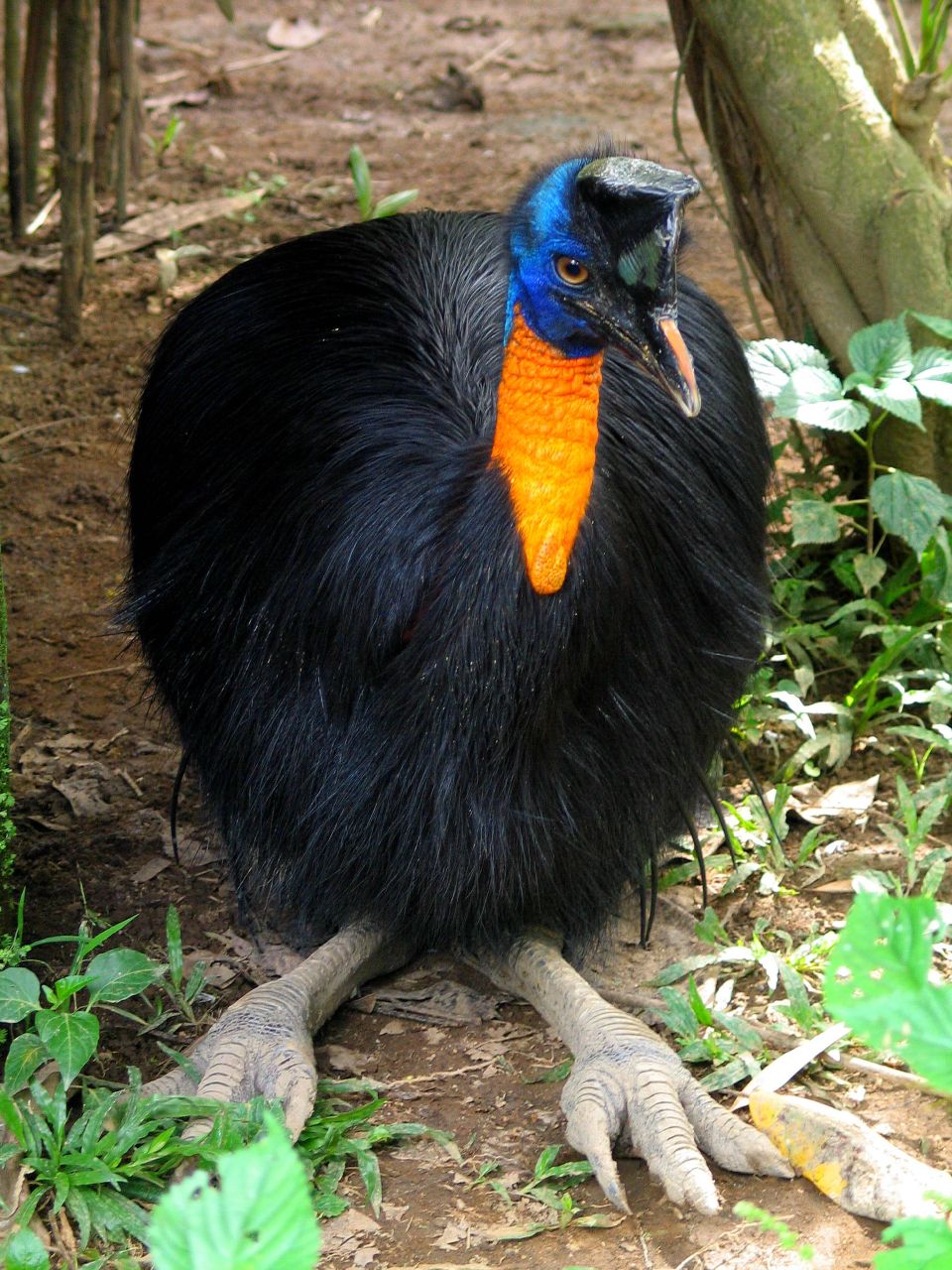
Adult Southern Cassowaries are unmistakable due to their imposing stature, typically standing up to 170 cm (5.6 ft) tall. They possess glossy black plumage, which contrasts sharply with their vibrantly colored neck and head. The neck is a striking blue, while the two red wattles hang prominently, adding further color to their appearance. A distinctive feature of the Southern Cassowary is its casque, a helmet-like structure atop its head, which can vary in shape and size among individuals.
Juvenile cassowaries differ in appearance, displaying a brownish plumage that gradually darkens with age. This coloration provides a form of camouflage in their dense forest habitat. Males and females are similar in plumage; however, females are generally larger and heavier, sometimes exceeding 80 kg (176 lbs).
Confusion with other species is minimal due to the Southern Cassowary's unique features. However, it can be mistaken for other cassowary species in areas where their ranges overlap. Unlike many birds, the Southern Cassowary does not have a flight silhouette due to its flightless nature, and its perching posture is rarely observed since it spends most of its time on the ground.
Having trouble telling birds apart? Upload a photo to our bird identification tool for an instant species match.
Southern Cassowary Habitat and Range
Preferred Habitat
The Southern Cassowary inhabits tropical rainforests, primarily in the lowland and montane regions of northern Australia and New Guinea. These birds favor dense, humid forests with a rich diversity of fruit-bearing trees, which provide their primary food source. They are also found in secondary forests and sometimes in palm swamps and mangroves.
While they prefer the cover and resources of intact forests, they occasionally venture into more open woodland areas or near water bodies. Southern Cassowaries can be found from sea level up to elevations of about 1,000 meters (3,280 feet), although they rarely ascend higher unless fruit availability necessitates it.
While traditionally forest dwellers, they are increasingly sighted near urban fringes, especially where their habitat intersects with human developments. This shift often leads to increased human-cassowary interactions, which can be dangerous for both parties.
Geographic Range
The Southern Cassowary's range extends across the tropical regions of northern Queensland in Australia and the island of New Guinea, including both Papua New Guinea and Indonesian territories. They do not undertake long migrations, but their movements within their range are influenced by fruit availability, prompting them to travel considerable distances in search of food.
In Australia, their population is concentrated in the Wet Tropics World Heritage Area, with a significant portion residing in the Daintree Rainforest. New Guinea hosts a broader distribution, with the cassowary present in both lowland and montane rainforests.
Despite this seemingly extensive range, cassowaries are generally sparsely distributed and primarily isolated to areas with suitable forest cover. Fragmentation of their habitat due to agricultural expansion and urban development has further restricted their range, making conservation efforts critical in maintaining population connectivity.
Want to know which birds visit your area? Browse our backyard birds by location guides for region-specific species lists.
What Does the Southern Cassowary Eat?
The Southern Cassowary primarily feeds on fruit, which constitutes up to 90% of its diet. They consume a wide variety of fruits from native trees and palms, including those that are toxic to other animals. Their digestive system is uniquely adapted to handle these, allowing them to play a vital role in seed dispersal.
While fruit is their primary food source, they also consume small vertebrates, invertebrates, fungi, and plant matter when available. Seasonal shifts influence their diet, with a reliance on different fruiting species throughout the year. During periods of fruit scarcity, they may become more opportunistic, foraging for less palatable items.
Cassowaries forage on the forest floor, using their strong legs to move through dense vegetation and access fallen fruit. They typically feed alone due to their solitary nature, which reduces competition for food resources within their territory.
Southern Cassowary Behavior and Social Structure
Southern Cassowaries are solitary birds, with interactions primarily occurring during the breeding season. They establish and defend territories using low-frequency vocalizations and physical displays. Males and females both maintain territories, with overlap typically occurring during courtship.
Courtship involves a series of ritualized displays, including bowing and circling by the male, who also constructs a nest on the forest floor. After mating, the male takes on the role of incubating the eggs and caring for the young, which is uncommon among birds. This paternal care includes defending the chicks from predators and teaching them to forage.
Cassowaries are diurnal, with activity patterns closely tied to food availability. They spend their days foraging and resting, often near water sources. In response to predators, cassowaries can deliver powerful kicks with their three-toed feet, which are equipped with dagger-like claws. This defensive behavior, coupled with their speed and agility, makes them formidable opponents in their natural habitat.
Southern Cassowary Nesting and Reproduction
Southern Cassowaries nest on the forest floor, where the male constructs a rudimentary nest using leaves and vegetation. The nest site is typically located in a secluded area within dense forest to provide protection from predators and the elements.
The female lays a clutch of 3 to 5 large, pale green eggs, which the male incubates for about 50 days. During this period, the male remains highly protective and rarely leaves the nest, even to feed. After hatching, the male continues to care for the chicks, leading them to food sources and defending them from threats.
Chicks are precocial, meaning they are relatively mature and mobile shortly after hatching. They stay with their father for up to nine months, gradually becoming independent as they learn to forage. Southern Cassowaries typically raise one brood per year, although this can vary based on environmental conditions and food availability.
Southern Cassowary Sounds and Vocalizations
The Southern Cassowary's vocalizations are low-frequency and resonate deeply through the forest. Their primary call is a deep, booming sound that can carry over long distances, often likened to the sound of a distant bass drum. This call serves both territorial and communicative functions, allowing individuals to maintain contact over dense forest areas.
In addition to their booming calls, cassowaries produce a variety of grunts and hisses, often used in more immediate social interactions or to express agitation. Alarm calls, though infrequent, are higher-pitched and serve to alert other birds or family members of potential danger.
During the predawn hours, their calls contribute to the forest's acoustic landscape, though they are not as vocally dominant as some other bird species. The unique quality of the cassowary's calls makes them a fascinating subject of study for bioacousticians interested in low-frequency communication.
Interesting Facts About the Southern Cassowary
- 1The Southern Cassowary can run up to 50 km/h (31 mph) through dense forest, making it one of the fastest bipedal animals in its habitat.
- 2Cassowaries are known to jump as high as 1.5 meters (5 feet), using their powerful legs to navigate obstacles in their forest environment.
- 3The casque on the cassowary's head grows continuously throughout its life and may serve as a resonance chamber for their low-frequency calls.
- 4Southern Cassowaries produce the lowest frequency bird call known to science, often below the range of human hearing.
- 5The cassowary's digestive system can process and safely distribute seeds from over 70 different rainforest plant species.
- 6Despite their fearsome reputation, cassowaries are primarily frugivorous, relying on fruit for over 90% of their diet.
- 7Their droppings are an important ecological resource, as they contain seeds that help regenerate rainforest plants.
Southern Cassowary Conservation Status
The Southern Cassowary is listed as Vulnerable on the IUCN Red List, with population trends indicating a decline due to habitat loss and fragmentation. Primary threats include deforestation, vehicle strikes, and dog attacks, with human development encroaching on their natural habitat. Conservation efforts focus on habitat preservation and restoration, as well as public education to reduce human-cassowary conflicts. Initiatives include the establishment of wildlife corridors to facilitate safe movement between fragmented habitats and community engagement in cassowary conservation. Historically, populations have fluctuated with environmental changes, but modern human impacts pose unprecedented challenges. Conservationists emphasize the importance of maintaining genetic diversity and stable populations to ensure the long-term survival of this iconic species.
Other Casuariidae Species


Birds Similar to the Southern Cassowary
These species are often confused with the Southern Cassowary due to similar appearance or overlapping range.